Money Cannot Buy Integrity

Dr. Rajendra Panthee
Recently, while listening to CBC Radio’s Ideas program on The Age of Billionaires, I found myself thinking about a question that has become increasingly relevant in Nepal.

Can wealth eliminate corruption?

This question became especially important after the formation of Nepal’s new government. When ministers declared their assets, many people were surprised by the amount of wealth some of them possessed. Supporters argued that these were successful people who had already earned enough money and therefore had no reason to engage in corruption. According to this argument, wealthy individuals enter politics to serve the country rather than enrich themselves.

It is an attractive argument. Unfortunately, history and global experience suggest that things are not so simple.

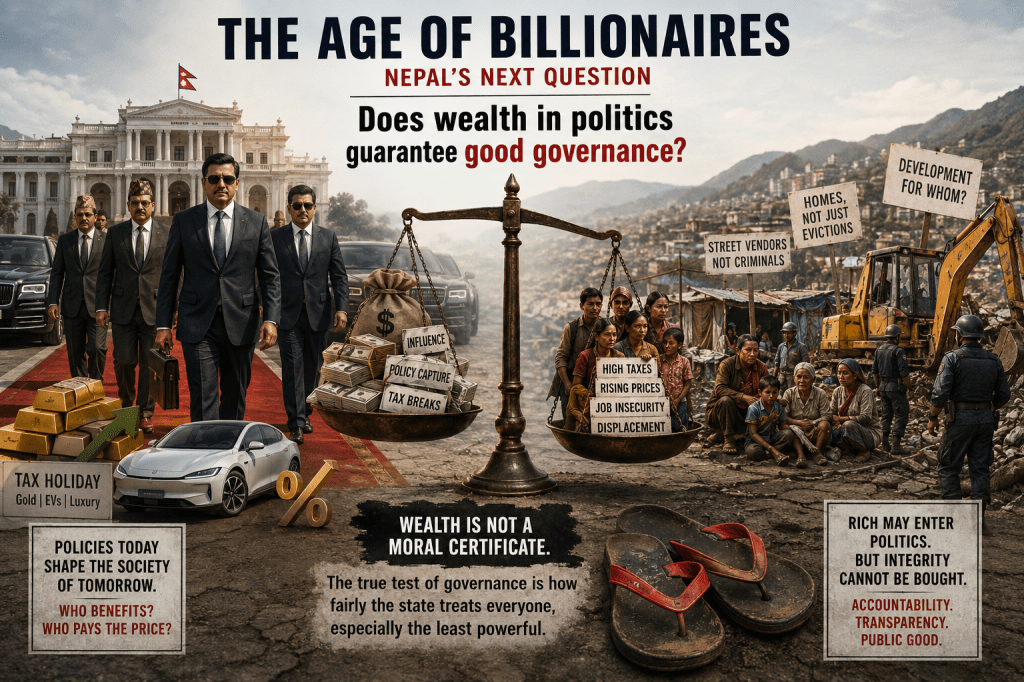
Wealth does not automatically produce integrity. Financial success is not a certificate of morality. Being rich does not guarantee good governance any more than being poor guarantees honesty.

The recent discussion on CBC Radio’s Ideas raised an important concern. Across the world, extreme wealth is increasingly shaping politics and public policy. Economic power often translates into political influence. As a result, policies may begin to favor those who already possess wealth and influence, while ordinary citizens are left to bear the costs.

Nepal appears to be facing similar questions.

Recent tax policies have provided relief for gold purchases and electric vehicles. These measures may benefit affluent and middle class consumers, but they raise legitimate questions about priorities when ordinary people continue to struggle with the cost of daily necessities.

At the same time, several ministers and public officials are facing growing public scrutiny regarding their decisions and conduct. Citizens who expected a new political culture are beginning to ask difficult questions.

This does not mean that wealthy people are inherently corrupt. Nor does it mean that every allegation is true. Allegations must be investigated fairly, and conclusions must be based on evidence rather than emotions.

However, one assumption deserves reconsideration.

The belief that rich politicians will automatically eliminate corruption has no historical foundation. Wealth alone cannot replace accountability, transparency, or strong institutions.

In fact, when wealthy and powerful individuals become involved in misconduct, the consequences can be far greater because their influence, networks, and resources are also much greater.

Ultimately, the issue is not whether politicians are rich or poor.

The real question is this.

Who benefits from public policy?

Do policies serve the majority of citizens, or do they increasingly protect the interests of those who already possess wealth and influence?

The true test of governance is not how firmly the state acts against the powerless. It is how fairly it treats everyone. A government that can easily remove street vendors, evict landless settlers, or confiscate the livelihood of the poor, but hesitates when confronting wealth and influence, risks creating two different systems of justice.

Nepal must ask itself whether development should benefit the many or merely preserve the privileges of the few.

Money can buy success.

Money can buy influence.

Money can even buy political power.

But money cannot buy integrity.

That must still come from character, accountability, and a commitment to the public good.
Clean Leaders Alone Can’t Make Nepal a Ram Rajya

Dr. Rajendra K. Panthee

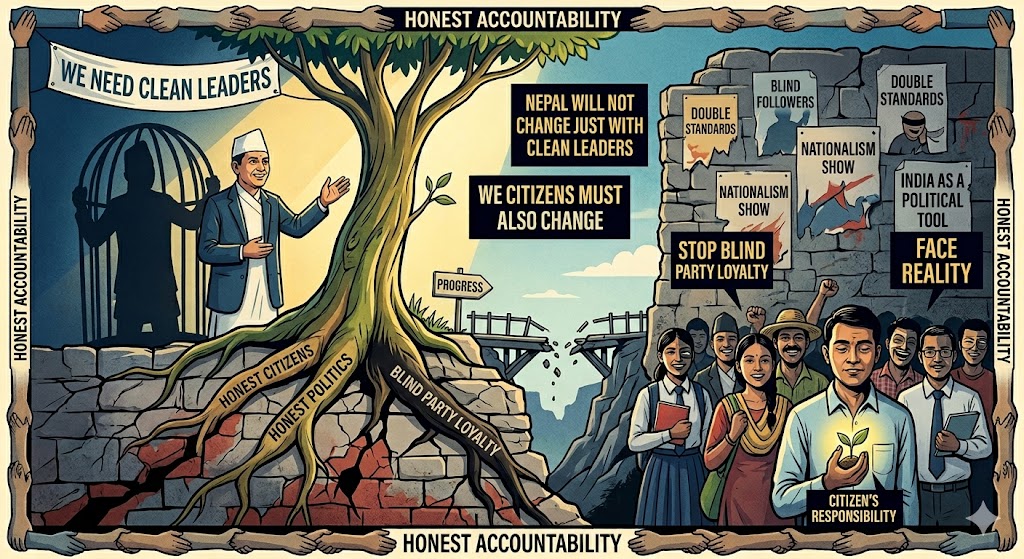
Imagine for a moment that Nepal is suddenly ruled by the most corruption-hating leader in the world. Let us say someone like Lee Kuan Yew, the founding father of Singapore, who is globally known for turning a corrupt and underdeveloped port into a clean and efficient economy. Or perhaps Estonia’s reformers, who built a digital governance model that many countries admire. Imagine his cabinet ministers are equally clean, selfless, and devoted only to the nation. In one magical day, Nepal becomes a Ram Rajya. Honest. Efficient. Benevolent. No more rigged tenders. No more ghost schools. No more money laundering through cooperatives.

Still, Nepal might not change or develop. For a few stubborn reasons.

1. The people
Too many of us do not think about the nation as a shared project. We think about personal benefit, party loyalty, and who will protect our group. Blind support for a party becomes more important than policy, integrity, or long term vision. We say we want clean leaders, but when it comes to our own people, we say, he is not corrupt, he is our guy, he feeds us, he protects us, he is like family.

We want clean leaders at the top, but we also want our own people to be protected, promoted, and let off the hook. We want the system to work for us, not for the nation. We want to be the exception, not the rule.

Even a perfect government gets worn down by our own cynicism, favoritism, and indifference to the public good. We ask for Ram Rajya, but we do not want to live in it. We protest against corruption, but we also protect our corrupt uncle. We vote for clean candidates, but we also vote for the one who gives us a job, a contract, or a favor.

Nepal will not change because we do not want to change. We want the system to be clean, but we do not want to be clean.

2. The political class
There is another ugly truth. Many Nepali political leaders and their supporters also make India into a convenient political weapon. When they feel close to India, everything suddenly feels normal. When they feel ignored, less useful, or less favored than other leaders, they quickly start saying India is playing a game or interfering in Nepal’s affairs.

This is where the hypocrisy becomes obvious. On one hand, some of them are ready to become a puppet of India when it suits their own power. On the other hand, they pull out the nationalist card and shout anti India slogans to emotionally blackmail simple Nepali people. They do not use nationalism as principle. They use it as a tool.

This pattern is dangerous because it turns foreign policy into a domestic performance. Instead of speaking honestly about Nepal’s interests, they use India either as a shield or as a villain depending on what benefits them politically at that moment. That is not patriotism. That is manipulation.

India, as a big and powerful country with its own strategic interests, will never ignore Nepal completely. That much is obvious. But Nepali leaders also help create this cycle by using India whenever it helps them defend themselves, attack rivals, or distract the public from their own failures.

The result is always the same. The public gets confused, the debate gets emotional, and serious national issues become cheap slogans.

The bitter reality
Nepal’s future is not just about cleaning up corruption at the top. It is about how we, as citizens, act. It is about whether we can stop being blind supporters of one party and start being citizens who demand accountability. It is about whether we can stop thinking about personal benefits and start thinking about the nation as a shared project.

It is also about whether our leaders stop using India as a political mask whenever it suits them. A weak political class cannot build a strong state by playing nationalist theater on one side and foreign dependence on the other.

Nepal is stuck between pride and weakness, between sovereignty and dependency, between slogans and reality. Even Ram Rajya in Nepal would struggle, not because leaders alone are bad, but because the people are divided and the political class is often dishonest about bigger forces at play.

What can we do
We can stop being blind supporters. We can stop protecting our corrupt uncle. We can stop voting for the one who gives us a job and start voting for the one who gives us a future. We can start asking questions, demanding transparency, and holding our leaders accountable. We can also stop falling for the same tired game where leaders pretend to defend the nation while using India only when it suits their own power.

We can start being citizens, not just loyalists.

Conclusion
Even if Nepal gets Lee Kuan Yew as its Prime Minister, even if his cabinet is made of angels, even if Nepal becomes Ram Rajya overnight, it will not change or develop unless we change first. Unless we stop being blind supporters. Unless we stop protecting our corrupt uncle. Unless we stop letting leaders use India as a political weapon whenever they want sympathy or advantage.

Nepal’s future is not just about clean leaders. It is about clean citizens. It is about clean institutions. It is about honest politics. And it is about refusing to be emotionally blackmailed by nationalist slogans every time leaders want to hide their weakness.

Members of Parliament Don’t Know Parliamentary Language and We Call It Okay

Dr. Rajendra K Panthee

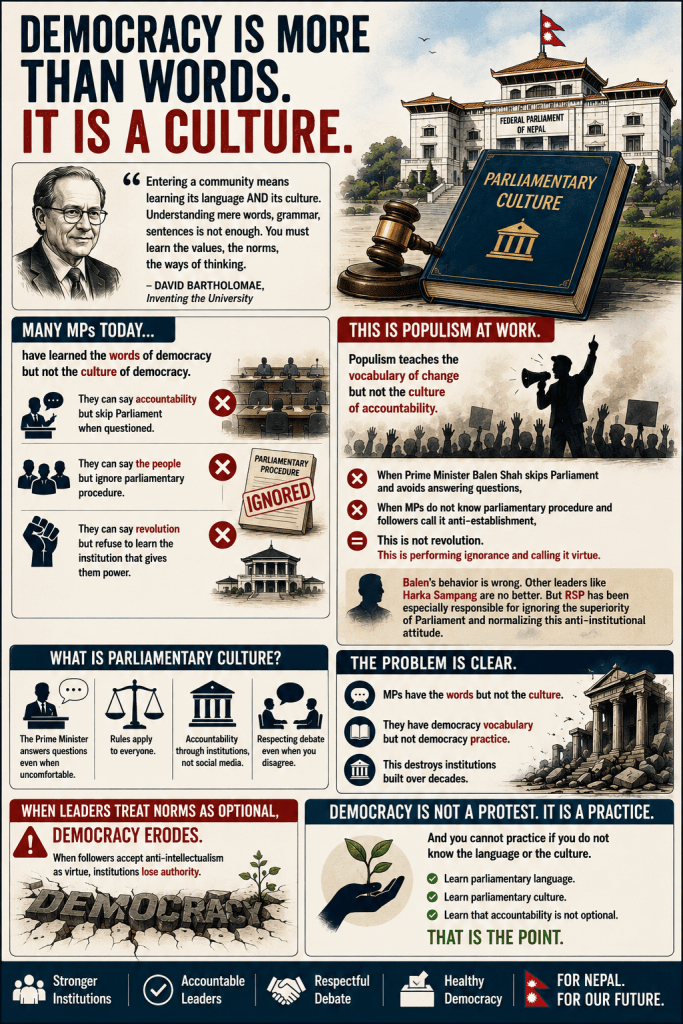
I teach David Bartholomae’s “Inventing the University” where he says entering a community means learning its language AND its culture. Understanding mere words, grammar, sentences is not enough. You must learn the values, the norms, the ways of thinking. Now look at our Parliament. Many MPs today have learned the words of democracy but not the culture of democracy. They can say accountability but skip Parliament when questioned. They can say the people but ignore parliamentary procedure. They can say revolution but refuse to learn the institution that gives them power.

This is populism at work. Populism teaches the vocabulary of change but not the culture of accountability. It teaches you to say the people but not to submit to institutions that represent them. It teaches you to say democracy but not to respect the rules of democracy. When Prime Minister Balen Sah skips Parliament and avoids answering questions, when MPs do not know parliamentary procedure and followers call it anti establishment, this is not revolution. This is performing ignorance and calling it virtue.

Balen Sah’s behavior is wrong. It is not just about one party. Other leaders like Harka Sampang are no better. But RSP has been especially responsible for ignoring the superiority of Parliament and normalizing this anti institutional attitude. The party has helped create a culture where skipping Parliament is acceptable, where parliamentary procedure is elite, and where accountability is optional.

Bartholomae would say you cannot participate in a community you refuse to learn. Parliamentary culture means the Prime Minister answers questions even when uncomfortable. It means rules apply to everyone not just the opposition. It means accountability through institutions not social media. It means respecting debate even when you disagree. It means you submit to the institution even when it costs you politically.

Many MPs have the words but not the culture. They have democracy vocabulary but not democracy practice. They have the appearance of representation without the substance of accountability. This destroys institutions built over decades. When leaders treat norms as optional, democracy erodes. When followers accept anti intellectualism as virtue, institutions lose authority. When populists say institutions are corrupt, they weaken representative democracy itself.

This is the destructive nature of populist anti-intellectualism. Populism while potentially serving as a corrective force poses significant threats to democratic norms. The pattern is clear. Institutional erosion happens when leaders treat norms as optional. Democratic accountability disappears when followers accept anti intellectualism as virtue. The research shows we need to strengthen checks and balances to counter the appeal of populism. But first we need to recognize what is happening. We need to name it. We need to teach people why institutions matter. We need to teach them that culture matters as much as words.

When we lose parliamentary literacy, we lose the ability to hold power accountable through institutional means. When we lose parliamentary culture, we lose the values that make accountability possible. We lose the ability to debate respectfully. We lose the ability to build consensus. We lose the ability to protect minority rights. We lose the ability to govern effectively.

What we gain is chaos. What we gain is personal rule. What we gain is the illusion of representation without the reality of accountability. What we gain is the words of democracy without the culture of democracy.

We need to teach democratic literacy the way we teach academic literacy. We need to teach students and citizens how institutions work. We need to teach them why rules matter. We need to teach them that accountability is not optional. And we need to teach them the culture of democracy, not just the vocabulary.

David Bartholomae taught us that learning a new language is hard. It requires effort. It requires humility. It requires practice. Entering a new community means learning to speak like its members. But it also means learning to think like its members. It means learning its values. It means learning its culture.

Entering a democratic community means learning the language of democracy. It means learning parliamentary procedure. It means learning to hold power accountable through institutions. It means learning that rules protect us all not just the elite. And it means learning the culture of democracy, which means submission to process even when it is uncomfortable.

When MPs refuse to learn this language and culture they are not revolutionaries. They are illiterates. And when their supporters say it is okay they are complicit in the destruction of democracy.

Democracy requires language. It requires culture. It requires institutions. It requires people who know how to participate in the code even when it is uncomfortable. Populism promises to give power to the people but it delivers power to the leader. It promises to disrupt the system but it disrupts democracy itself. It teaches the words but not the culture. It teaches the vocabulary without the values.

Balen must answer questions in Parliament. MPs must learn parliamentary procedure. RSP must stop normalizing disrespect for institutions. Other populist leaders must stop treating Parliament as optional. Accountability is not optional. That is the point.

Democracy is not a protest. It is a practice. And you cannot practice if you do not know the language or the culture.

A Reflection on Rabi Lamichhane’s Hindustan Times Article

Dr. Rajendra K Panthee

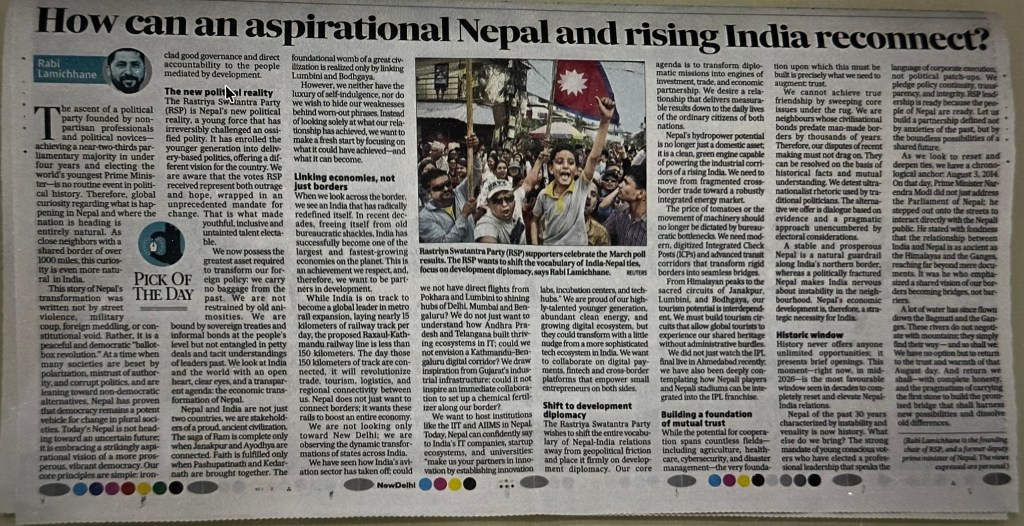
I started reading Rabi Lamichhane’s article “How can an aspirational Nepal and rising India reconnect?” in Hindustan Times and felt compelled to share some thoughts on how we remember Nepal’s recent political transformation.

The article frames Nepal’s transformation as a “peaceful ballot-box revolution” focused on development and aspirational vision. However, the historical record shows that the 2026 election was called because of the September 2025 Gen Z protests, which resulted in:

  • 19 people killed when police opened fire on protesters
  • Over 300 injured with tear gas, rubber bullets, and live ammunition
  • Parliament building damaged during the protests
  • $21 billion in damage — half of Nepal’s annual GDP
  • School kids in uniforms brought to the streets

More than 800,000 new voters registered—two-thirds of them Gen Z. The movement wasn’t about RSP specifically; it was about accountability, anti-corruption, and demanding a political system that serves ordinary citizens. The 2/3 RSP majority we see today is a direct result of this Gen Z movement.

When the article describes this as a “peaceful ballot-box revolution,” it risks erasing the young people who died to make this election possible. The families of the martyrs deserve to be acknowledged in any narrative about Nepal’s transformation.

On border relations, the article’s call to “resolve disputes through dialogue” is constructive, especially after PM Balen’s recent parliamentary remarks on border encroachment sparked debate. What would strengthen Nepal-India ties is not just aspirational vision but transparent governance, accountability for all parties, and respect for democratic institutions.

The warm reception Rabi received in India reflects genuine interest in Nepal-India cooperation, which should be welcomed. However, for that cooperation to be sustainable, both countries need leaders who balance diplomatic engagement with domestic accountability.

When RSP’s 2/3 majority enables governance, it also brings responsibility to ensure that power serves all citizens, not just party interests. True reconnection between Nepal and India will come not from rewriting history, but from building relationships grounded in mutual respect, transparency, and honoring the Gen Z generation whose uprising made this new political moment possible.

We should all remember: accountability today strengthens democracy tomorrow.