
Dr. Rajendra Panthee
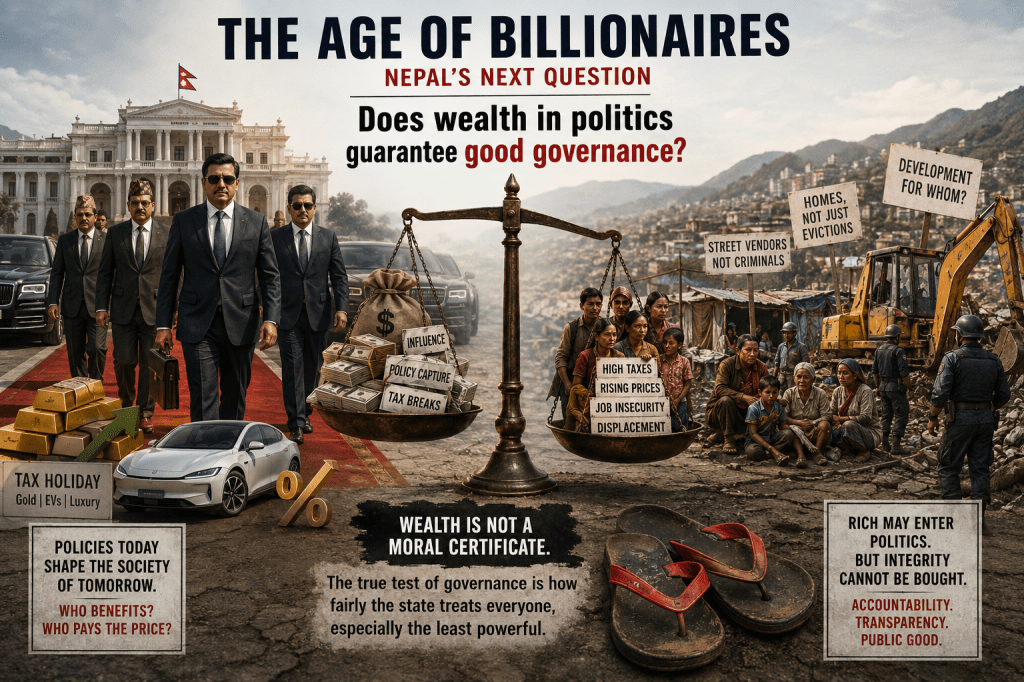
Recently, while listening to CBC Radio’s Ideas program on The Age of Billionaires, I found myself thinking about a question that has become increasingly relevant in Nepal.
Can wealth eliminate corruption?
This question became especially important after the formation of Nepal’s new government. When ministers declared their assets, many people were surprised by the amount of wealth some of them possessed. Supporters argued that these were successful people who had already earned enough money and therefore had no reason to engage in corruption. According to this argument, wealthy individuals enter politics to serve the country rather than enrich themselves.
It is an attractive argument. Unfortunately, history and global experience suggest that things are not so simple.
Wealth does not automatically produce integrity. Financial success is not a certificate of morality. Being rich does not guarantee good governance any more than being poor guarantees honesty.
The recent discussion on CBC Radio’s Ideas raised an important concern. Across the world, extreme wealth is increasingly shaping politics and public policy. Economic power often translates into political influence. As a result, policies may begin to favor those who already possess wealth and influence, while ordinary citizens are left to bear the costs.
Nepal appears to be facing similar questions.
Recent tax policies have provided relief for gold purchases and electric vehicles. These measures may benefit affluent and middle class consumers, but they raise legitimate questions about priorities when ordinary people continue to struggle with the cost of daily necessities.
At the same time, several ministers and public officials are facing growing public scrutiny regarding their decisions and conduct. Citizens who expected a new political culture are beginning to ask difficult questions.
This does not mean that wealthy people are inherently corrupt. Nor does it mean that every allegation is true. Allegations must be investigated fairly, and conclusions must be based on evidence rather than emotions.
However, one assumption deserves reconsideration.
The belief that rich politicians will automatically eliminate corruption has no historical foundation. Wealth alone cannot replace accountability, transparency, or strong institutions.
In fact, when wealthy and powerful individuals become involved in misconduct, the consequences can be far greater because their influence, networks, and resources are also much greater.
Ultimately, the issue is not whether politicians are rich or poor.
The real question is this.
Who benefits from public policy?
Do policies serve the majority of citizens, or do they increasingly protect the interests of those who already possess wealth and influence?
The true test of governance is not how firmly the state acts against the powerless. It is how fairly it treats everyone. A government that can easily remove street vendors, evict landless settlers, or confiscate the livelihood of the poor, but hesitates when confronting wealth and influence, risks creating two different systems of justice.
Nepal must ask itself whether development should benefit the many or merely preserve the privileges of the few.
Money can buy success.
Money can buy influence.
Money can even buy political power.
But money cannot buy integrity.
That must still come from character, accountability, and a commitment to the public good.
Discover more from Toronto Realty and Rhetoric
Subscribe to get the latest posts sent to your email.
