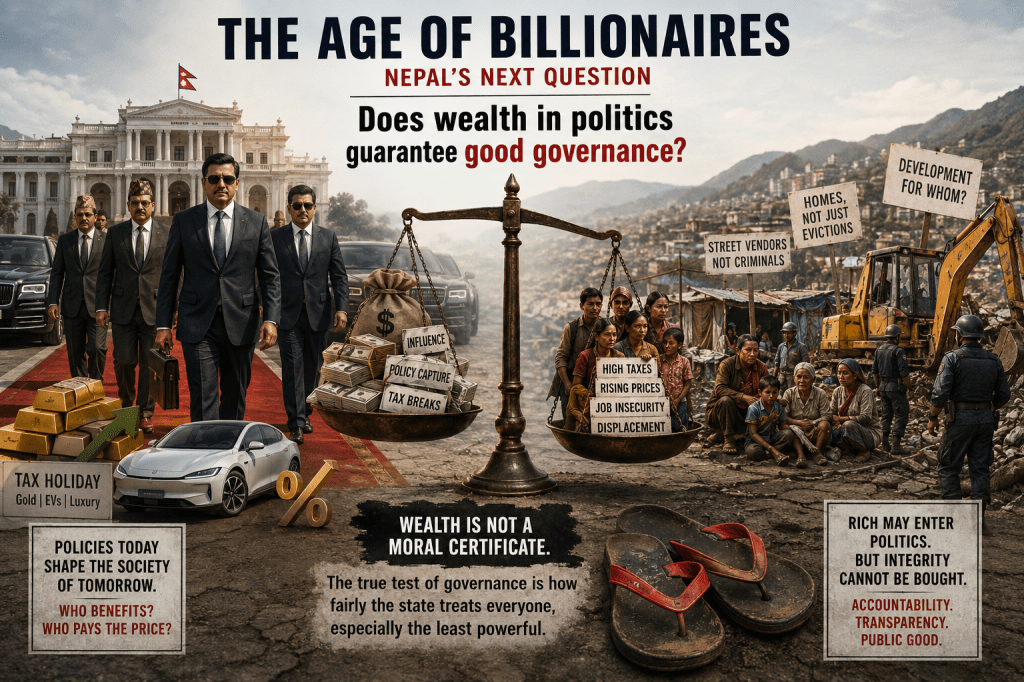
Members of Parliament Don’t Know Parliamentary Language and We Call It Okay

Dr. Rajendra K Panthee

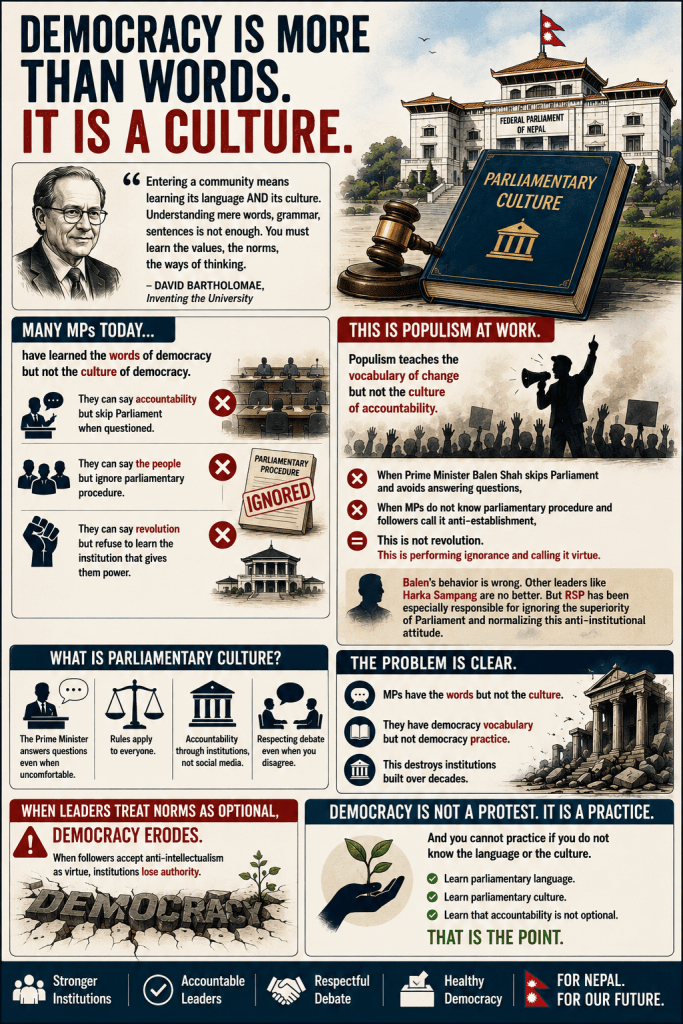
I teach David Bartholomae’s “Inventing the University” where he says entering a community means learning its language AND its culture. Understanding mere words, grammar, sentences is not enough. You must learn the values, the norms, the ways of thinking. Now look at our Parliament. Many MPs today have learned the words of democracy but not the culture of democracy. They can say accountability but skip Parliament when questioned. They can say the people but ignore parliamentary procedure. They can say revolution but refuse to learn the institution that gives them power.

This is populism at work. Populism teaches the vocabulary of change but not the culture of accountability. It teaches you to say the people but not to submit to institutions that represent them. It teaches you to say democracy but not to respect the rules of democracy. When Prime Minister Balen Sah skips Parliament and avoids answering questions, when MPs do not know parliamentary procedure and followers call it anti establishment, this is not revolution. This is performing ignorance and calling it virtue.

Balen Sah’s behavior is wrong. It is not just about one party. Other leaders like Harka Sampang are no better. But RSP has been especially responsible for ignoring the superiority of Parliament and normalizing this anti institutional attitude. The party has helped create a culture where skipping Parliament is acceptable, where parliamentary procedure is elite, and where accountability is optional.

Bartholomae would say you cannot participate in a community you refuse to learn. Parliamentary culture means the Prime Minister answers questions even when uncomfortable. It means rules apply to everyone not just the opposition. It means accountability through institutions not social media. It means respecting debate even when you disagree. It means you submit to the institution even when it costs you politically.

Many MPs have the words but not the culture. They have democracy vocabulary but not democracy practice. They have the appearance of representation without the substance of accountability. This destroys institutions built over decades. When leaders treat norms as optional, democracy erodes. When followers accept anti intellectualism as virtue, institutions lose authority. When populists say institutions are corrupt, they weaken representative democracy itself.

This is the destructive nature of populist anti-intellectualism. Populism while potentially serving as a corrective force poses significant threats to democratic norms. The pattern is clear. Institutional erosion happens when leaders treat norms as optional. Democratic accountability disappears when followers accept anti intellectualism as virtue. The research shows we need to strengthen checks and balances to counter the appeal of populism. But first we need to recognize what is happening. We need to name it. We need to teach people why institutions matter. We need to teach them that culture matters as much as words.

When we lose parliamentary literacy, we lose the ability to hold power accountable through institutional means. When we lose parliamentary culture, we lose the values that make accountability possible. We lose the ability to debate respectfully. We lose the ability to build consensus. We lose the ability to protect minority rights. We lose the ability to govern effectively.

What we gain is chaos. What we gain is personal rule. What we gain is the illusion of representation without the reality of accountability. What we gain is the words of democracy without the culture of democracy.

We need to teach democratic literacy the way we teach academic literacy. We need to teach students and citizens how institutions work. We need to teach them why rules matter. We need to teach them that accountability is not optional. And we need to teach them the culture of democracy, not just the vocabulary.

David Bartholomae taught us that learning a new language is hard. It requires effort. It requires humility. It requires practice. Entering a new community means learning to speak like its members. But it also means learning to think like its members. It means learning its values. It means learning its culture.

Entering a democratic community means learning the language of democracy. It means learning parliamentary procedure. It means learning to hold power accountable through institutions. It means learning that rules protect us all not just the elite. And it means learning the culture of democracy, which means submission to process even when it is uncomfortable.

When MPs refuse to learn this language and culture they are not revolutionaries. They are illiterates. And when their supporters say it is okay they are complicit in the destruction of democracy.

Democracy requires language. It requires culture. It requires institutions. It requires people who know how to participate in the code even when it is uncomfortable. Populism promises to give power to the people but it delivers power to the leader. It promises to disrupt the system but it disrupts democracy itself. It teaches the words but not the culture. It teaches the vocabulary without the values.

Balen must answer questions in Parliament. MPs must learn parliamentary procedure. RSP must stop normalizing disrespect for institutions. Other populist leaders must stop treating Parliament as optional. Accountability is not optional. That is the point.

Democracy is not a protest. It is a practice. And you cannot practice if you do not know the language or the culture.

A Reflection on Rabi Lamichhane’s Hindustan Times Article

Dr. Rajendra K Panthee

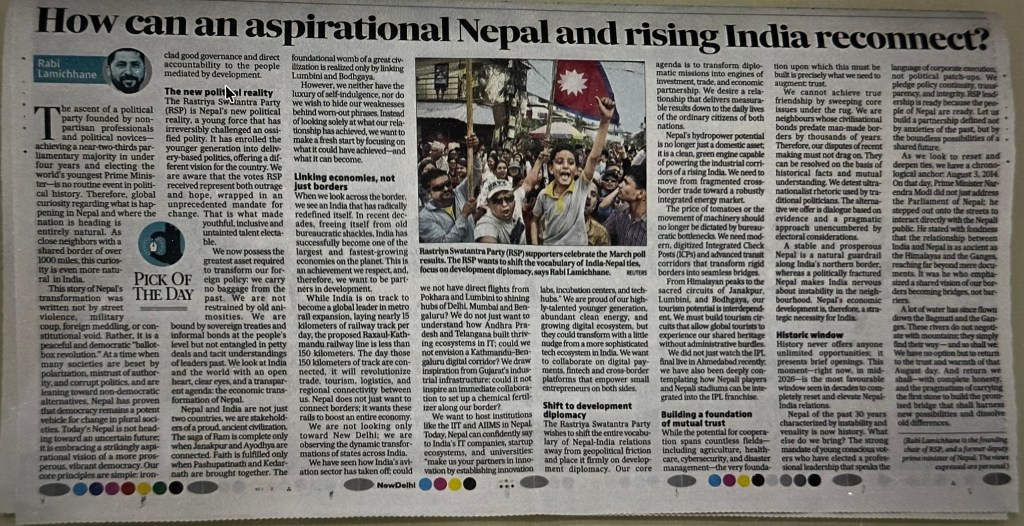
I started reading Rabi Lamichhane’s article “How can an aspirational Nepal and rising India reconnect?” in Hindustan Times and felt compelled to share some thoughts on how we remember Nepal’s recent political transformation.

The article frames Nepal’s transformation as a “peaceful ballot-box revolution” focused on development and aspirational vision. However, the historical record shows that the 2026 election was called because of the September 2025 Gen Z protests, which resulted in:

  • 19 people killed when police opened fire on protesters
  • Over 300 injured with tear gas, rubber bullets, and live ammunition
  • Parliament building damaged during the protests
  • $21 billion in damage — half of Nepal’s annual GDP
  • School kids in uniforms brought to the streets

More than 800,000 new voters registered—two-thirds of them Gen Z. The movement wasn’t about RSP specifically; it was about accountability, anti-corruption, and demanding a political system that serves ordinary citizens. The 2/3 RSP majority we see today is a direct result of this Gen Z movement.

When the article describes this as a “peaceful ballot-box revolution,” it risks erasing the young people who died to make this election possible. The families of the martyrs deserve to be acknowledged in any narrative about Nepal’s transformation.

On border relations, the article’s call to “resolve disputes through dialogue” is constructive, especially after PM Balen’s recent parliamentary remarks on border encroachment sparked debate. What would strengthen Nepal-India ties is not just aspirational vision but transparent governance, accountability for all parties, and respect for democratic institutions.

The warm reception Rabi received in India reflects genuine interest in Nepal-India cooperation, which should be welcomed. However, for that cooperation to be sustainable, both countries need leaders who balance diplomatic engagement with domestic accountability.

When RSP’s 2/3 majority enables governance, it also brings responsibility to ensure that power serves all citizens, not just party interests. True reconnection between Nepal and India will come not from rewriting history, but from building relationships grounded in mutual respect, transparency, and honoring the Gen Z generation whose uprising made this new political moment possible.

We should all remember: accountability today strengthens democracy tomorrow.

When Fraud Wears a Suit: The Quiet Rise of Financial Crime in Ontario, Canada and Beyond

Dr. Rajendra K Panthee

What would you do if your life savings disappeared not through a robbery, but through documents you believed you could trust?

Across the Greater Toronto Area and beyond financial crime is becoming harder to see and easier to fall into. It no longer happens in dark alleys. It moves through contracts investment pitches and professional networks that appear legitimate on the surface. Some of the most damaging crimes today wear suits speak confidently and promise opportunity.

What makes this even more concerning is how risk now cuts across industries we normally trust Insurance real estate and investment spaces are not immune. Whether it is a policy that is not fully explained a property deal that hides risk or an online investment promising life changing returns the pattern is often the same. I came close to falling into one of these traps myself. A few years ago I saw an online promotion claiming that Elon Musk wanted Canadian ordinary people to become millionaires through a limited opportunity. It looked convincing professional and urgent. That is exactly how these schemes work not by appearing suspicious but by appearing credible.

Financial fraud is not victimless, and it is rarely obvious. In Ontario patterns have emerged through warnings and reported cases. Misuse of real estate trust funds high risk promissory notes marketed as safe mortgage fraud through misrepresentation and unregistered investment schemes are becoming more visible. Vulnerable groups including seniors newcomers and those unfamiliar with financial systems are often targeted. Organizations like the Ontario Securities Commission and the Financial Services Regulatory Authority of Ontario continue to issue alerts, yet many people only encounter these warnings after losses occur.

There is also a growing frustration that nothing seems to happen when financial crime occurs. The truth is more complex. These cases involve extensive documentation multiple actors and the challenge of proving intent. Investigations take time and legal thresholds are high. This creates a gap between public expectation and visible accountability. That gap slowly erodes trust and discourages victims from speaking out.

Behind every case there is a human story. Financial fraud takes more than money. It takes security dignity and peace of mind. People have lost retirement savings home equity compensation funds and years of stability. Victims are not reckless. Many are careful people who believed they were making responsible decisions. Families trying to build a future seniors seeking stability and newcomers trying to navigate a new system often carry the heaviest burden.

Unlike street crime financial fraud hides behind legitimacy. It uses complex paperwork, legal language trusted intermediaries, and emotional connection. It often relies on urgency and familiarity. By the time doubt appears the damage is already done.

There are warning signs that should never be ignored. Promises of high returns with little risk pressure to act quickly lack of transparency unverified professionals and appeals based on trust or community. If something feels rushed or unclear it is worth pausing. That pause can protect everything you have worked for.

In a complex financial environment awareness becomes your strongest protection. Verifying credentials through the Ontario Securities Commission or the Financial Services Regulatory Authority of Ontario seeking independent legal advice and asking direct questions are no longer optional steps. They are necessary habits. Reporting suspicious activity to organizations like the Canadian Anti-Fraud Centre also helps protect others.

This is not about creating fear. It is about closing the gap between trust and understanding In fast growing regions like the Greater Toronto Area opportunity and risk move together. Fraud thrives where awareness is low and blind trust is high.

A healthy society does not rely only on punishment after damage is done. It builds people who can recognize deception before becoming victims. When fraud wears a suit awareness becomes the first line of defense.

Before trusting a financial promise remember that due diligence is always cheaper than regret.

RSP’s First Month: Visible Action, But the Real Test is Still Ahead

Dr. Rajendra K Panthee

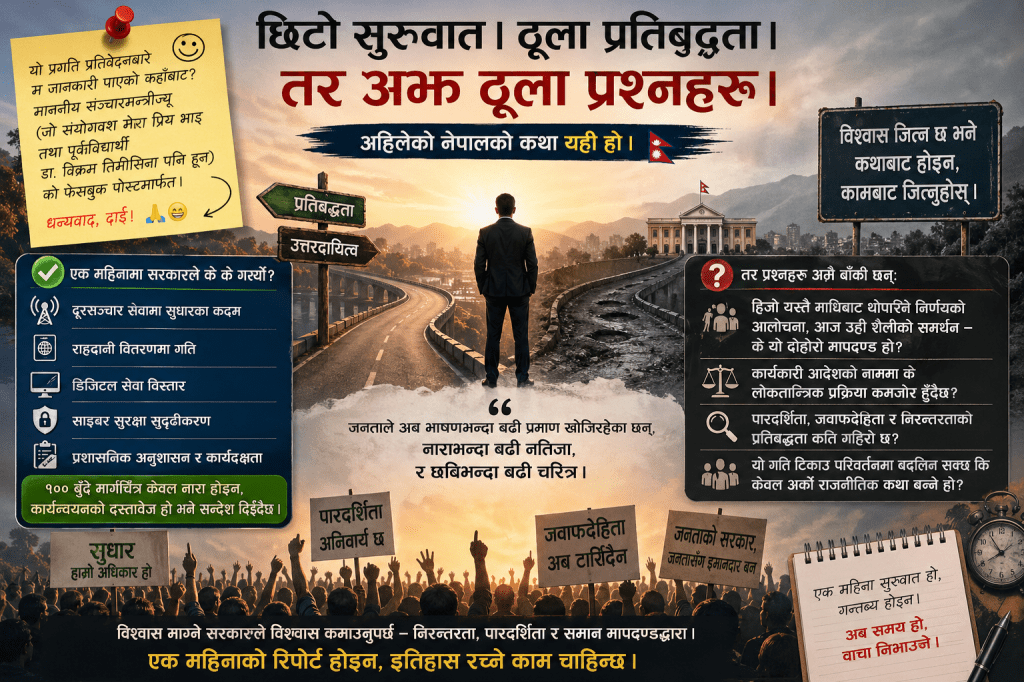
The RSP government has opened its tenure with speed, energy, and a clear effort to project competence. Its one-month progress report is packed with concrete measures, from telecom and postal reforms to digital service upgrades, cybersecurity steps, and administrative discipline tied to the 100-point governance roadmap. That is a promising start. But a promising start is not yet proof of lasting reform.

What stands out most in the report is its focus on visible, everyday services. Extending prepaid package validity, introducing choice in PAYG billing, improving data-usage alerts, advancing 5G readiness, expanding one-time KYC, and improving passport delivery are practical changes people can understand. In a political culture where governments are often accused of producing more slogans than results, that kind of specificity matters. It gives the administration something tangible to point to.

The report also suggests a government that understands that reform is not only about high-level announcements. Its emphasis on zero pending files, business process re-engineering, and better coordination across agencies shows some awareness that the machinery of government must be fixed if public service is to improve. That is a welcome sign. Administrative reform is often boring, but it is usually the difference between public frustration and public trust.

Still, one month is too short a period to treat these measures as full achievements. Many of the report’s items appear to be starts, not finishes. A policy can be introduced, a system can be launched, and a directive can be issued without yet producing durable institutional change. That distinction matters. Citizens do not ultimately judge governments by the number of announcements they make, but by whether those announcements improve the way the state actually works.

That is why the 100-point roadmap should be read as a test, not a trophy. Roadmaps are useful only if they can be translated into deadlines, measurable outcomes, and real accountability. The report shows movement, but movement is not the same as transformation. Some projects appear to be operational, while others are still at the stage of preparation or coordination. The real challenge is whether this initial momentum can survive beyond the first month.

There is also an important political dimension here. Every new government wants to create a story of competence early in its tenure. That is normal. But the more strongly a government advertises early success, the more closely it will later be judged on whether that success endures. Public trust is not built by momentum alone. It is built by consistency, follow-through, and visible results that ordinary people can feel.

So the fairest reading of the report is balanced. The RSP government has made a fast and visible start, and that should be acknowledged. But it has not yet proven that this start will become a sustained record of reform. The one-month report shows intention, direction, and energy. What it does not yet show is whether the government can turn those qualities into lasting change.

Two Democracies, One Problem: When Governments Block the People’s Right to Know 

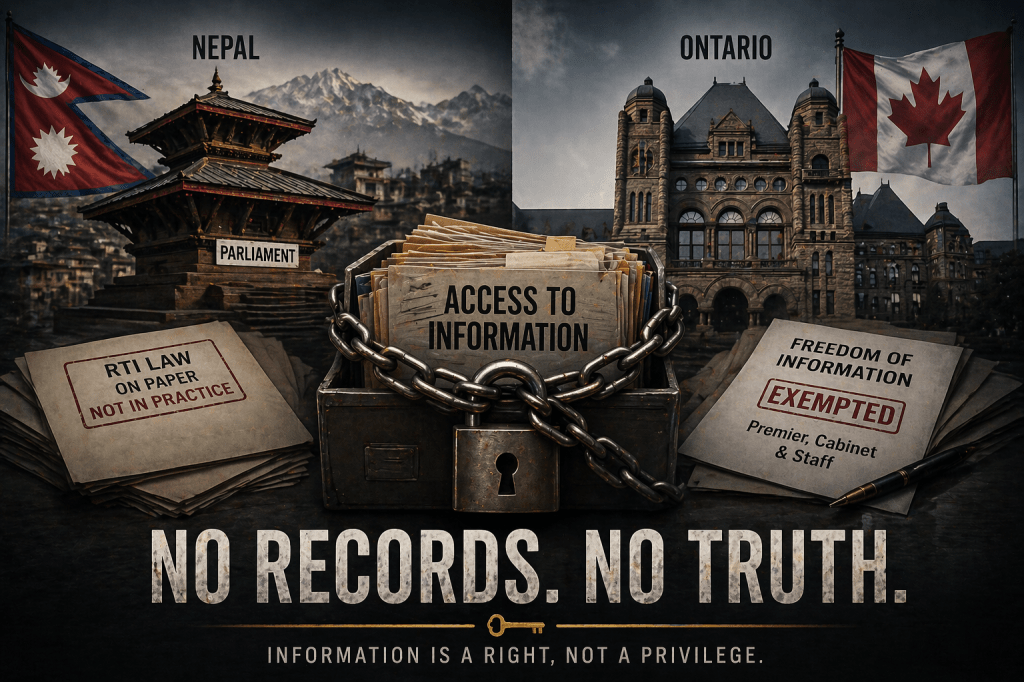
In Ontario, Canada, the Doug Ford government just passed changes to freedom of information laws. These changes exempt the premier, cabinet ministers, and their staff from disclosing emails, texts, and other records related to public business. Across the world in Nepal, the Right to Information Act of 2007 exists on paper. But it routinely fails when citizens seek records about political corruption, elite wealth, or government spending. These are not isolated incidents. They represent a global pattern. Governments promise reform while quietly making it harder for citizens to verify those promises.

The parallel is striking. Ontario’s changes came after court rulings demanded access to the premier’s phone records in connection with the Greenbelt scandal. Nepal’s RTI system has existed for nearly two decades. Yet political offices consistently delay, redact, or deny requests about ministers’ assets, public procurement, or the implementation of reform roadmaps. In both cases, ordinary government agencies must disclose information. But the political leadership creates exemptions for itself.

This is not about partisan politics. It is about a fundamental principle of democratic accountability. Citizens have a right to know how decisions affecting their lives were made. Freedom of information laws exist precisely because governments cannot be trusted to tell their own stories accurately. When leaders exempt themselves from these laws, they are saying their work is too sensitive for public eyes. The public is left to accept official narratives without the records to test them against reality.

In Nepal, the stakes are particularly high. The new government’s 100‑point reform roadmap promises anti‑corruption measures, faster service delivery, and transparent governance. But without strong RTI enforcement, citizens have no way to verify whether these are real commitments or political theatre. Journalists requested details about ministers’ recently declared gold holdings and property. What did they receive? Delays, partial disclosures, or outright denials. The same pattern repeats with questions about arrests of former leaders, implementation of the roadmap, or the budget allocations for promised reforms.

Ontario offers a cautionary tale. The FOI changes there were framed as modernization for the digital age. Yet critics, including the province’s privacy commissioner, warned they would make government less transparent than even some authoritarian states. The timing also mattered. The changes came after court losses over access to political records. That timing suggested a deeper motive. Leaders wanted to shield decision‑making from scrutiny.

Both situations reveal the same structural flaw. Democratic governments often weaken the very mechanisms designed to hold them accountable. Nepal’s RTI Commission exists but lacks teeth. Ontario’s Information and Privacy Commissioner can complain but cannot compel disclosure from the political elite. The result is predictable. Leaders control the flow of information while citizens struggle to separate fact from spin.

This matters most for Nepal because the new government came to power promising to break decades of corrupt governance. The public wants to believe in that promise. But belief without verification becomes blind faith. When citizens cannot access records showing how ministers accumulated their wealth, whether arrests followed due process, or if the 100‑point roadmap has concrete timelines and budgets, skepticism grows. Transparency is not a luxury. It is the foundation of trust.

The solution is straightforward but politically difficult. Nepal should strengthen its RTI law. It should mandate timelines for political office responses, create real penalties for non‑compliance, and give the National Information Commission power to compel disclosure. Ontario should reverse its exemptions and recommit to the principle that no public official is above public scrutiny.

Around the world, democracies face this same test. When governments limit access to information, they limit the public’s ability to govern itself. Nepal and Ontario show that the problem transcends borders, political systems, and cultures. The right to know is universal because the need to hold power accountable is universal.

Leaders promising reform should welcome scrutiny, not evade it. Citizens demanding accountability should insist on records, not just rhetoric. When governments exempt themselves from transparency laws, they are not modernizing democracy. They are undermining it.

Canada’s Changing Reality: A Wake-Up Call for International Students

Dr. Rajendra Panthee

Recent discussions about Canada’s slowing, and in some cases declining, population are more than just statistics. They reflect a deeper shift in immigration policy, economic pressure, and the consequences of rapid population growth over the past few years. For prospective international students and foreign workers, especially from countries like Nepal, India, and others, this changing reality demands serious reflection.

After listening to Ron Butler on the Angry Mortgage Podcast on March 20, 2026, one thing becomes clear. A system built on rapid expansion, aggressive recruitment, and unrealistic promises is now being forced to correct itself. When such systems correct, it is often the most vulnerable, young international students, who pay the price.

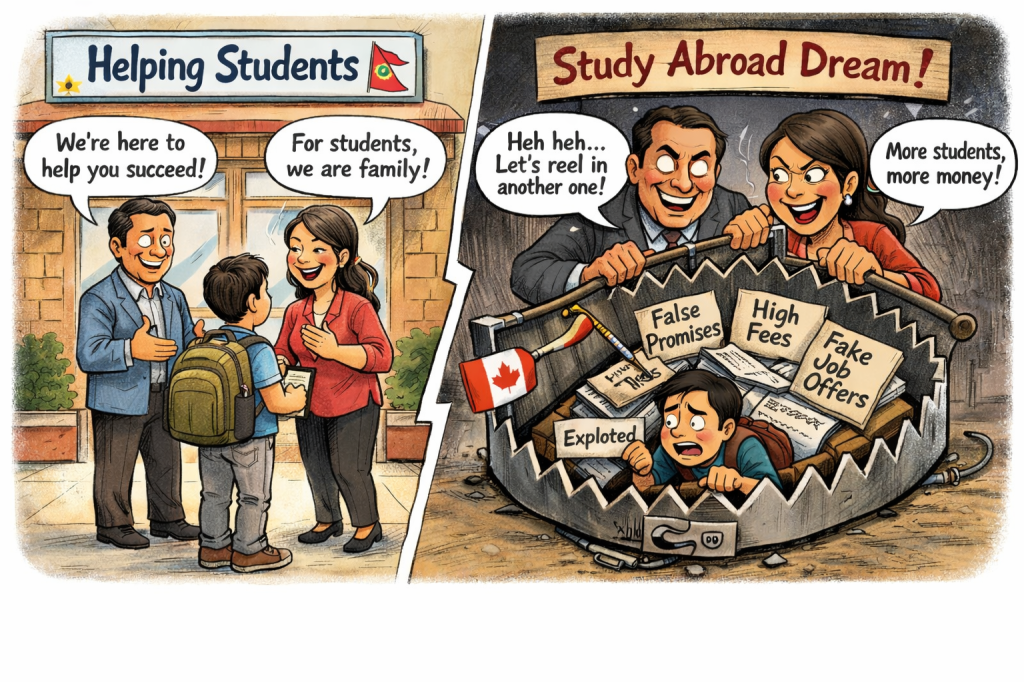
For many young people, the journey begins right after high school. They come to Canada as students, but for many, education is not the primary goal. The real objective is often permanent residency or citizenship. There is nothing inherently wrong with that aspiration. The problem begins when that dream is sold through misinformation, consultants, and brokers who promise easy pathways that no longer exist.

What often goes unspoken are the consequences of believing these promises. As Dr. Punya Sagar Marahatta has consistently warned through his awareness posts—such as his writings on “Diploma Mills” and his recent reflections on March 29—many students arrive with expectations shaped by consultants, only to encounter a completely different reality. Instead of stable work and a clear path forward, they face financial pressure, isolation, and deep uncertainty. In some cases, this leads to serious mental health struggles. There have been tragic incidents, including the recent death of a student in the Niagara region, along with several similar cases in the past. Others have experienced homelessness or have been forced to return home after exhausting their resources. These are not isolated stories but part of a broader pattern that demands urgent attention. Efforts to regulate and monitor consultancies, both in Nepal and abroad, are not just policy discussions—they are a necessary step to prevent further harm to vulnerable students. I say this not as an outsider, but from personal experience.

I say this not as an outsider, but from personal experience.

I came to the United States for my PhD on a teaching assistantship. I prepared for TOEFL and GRE, applied directly to universities, contacted departments and professors, and secured funding. Because I was funded, my focus was entirely on study. That is what studying abroad is supposed to look like.

In early 2010, my journey toward Canadian permanent residence began. At the time, an acquaintance of mine had repeatedly failed to obtain a U.S. visa. In his search for alternatives, he discovered Canada’s high-skilled immigration program, which allowed him to apply for permanent residence for himself and his family. He saw this as a pathway for his family to settle in Canada, with the added advantage of making future travel to the United States easier. Inspired by his approach, I followed his steps, even though my own family was living in the U.S. at the time. The job prospects there were uncertain, and as my dependent, my wife was unable to attend school or work. I applied under the same high-skilled category. However, Canada later decided to eliminate that immigration category. Fortunately, because we had submitted our application before the rule change, our case was still considered. The process took a long time, but finally, we landed in Toronto in April 2013.

Since then, my life has been defined by movement.

While I was based in Texas, I would come to Toronto only during semester breaks. Later, after securing my position at Syracuse University, I found myself about a four-hour drive from Toronto, making frequent weekend trips to stay connected with my family. This back-and-forth life was not ideal, but it was a conscious choice shaped by both professional commitment and family responsibility.

After graduating from the University of Texas, I joined Centennial College as a contract professor in January 2014. In July 2015, I received a job offer from Syracuse University and continued working in both places for some time.

Many people asked me why I did not simply stay in Canada with my family instead of commuting so frequently between the US and Canada.

The answer was simple. It was not that full-time positions at community colleges were hard to obtain at the time. In fact, I could likely have secured a full-time role at Centennial within two or three years. My decision, therefore, was about the kind of academic career I wanted. I chose to remain connected to a top-tier university environment like Syracuse University, where I could focus on research, intellectual growth, and long-term academic development.

Today, with the recent decline in international student numbers, my contract teaching at Centennial is no longer there. Looking back, I feel that decision was the right one.

This is exactly the reality many students are not told.

Over the past few years, a troubling ecosystem has developed around low-tier private and community colleges. Consultants, mostly based in home countries, have been selling a dream. Study well, get a good job, secure PR, build a future. Families take loans, sell land, and invest everything. But what many students encounter instead is a harsh reality. High living costs, unstable work, and an education that often takes a back seat to survival.

If a student is truly committed to education, there is a better path.

Studying abroad in countries like Canada or the United States can be transformative, but it makes the most sense at the graduate level, especially with scholarships, teaching assistantships, or research assistantships. Funded students have the time and stability to focus on learning. In contrast, those who arrive after paying large sums to private colleges often find themselves forced to prioritize work over study.

More importantly, pursuing graduate study does not require paying consultants. Students can apply directly through university websites, meet admission requirements, and contact faculty members themselves. This route is transparent, merit-based, and far more reliable than depending on intermediaries.

This is not an argument against immigration. Canada has long benefited from newcomers, and a well-managed system remains essential. But as Ron Butler also suggests, the recent model driven by volume rather than capacity has reached its limits.

To students and families,
Do not confuse marketing with reality.
Do not confuse shortcuts with opportunity.

Studying abroad can still be a powerful and life-changing experience, but only when it is approached with clarity, preparation, and realistic expectations.

Otherwise, what is sold as a dream may turn into a very expensive lesson.

Kantipur’s Balen Feature: Reading Journalism Through Its Silences

Dr. Rajendra K Panthee

The most sophisticated way to read journalism isn’t merely to analyze what is written—it is to pay close attention to what is carefully, strategically left unsaid. Kantipur’s recent long feature on Kathmandu Mayor Balen Shah is, by conventional standards, an impressive piece of documentation. It traces his political journey from constitutional-era activism to his disruptive mayoralty and now to his growing national ambitions. It acknowledges controversies, administrative shortcomings, and raises legitimate questions about whether disruption at the municipal level can scale to national governance.

Yet it is precisely this apparent comprehensiveness that invites deeper scrutiny. When Nepal’s most influential establishment newspaper—one that spent years dismissing Balen as a “social media mayor”—suddenly produces an exhaustive, balanced profile at the exact moment he becomes electorally viable at the national level, the question is not simply what does the article say? The more important question is: what does it choose not to say, and why?

These silences are not accidental. They are rhetorical.

Silence as Power, Not Absence

Rhetorician Cheryl Glenn reminds us that silence is never empty. In her work on the rhetoric of silence, Glenn argues that silence functions as an active communicative force—it protects power, shapes legitimacy, avoids accountability, and guides interpretation without openly arguing anything. Institutions, especially powerful ones, often rely on silence not because they lack information, but because silence is strategically useful.

Reading Kantipur’s Balen feature through this lens reveals something crucial: the article’s power lies not in misinformation, but in selective omission.

The Missing Mirror: Media’s Own Role

The most striking absence in the feature is any serious self-reflection. The article is written as if Kantipur has always understood Balen’s political significance, merely documenting it now in fuller detail. There is no acknowledgment of the years during which he was treated as a novelty act rather than a serious political challenge. There is no examination of why tens of thousands of Kathmandu voters saw something the establishment media did not.

If this were fully honest journalism, the feature would have included a section titled something like: “Why We Got Balen Wrong.” That would require confronting uncomfortable questions: Why were his early interventions framed largely as authoritarian spectacle? Why were unverified accusations amplified while governance outcomes received less attention? Why did the media fail to recognize a structural shift in voter sentiment?

This silence serves a clear function. Acknowledging such misreading would undermine institutional authority. Instead, Kantipur performs what might be called narrative revisionism—rewriting the past as if skepticism never existed, thereby preserving credibility while adapting to new political realities. As Glenn would suggest, silence here works to protect institutional power.

The Money Question That Goes Unasked

Another conspicuous silence concerns political finance and business relationships. The article briefly mentions that Balen used a Land Rover Defender worth approximately NPR 4.2 crore during his campaign, borrowed from businessman Kamal Malpani of Timure Industries. This remarkable detail is presented without follow-up.

Why would a businessman lend such an asset to a mayoral candidate? What expectations, if any, accompany that support? Have any municipal decisions benefited related business interests? These are not “gotcha” questions—they are the foundation of democratic accountability journalism.

The absence of financial investigation is particularly striking given that transparency and anti-corruption form the core of Balen’s political brand. If those claims are robust, scrutiny should strengthen them. If such scrutiny is avoided, the silence itself becomes meaningful. As Glenn notes, silence often enables legitimacy by keeping inconvenient complexities out of public view.

The Strategic Minimization of Rabi Lamichhane

Perhaps the most politically consequential silence is the near-erasure of Rabi Lamichhane. In an 18-page feature about RSP’s prime ministerial prospects, the party’s founder and most prominent mass leader barely appears. This is not editorial oversight; it is narrative positioning.

By minimizing Rabi’s presence, the feature subtly frames Balen as the natural face of RSP’s national future, discouraging comparison, debate, or scrutiny of internal party dynamics. This silence matters because Rabi represents a more unpredictable challenge to establishment media. With a media background and a history of confrontation with Kantipur, his potential premiership carries greater institutional risk.

Balen, by contrast, is politically disruptive but media-naïve—less likely to challenge media power directly. Through silence, Kantipur may not be endorsing anyone outright, but it is shaping the field of acceptable political imagination.

The Absent Voices and the Policy Vacuum

The feature also avoids systematic engagement with municipal staff perspectives. Beyond headline conflicts, we hear little from those who actually work within Kathmandu Metropolitan City. Are they empowered reformers or reluctant executors? Is governance institutionalized or personality-driven? These questions determine whether Balen’s model can scale nationally—but silence keeps that ambiguity intact.

More striking still is the lack of substantive policy exploration. A long profile of a prime ministerial aspirant offers little insight into positions on federalism, foreign policy, economic strategy, or social justice questions. Silence here serves both subject and publisher: Balen remains broadly appealing, and Kantipur avoids alienating readers by forcing clarity.

Reading Through the Silences

None of this requires assuming a conspiracy. Institutional behavior rarely does. What we see instead is the cumulative effect of editorial caution, power preservation, access maintenance, and strategic adaptation. As Cheryl Glenn teaches us, silence often operates most effectively when it appears natural, neutral, or accidental.

Kantipur’s feature is not inaccurate. The facts presented are largely verifiable. But journalism’s responsibility is not only factual accuracy—it is contextual completeness. When omission consistently aligns with institutional interests, silence becomes a form of rhetoric.

The lesson extends beyond this single article. In moments of political transformation, media does not merely document change; it participates in shaping it. That participation often happens not through loud endorsements, but through quiet exclusions.

Kantipur’s Balen feature is valuable reading—but only if we listen carefully to what it does not say. In the politics of silence, absence is never neutral. It is power speaking softly.

Rabi-Balen Unity In Nepal: Is There a Genuine Reason for a Celebration?

Just read Professor Bishnu Sapkota’s powerful piece in Kantipur debunking three Nepali myths that desperately need challenging. His analysis resonates deeply with arguments I’ve been making about Nepal’s political landscape.

Speaking of myths: watching my Facebook friends celebrate the Rabi Lamichhane-Balen Shah unity as if it’s Nepal’s salvation feels like déjà vu. Remember the Gen Z movement excitement? Within months, we saw it was largely destruction of national heritage and property—not the transformation everyone promised.

This Lamichhane-Balen alliance is just another fleeting “blinker of hope” Nepalis have witnessed repeatedly in recent history. We get excited, we believe, we’re disappointed—rinse and repeat.

But here’s what nobody’s asking: What exactly IS this unity? Is it a formal political party merger? An electoral alliance? A friendship photo-op? More critically—has anyone heard their vision for actually running the country? What policies will they implement? How will they address corruption differently than their predecessors? What’s their economic plan? Their foreign policy? Their strategy for federal restructuring?

We have two popular personalities joining forces, but popularity is not policy. Social media following is not governance capacity. Photo opportunities are not reform agendas.

Will this alliance dismantle the myths Professor Sapkota identifies? Will they do anything substantial that future generations will remember as their contribution to breaking Nepal’s political deadlock? Or is this just another example of what I describe in my recent article—political entrepreneurship where personalities replace principles, and brand management substitutes for serious governance?

As I argue in my piece, these new formations represent populist moments, not sustainable movements. Without ideological foundations, institutional capacity, or history of genuine sacrifice, they’re political entrepreneurs treating democracy as business opportunity. The Lamichhane-Balen union seems to follow this exact pattern: high on publicity, silent on policy.

Professor Sapkota dismantles the myths keeping Nepal stuck. We need this intellectual honesty—and we need to demand more than charisma and popularity from our political leaders. We need answers: How will you govern? What will you change? Why should we believe you’ll succeed where others failed?

Until these questions are answered with substance rather than slogans, this is just another momentary distraction from the hard work of genuine political reform.

Speculators and Housing Bubble in Greater Toronto Area (GTA)


Let's start with the first factor of housing bubble for today.  The number one biggest driver of the housing bubble is speculators' speculation. Don't you ever wonder why home prices in the GTA are so high? If you think about housing prices here, one of the reasons why house prices are so high in the GTA is because of those speculators. Speculators buy properties not to live in or rent out, but to sell quickly and at high prices to make huge profits. A simple example is the fact that realtors have lots of houses in the GTA at a time when it is difficult for many Ontarians to buy a house! When speculation causes people to feel that home prices will rise indefinitely, this can lead to a bubble as people continue to buy homes at increasingly high prices for an investment purpose.

The same has been happening in the Greater Toronto Area (GTA) for a long time now. Speculators are banking on the fact that their home values ​​will continue to rise. One of the reasons Canadian homes are so expensive is because of speculators' valuation practices. The Canadian government comes up with various control measures to prevent this (such as the previous foreign buyer tax increase and the current higher tax on earnings over two hundred and fifty thousand) from time to time, however, they easily find flaws in the government's efforts, and it is difficult to completely control or prevent it. Yes, many immigrants have come and are coming to Canada, and they all prefer to settle in the GTA. Everyone in the GTA needs a house to have a roof over their head and raise their family for sure . Because of this the GTA housing market is heating up by the day. It cannot always be hot, and it needs to be cooled. The housing bubble created by this fever will one day burst, and it must burst to control the unruly real estate market. Honestly speaking,  many people want to see this market crash so they can afford to buy a house! And it's also true that the current housing situation is worse than a housing crash. However, this should not be an accident because its consequences are beyond imagination. (I'll talk about the second factor in the housing bubble in my next post!)