
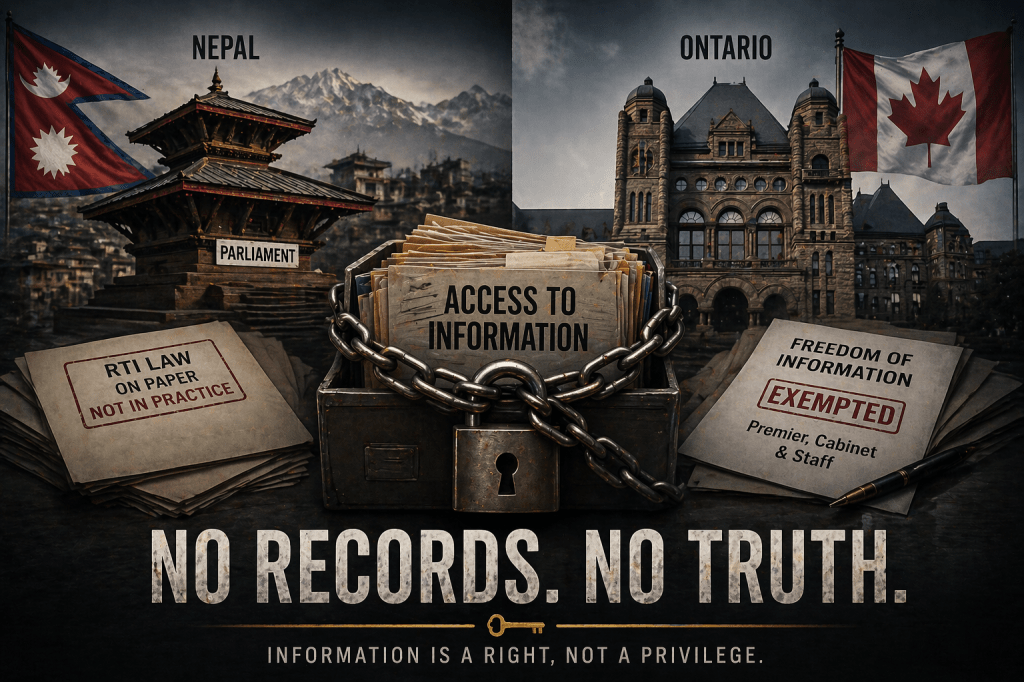
In Ontario, Canada, the Doug Ford government just passed changes to freedom of information laws. These changes exempt the premier, cabinet ministers, and their staff from disclosing emails, texts, and other records related to public business. Across the world in Nepal, the Right to Information Act of 2007 exists on paper. But it routinely fails when citizens seek records about political corruption, elite wealth, or government spending. These are not isolated incidents. They represent a global pattern. Governments promise reform while quietly making it harder for citizens to verify those promises.
The parallel is striking. Ontario’s changes came after court rulings demanded access to the premier’s phone records in connection with the Greenbelt scandal. Nepal’s RTI system has existed for nearly two decades. Yet political offices consistently delay, redact, or deny requests about ministers’ assets, public procurement, or the implementation of reform roadmaps. In both cases, ordinary government agencies must disclose information. But the political leadership creates exemptions for itself.
This is not about partisan politics. It is about a fundamental principle of democratic accountability. Citizens have a right to know how decisions affecting their lives were made. Freedom of information laws exist precisely because governments cannot be trusted to tell their own stories accurately. When leaders exempt themselves from these laws, they are saying their work is too sensitive for public eyes. The public is left to accept official narratives without the records to test them against reality.
In Nepal, the stakes are particularly high. The new government’s 100‑point reform roadmap promises anti‑corruption measures, faster service delivery, and transparent governance. But without strong RTI enforcement, citizens have no way to verify whether these are real commitments or political theatre. Journalists requested details about ministers’ recently declared gold holdings and property. What did they receive? Delays, partial disclosures, or outright denials. The same pattern repeats with questions about arrests of former leaders, implementation of the roadmap, or the budget allocations for promised reforms.
Ontario offers a cautionary tale. The FOI changes there were framed as modernization for the digital age. Yet critics, including the province’s privacy commissioner, warned they would make government less transparent than even some authoritarian states. The timing also mattered. The changes came after court losses over access to political records. That timing suggested a deeper motive. Leaders wanted to shield decision‑making from scrutiny.
Both situations reveal the same structural flaw. Democratic governments often weaken the very mechanisms designed to hold them accountable. Nepal’s RTI Commission exists but lacks teeth. Ontario’s Information and Privacy Commissioner can complain but cannot compel disclosure from the political elite. The result is predictable. Leaders control the flow of information while citizens struggle to separate fact from spin.
This matters most for Nepal because the new government came to power promising to break decades of corrupt governance. The public wants to believe in that promise. But belief without verification becomes blind faith. When citizens cannot access records showing how ministers accumulated their wealth, whether arrests followed due process, or if the 100‑point roadmap has concrete timelines and budgets, skepticism grows. Transparency is not a luxury. It is the foundation of trust.
The solution is straightforward but politically difficult. Nepal should strengthen its RTI law. It should mandate timelines for political office responses, create real penalties for non‑compliance, and give the National Information Commission power to compel disclosure. Ontario should reverse its exemptions and recommit to the principle that no public official is above public scrutiny.
Around the world, democracies face this same test. When governments limit access to information, they limit the public’s ability to govern itself. Nepal and Ontario show that the problem transcends borders, political systems, and cultures. The right to know is universal because the need to hold power accountable is universal.
Leaders promising reform should welcome scrutiny, not evade it. Citizens demanding accountability should insist on records, not just rhetoric. When governments exempt themselves from transparency laws, they are not modernizing democracy. They are undermining it.
Discover more from Toronto Realty and Rhetoric
Subscribe to get the latest posts sent to your email.
