Two Democracies, One Problem: When Governments Block the People’s Right to Know 

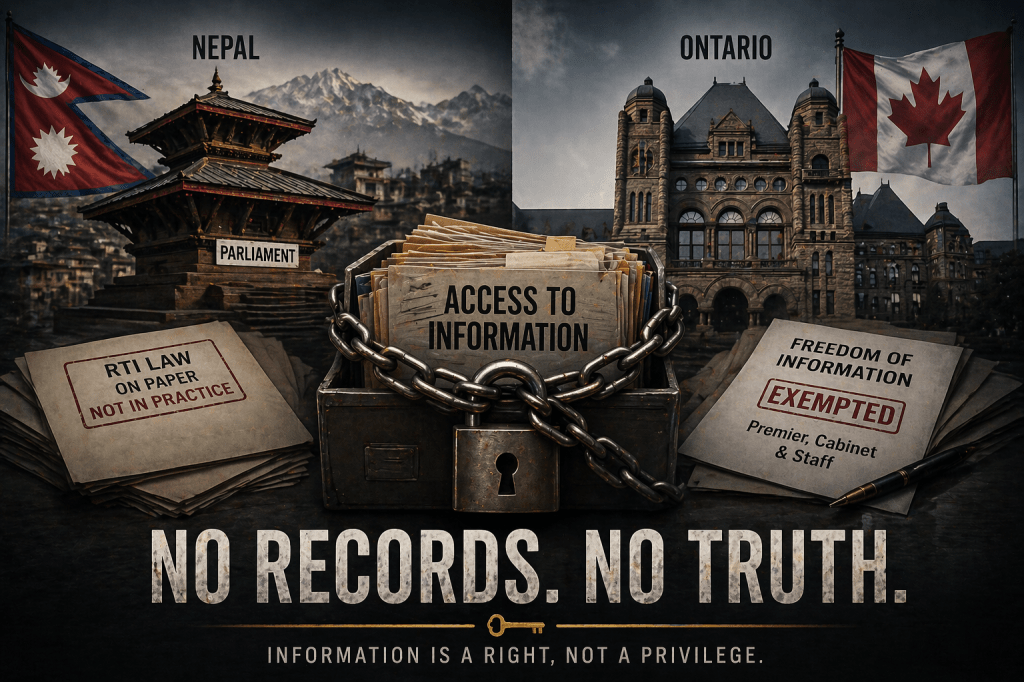
In Ontario, Canada, the Doug Ford government just passed changes to freedom of information laws. These changes exempt the premier, cabinet ministers, and their staff from disclosing emails, texts, and other records related to public business. Across the world in Nepal, the Right to Information Act of 2007 exists on paper. But it routinely fails when citizens seek records about political corruption, elite wealth, or government spending. These are not isolated incidents. They represent a global pattern. Governments promise reform while quietly making it harder for citizens to verify those promises.

The parallel is striking. Ontario’s changes came after court rulings demanded access to the premier’s phone records in connection with the Greenbelt scandal. Nepal’s RTI system has existed for nearly two decades. Yet political offices consistently delay, redact, or deny requests about ministers’ assets, public procurement, or the implementation of reform roadmaps. In both cases, ordinary government agencies must disclose information. But the political leadership creates exemptions for itself.

This is not about partisan politics. It is about a fundamental principle of democratic accountability. Citizens have a right to know how decisions affecting their lives were made. Freedom of information laws exist precisely because governments cannot be trusted to tell their own stories accurately. When leaders exempt themselves from these laws, they are saying their work is too sensitive for public eyes. The public is left to accept official narratives without the records to test them against reality.

In Nepal, the stakes are particularly high. The new government’s 100‑point reform roadmap promises anti‑corruption measures, faster service delivery, and transparent governance. But without strong RTI enforcement, citizens have no way to verify whether these are real commitments or political theatre. Journalists requested details about ministers’ recently declared gold holdings and property. What did they receive? Delays, partial disclosures, or outright denials. The same pattern repeats with questions about arrests of former leaders, implementation of the roadmap, or the budget allocations for promised reforms.

Ontario offers a cautionary tale. The FOI changes there were framed as modernization for the digital age. Yet critics, including the province’s privacy commissioner, warned they would make government less transparent than even some authoritarian states. The timing also mattered. The changes came after court losses over access to political records. That timing suggested a deeper motive. Leaders wanted to shield decision‑making from scrutiny.

Both situations reveal the same structural flaw. Democratic governments often weaken the very mechanisms designed to hold them accountable. Nepal’s RTI Commission exists but lacks teeth. Ontario’s Information and Privacy Commissioner can complain but cannot compel disclosure from the political elite. The result is predictable. Leaders control the flow of information while citizens struggle to separate fact from spin.

This matters most for Nepal because the new government came to power promising to break decades of corrupt governance. The public wants to believe in that promise. But belief without verification becomes blind faith. When citizens cannot access records showing how ministers accumulated their wealth, whether arrests followed due process, or if the 100‑point roadmap has concrete timelines and budgets, skepticism grows. Transparency is not a luxury. It is the foundation of trust.

The solution is straightforward but politically difficult. Nepal should strengthen its RTI law. It should mandate timelines for political office responses, create real penalties for non‑compliance, and give the National Information Commission power to compel disclosure. Ontario should reverse its exemptions and recommit to the principle that no public official is above public scrutiny.

Around the world, democracies face this same test. When governments limit access to information, they limit the public’s ability to govern itself. Nepal and Ontario show that the problem transcends borders, political systems, and cultures. The right to know is universal because the need to hold power accountable is universal.

Leaders promising reform should welcome scrutiny, not evade it. Citizens demanding accountability should insist on records, not just rhetoric. When governments exempt themselves from transparency laws, they are not modernizing democracy. They are undermining it.

Canada’s Changing Reality: A Wake-Up Call for International Students

Dr. Rajendra Panthee

Recent discussions about Canada’s slowing, and in some cases declining, population are more than just statistics. They reflect a deeper shift in immigration policy, economic pressure, and the consequences of rapid population growth over the past few years. For prospective international students and foreign workers, especially from countries like Nepal, India, and others, this changing reality demands serious reflection.

After listening to Ron Butler on the Angry Mortgage Podcast on March 20, 2026, one thing becomes clear. A system built on rapid expansion, aggressive recruitment, and unrealistic promises is now being forced to correct itself. When such systems correct, it is often the most vulnerable, young international students, who pay the price.

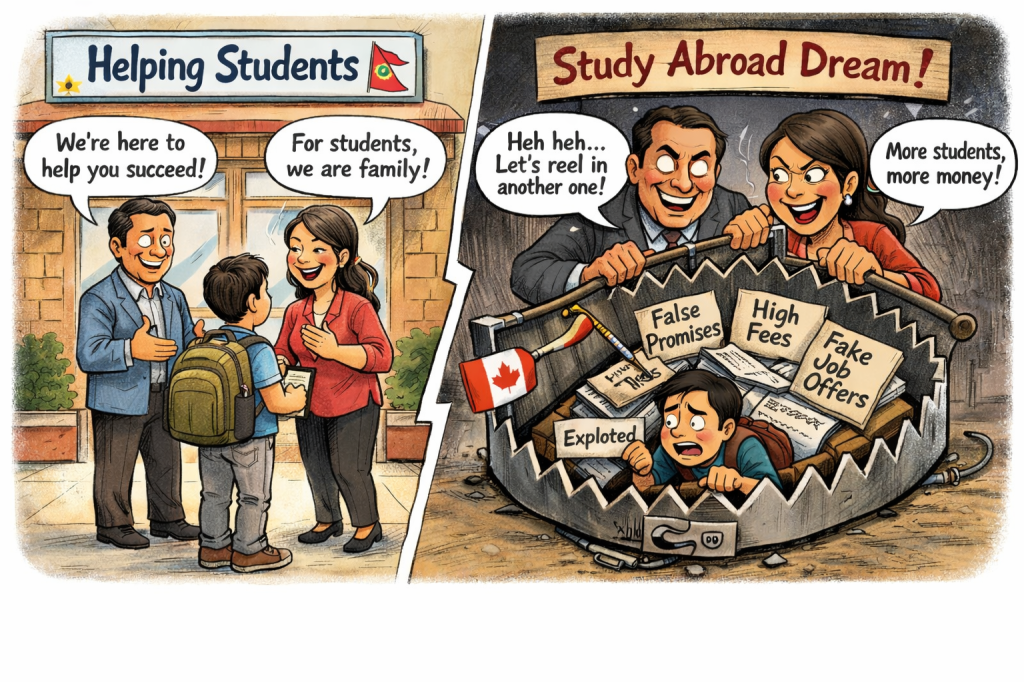
For many young people, the journey begins right after high school. They come to Canada as students, but for many, education is not the primary goal. The real objective is often permanent residency or citizenship. There is nothing inherently wrong with that aspiration. The problem begins when that dream is sold through misinformation, consultants, and brokers who promise easy pathways that no longer exist.

What often goes unspoken are the consequences of believing these promises. As Dr. Punya Sagar Marahatta has consistently warned through his awareness posts—such as his writings on “Diploma Mills” and his recent reflections on March 29—many students arrive with expectations shaped by consultants, only to encounter a completely different reality. Instead of stable work and a clear path forward, they face financial pressure, isolation, and deep uncertainty. In some cases, this leads to serious mental health struggles. There have been tragic incidents, including the recent death of a student in the Niagara region, along with several similar cases in the past. Others have experienced homelessness or have been forced to return home after exhausting their resources. These are not isolated stories but part of a broader pattern that demands urgent attention. Efforts to regulate and monitor consultancies, both in Nepal and abroad, are not just policy discussions—they are a necessary step to prevent further harm to vulnerable students. I say this not as an outsider, but from personal experience.

I say this not as an outsider, but from personal experience.

I came to the United States for my PhD on a teaching assistantship. I prepared for TOEFL and GRE, applied directly to universities, contacted departments and professors, and secured funding. Because I was funded, my focus was entirely on study. That is what studying abroad is supposed to look like.

In early 2010, my journey toward Canadian permanent residence began. At the time, an acquaintance of mine had repeatedly failed to obtain a U.S. visa. In his search for alternatives, he discovered Canada’s high-skilled immigration program, which allowed him to apply for permanent residence for himself and his family. He saw this as a pathway for his family to settle in Canada, with the added advantage of making future travel to the United States easier. Inspired by his approach, I followed his steps, even though my own family was living in the U.S. at the time. The job prospects there were uncertain, and as my dependent, my wife was unable to attend school or work. I applied under the same high-skilled category. However, Canada later decided to eliminate that immigration category. Fortunately, because we had submitted our application before the rule change, our case was still considered. The process took a long time, but finally, we landed in Toronto in April 2013.

Since then, my life has been defined by movement.

While I was based in Texas, I would come to Toronto only during semester breaks. Later, after securing my position at Syracuse University, I found myself about a four-hour drive from Toronto, making frequent weekend trips to stay connected with my family. This back-and-forth life was not ideal, but it was a conscious choice shaped by both professional commitment and family responsibility.

After graduating from the University of Texas, I joined Centennial College as a contract professor in January 2014. In July 2015, I received a job offer from Syracuse University and continued working in both places for some time.

Many people asked me why I did not simply stay in Canada with my family instead of commuting so frequently between the US and Canada.

The answer was simple. It was not that full-time positions at community colleges were hard to obtain at the time. In fact, I could likely have secured a full-time role at Centennial within two or three years. My decision, therefore, was about the kind of academic career I wanted. I chose to remain connected to a top-tier university environment like Syracuse University, where I could focus on research, intellectual growth, and long-term academic development.

Today, with the recent decline in international student numbers, my contract teaching at Centennial is no longer there. Looking back, I feel that decision was the right one.

This is exactly the reality many students are not told.

Over the past few years, a troubling ecosystem has developed around low-tier private and community colleges. Consultants, mostly based in home countries, have been selling a dream. Study well, get a good job, secure PR, build a future. Families take loans, sell land, and invest everything. But what many students encounter instead is a harsh reality. High living costs, unstable work, and an education that often takes a back seat to survival.

If a student is truly committed to education, there is a better path.

Studying abroad in countries like Canada or the United States can be transformative, but it makes the most sense at the graduate level, especially with scholarships, teaching assistantships, or research assistantships. Funded students have the time and stability to focus on learning. In contrast, those who arrive after paying large sums to private colleges often find themselves forced to prioritize work over study.

More importantly, pursuing graduate study does not require paying consultants. Students can apply directly through university websites, meet admission requirements, and contact faculty members themselves. This route is transparent, merit-based, and far more reliable than depending on intermediaries.

This is not an argument against immigration. Canada has long benefited from newcomers, and a well-managed system remains essential. But as Ron Butler also suggests, the recent model driven by volume rather than capacity has reached its limits.

To students and families,
Do not confuse marketing with reality.
Do not confuse shortcuts with opportunity.

Studying abroad can still be a powerful and life-changing experience, but only when it is approached with clarity, preparation, and realistic expectations.

Otherwise, what is sold as a dream may turn into a very expensive lesson.

Balen Shah’s March Toward Power: Nepal’s Lucifer Moment

Wherever Balen Shah campaigns, crowds materialize. The former rapper turned Kathmandu mayor draws thousands simply wanting to see him, a phenomenon unprecedented in recent Nepali politics. Current polling suggests he and his Rastriya Swatantra Party (RSP) are poised for sweeping victory in March 2026—even in Jhapa-5, where he faces KP Sharma Oli on the former prime minister’s home turf. After three decades of broken promises from traditional parties, Nepalis seem ready for wholesale change.

Yet his path is shadowed by accusations. Communist parties label him a foreign agent, compare him to Zelensky warning Nepal will become “another Ukraine” or “another Venezuela,” and some blame him for the September 24, 2025 Singh Durbar fire. Political analyst Sourav and UML leaders call him “Lucifer”—a metaphor more revealing than intended.

The Lucifer Paradox

In calling Balen “Lucifer,” UML likely means to paint him as destructive and malevolent. But Lucifer—literally “light-bearer” in Latin—represents the beautiful rebel who challenges divine authority and brings forbidden knowledge. Milton’s Paradise Lost portrays him declaring “Better to reign in Hell than serve in Heaven”—resonating uncomfortably well with Balen’s positioning.

The metaphor inadvertently captures his appeal: the rebel bearing light into a system that has kept citizens in darkness through decades of corruption and broken promises. UML’s use reveals their desperation—after thirty years rotating the same faces through power while delivering minimal change, they face electoral reckoning. By invoking Lucifer rather than debating governance, they signal Balen represents an existential threat to their entire political order.

Conspiracy Theories as Last Resort

Most revealing is the Zelensky comparison. UML warns Nepal will become a failed state like Ukraine under Russian invasion or Venezuela under economic collapse if Balen wins.

This comparison is geopolitically absurd. Zelensky’s Ukraine isn’t a failed state—it’s defending sovereignty against Russian imperial aggression. Putin’s invasion had nothing to do with Zelensky’s personality; Putin explicitly denies Ukraine’s right to exist as an independent nation, views predating Zelensky by decades. To blame Zelensky for Russia’s invasion is victim-blaming elevated to geopolitical analysis. Moreover, Nepal’s strategic situation bears no resemblance to Ukraine’s—both India and China benefit from Nepal’s stability, not its collapse.

The Venezuela comparison is equally illiterate. Venezuela’s crisis resulted from decades of mismanagement, corruption, and authoritarian consolidation under leaders who systematically dismantled democratic institutions—not political outsiders challenging established elites. Blaming American sanctions ignores that economic collapse began long before significant sanctions, rooted in oil dependency and currency manipulation.

These conspiracy theories reveal Communist parties have nothing left but fear-mongering. After thirty years in power—UML alone has given Nepal multiple prime ministers—they cannot point to transformative achievements. Roads remain unpaved, electricity unreliable, youth emigrate seeking opportunities traditional parties failed to create. So they invoke foreign bogeymen, claiming America will use Balen to destabilize Nepal. This is classic authoritarian rhetoric: when domestic legitimacy evaporates, blame external enemies.

The tragic irony? Communist parties themselves have proven remarkably pliable to foreign influence when convenient, spending decades playing India and China against each other while delivering little to ordinary Nepalis.

The Mayoral Record

Sudip Shrestha’s Setopati examination provides crucial context. Balen’s three years governing Kathmandu demonstrated both promise and peril.

What worked: He brought integrity to an office historically associated with graft, challenged entrenched interests, and refused to play by old rules.

What failed: Nearly every major promise went unfulfilled. The waste management system never materialized. Incineration projects were abandoned. Waste segregation never happened. Claims about creating jobs and exporting organic fertilizer proved empty.

Authoritarian patterns emerged: bulldozers against street vendors without providing alternatives, refusal to consult ward chairpersons or federal officials, attempts to demolish legally built homes without court orders. Most telling: Kathmandu Metropolitan City recorded the lowest capital expenditure among major municipalities despite having Nepal’s largest budget.

Yet voters appear willing to overlook these failures, reasoning that even imperfect change beats predictable stagnation.

Strategic Calculations

Balen’s Jhapa-5 candidacy against Oli reveals calculated positioning. In Janakpur, he declared himself a “son of Madhesh”—striking given he told Setopati three years ago he belonged to a “Suryavanshi royal family,” explicitly rejecting Madhesi identity. He’s reversed his opposition to federalism and promises 10 million tourists annually to Janakpur—wildly disconnected from Nepal’s reality of approximately 1 million total tourists. These shifts suggest he’s learning conventional political rhetoric, promising what constituencies want to hear.

Why Balen?

Narayan Wagle reframes the debate: “The question isn’t Balen—it’s ourselves.” Balen didn’t manufacture his appeal—he channels genuine rage at a political class that failed to deliver governance or accountability for thirty years. His confrontational style resonates because it mirrors how many Nepalis feel.

Wagle’s uncomfortable question becomes urgent with victory likely: What do voters actually expect him to accomplish? Are those expectations grounded in reality? The Lucifer metaphor captures this tension: Are voters seeking someone who will genuinely bring light—transparency, accountability, competent governance—or simply drawn to a rebel who promises to burn down a corrupt system, consequences be damned?

The Governance Challenge

When Balen becomes prime minister, he inherits challenges exponentially more complex than running Kathmandu: building coalitions, navigating federal-provincial-local tensions he previously ignored, managing delicate relations with India and China amid foreign agent accusations, addressing systemic failures in education and healthcare that three decades of traditional parties couldn’t solve.

His mayoral record suggests significant gaps between rhetoric and implementation. Winning power through anti-establishment appeal differs entirely from building functional bureaucracies and delivering sustained development.

Light-Bearer or Destroyer?

The likely RSP victory will signal the most dramatic political transformation in Nepal since the monarchy’s end. But the deeper question transcends electoral outcomes: Can Balen actually govern better than those he’s replacing?

The Lucifer metaphor and conspiracy theories about Ukraine reveal the bankruptcy of old parties’ arguments while hinting at genuine challenges Balen will face navigating Nepal’s position between major powers. The difference is that India and China both benefit from Nepal’s stability, not its collapse.

The crowds gathering to glimpse Balen represent both hope and danger—hope that change is finally possible, danger that charisma might prove insufficient for the patient work of building functional governance. Nepal will soon discover whether its light-bearer can actually illuminate a path forward, or whether the country has simply traded one set of broken promises for another, more charismatic version.

But one thing is certain: when political parties resort to calling opponents Lucifer and warning of Ukrainian collapse, they’ve conceded their own record cannot withstand scrutiny. Nepal’s voters appear to have reached exactly that conclusion.

Rabi-Balen Unity In Nepal: Is There a Genuine Reason for a Celebration?

Just read Professor Bishnu Sapkota’s powerful piece in Kantipur debunking three Nepali myths that desperately need challenging. His analysis resonates deeply with arguments I’ve been making about Nepal’s political landscape.

Speaking of myths: watching my Facebook friends celebrate the Rabi Lamichhane-Balen Shah unity as if it’s Nepal’s salvation feels like déjà vu. Remember the Gen Z movement excitement? Within months, we saw it was largely destruction of national heritage and property—not the transformation everyone promised.

This Lamichhane-Balen alliance is just another fleeting “blinker of hope” Nepalis have witnessed repeatedly in recent history. We get excited, we believe, we’re disappointed—rinse and repeat.

But here’s what nobody’s asking: What exactly IS this unity? Is it a formal political party merger? An electoral alliance? A friendship photo-op? More critically—has anyone heard their vision for actually running the country? What policies will they implement? How will they address corruption differently than their predecessors? What’s their economic plan? Their foreign policy? Their strategy for federal restructuring?

We have two popular personalities joining forces, but popularity is not policy. Social media following is not governance capacity. Photo opportunities are not reform agendas.

Will this alliance dismantle the myths Professor Sapkota identifies? Will they do anything substantial that future generations will remember as their contribution to breaking Nepal’s political deadlock? Or is this just another example of what I describe in my recent article—political entrepreneurship where personalities replace principles, and brand management substitutes for serious governance?

As I argue in my piece, these new formations represent populist moments, not sustainable movements. Without ideological foundations, institutional capacity, or history of genuine sacrifice, they’re political entrepreneurs treating democracy as business opportunity. The Lamichhane-Balen union seems to follow this exact pattern: high on publicity, silent on policy.

Professor Sapkota dismantles the myths keeping Nepal stuck. We need this intellectual honesty—and we need to demand more than charisma and popularity from our political leaders. We need answers: How will you govern? What will you change? Why should we believe you’ll succeed where others failed?

Until these questions are answered with substance rather than slogans, this is just another momentary distraction from the hard work of genuine political reform.