Food Banks Were Meant to Be a Bridge, Not a Way of Life

Dr. Rajendra K Panthee
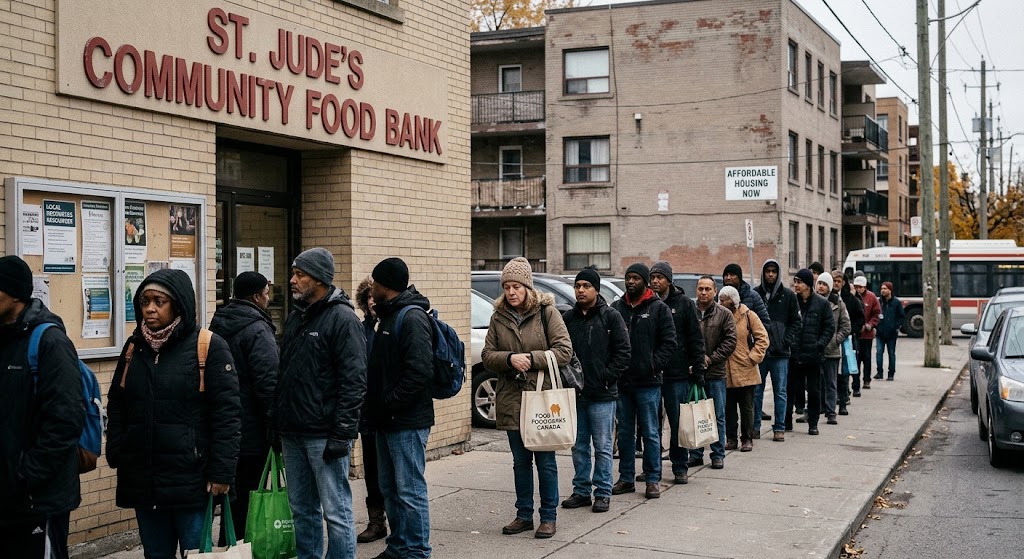
In March 2026, Canadians made 2.35 million visits to food banks. It was the highest monthly number ever recorded and more than double the level of March 2019. In Toronto, Daily Bread Food Bank and North York Harvest Food Bank reported 4.1 million client visits in the year before April 2025, an increase of 340 per cent since 2019. More than 112,000 people used a food bank for the first time in that year alone.

Across Canada, more than 65,000 people were counted as homeless on a single night in 2025. That was 59 per cent higher than in 2020 to 2022. In Toronto, an estimated 12,196 people were experiencing homelessness in October 2025, including 1,446 people staying outdoors.

At the same time, many Canadians say they feel less safe. They see homelessness, addiction, mental-health distress, theft, and sometimes violence in their neighbourhoods. Canada’s Crime Severity Index did fall by 5 per cent in 2025, but that statistic does not erase the fear people feel on a dark street, at a bus stop, or outside a shelter.

These numbers describe a country under strain. They describe people who cannot afford rent, food, medicine, or safety. They describe cities where emergency services have become part of everyday life.

This is not the Canada I imagined when I came here.

Canada meant opportunity, fairness, order, and a decent life for people who worked hard. Like many immigrants, I admired its public institutions and its reputation for looking after those who had fallen behind. I believed Canada was a place where a person who worked honestly could live with dignity.

That is why the news I keep hearing now troubles me so deeply.

Behind every food-bank visit is a person making an impossible choice between rent and groceries, between medication and food, between paying the heating bill and feeding the children. Behind every homeless count is someone without a stable place to sleep. Behind every conversation about crime is a community asking why basic needs have become so difficult to meet.

Hunger has changed its face

For a long time, many Canadians imagined food-bank users as homeless people living on the street. That image is no longer enough. Hunger has entered apartments, workplaces, university campuses, and family homes.

Nearly one in five food-bank clients in Canada is employed. Children account for about one-third of food-bank visits. These are people who wake up, go to work, study, care for their families, and still cannot make their incomes stretch far enough.

When I hear such numbers, I think of Nepal, where poverty has often been visible and where many families have learned to live with scarcity. Canada was supposed to be different.

I still believe that. But belief alone does not put food on the table.

A rich country with a growing problem

Some people ask how this can happen in one of the richest countries in the world. I think the better question is why a rich country has allowed hunger to become so ordinary.

Canada has always had poor people. What has changed is the scale of the problem and the willingness to treat it as normal. Food banks were meant to be emergency bridges. A person might need one after losing a job, after an illness, after a family breakdown, or after an unexpected expense. They were never meant to become a permanent part of life for millions of people.

Yet that is what is happening. When millions of visits become routine, the failure does not belong to charity. It belongs to public policy.

The reasons are not mysterious. Rents have risen faster than incomes. Grocery prices climbed after the pandemic, inflation, supply disruptions, and trade pressures. Many people work in low-paid or unstable jobs. Social assistance and disability benefits have not kept pace with the real cost of living. Newcomers, international students, refugees, single parents, seniors, and people with disabilities often face extra barriers.

COVID-19 did not create these weaknesses. It exposed them. Then it made them worse.

Charity deserves praise, but it cannot replace policy

Organizations such as Daily Bread, North York Harvest, and Second Harvest deserve enormous respect. They feed people, rescue surplus food, mobilize volunteers, and preserve dignity in difficult circumstances. Second Harvest reported distributing 95.3 million pounds of food through community organizations across Canada in its 2025 fiscal year.

The recent attack on Second Harvest’s food-rescue trucks showed both the cruelty and the decency present in our society. Thieves broke into the charity’s Etobicoke yard over Thanksgiving weekend, cut the catalytic converters from seven of its eight trucks, and left most of its fleet unable to deliver food.

Then something good happened. Aurora Foods, a Toronto family business, donated $60,000 to help repair the trucks. Community members also offered money, food, and even vehicles. That generosity deserves praise.

But it also raises an uncomfortable question. Why should a charity that rescues food for hungry people have to depend on emergency donations just to keep its trucks on the road?

We should admire volunteers, donors, and community organizations. We should also refuse to accept a society in which charity must constantly repair what public policy has failed to protect.

Foreign aid and our own people

Some people now say Canada should stop helping Ukraine or reduce foreign aid because Canadians at home are struggling. I understand the anger behind that feeling. When people here cannot afford food, it is natural to ask why resources are being spent elsewhere.

But I do not think the answer is to abandon Ukraine or retreat from the world. Canada can support Ukraine and also feed its own people. These are not either-or choices.

The real issue is different. Canada should not use international commitments as an excuse to neglect people at home. Nor should it use hardship at home as an excuse to abandon its responsibilities abroad.

A mature country can do both. It can defend democratic allies overseas and protect vulnerable people within its own borders. The question is whether our governments have the political will to treat poverty at home with the same urgency they show during foreign crises.

More police cannot solve hunger

There is another uncomfortable issue. Crime, homelessness, addiction, and mental-health crises are becoming more visible in our cities. Some people respond by demanding more police and harsher laws.

Police have a role, especially where there is violence, theft, or exploitation. But police cannot build affordable housing. They cannot raise wages. They cannot improve disability benefits. They cannot make groceries affordable.

Poverty does not automatically produce crime, and most poor people are not criminals. But prolonged desperation can push people toward dangerous situations. It can lead to exploitative work, informal economies, addiction, conflict, and despair.

If people cannot meet their basic needs through legitimate means, society becomes less safe for everyone. That is why slogans about being tough on crime are not enough. A country cannot arrest its way out of hunger, homelessness, or hopelessness.

Employment insurance is not enough

Recent changes to Employment Insurance may help some workers affected by tariffs and job losses. Since March 2025, eligible claimants have benefited from the removal of the usual one-week waiting period, flexibility around severance payments, and extended benefits for some long-tenured workers.

These measures may prevent an immediate income collapse for some families. But temporary measures are not the same as a durable income-security system.

Many people who face food insecurity are not covered by EI at all. They may be self-employed, working too few hours, new to Canada, between precarious jobs, or living on disability or social assistance. When rents and food prices rise, these people have little protection.

A country that patches emergencies one by one will always be reacting too late. It needs stronger foundations.

Not only Canada’s problem

This is not uniquely Canadian. After COVID-19, many wealthy countries have faced rising food insecurity, housing stress, and pressure on emergency services. The United States, the United Kingdom, and parts of Europe have seen similar debates about working people relying on food charities.

In poorer countries, the crisis may look different. Families may eat fewer meals, borrow more, migrate, or depend on informal work. But the underlying issue is similar. The pandemic, inflation, war, climate disruption, and unequal economic systems have made survival harder for people already living close to the edge.

Canada’s case is especially troubling because this country has the wealth, institutions, and public values to do better. When a rich country allows hunger to become ordinary, it faces not only an economic problem but a moral one.

What Canada must do

Canada needs more than sympathy, donation drives, and temporary programs. It needs policies that reduce the need for food banks in the first place.

We need genuinely affordable housing. We need income supports that reflect the real cost of living. We need accessible childcare, transit, and health care. We need protection for workers trapped in precarious employment. We need reforms that do not leave newcomers, students, and refugees in prolonged insecurity. And we need governments to treat food insecurity as an emergency, with clear targets and public accountability.

Food banks should be able to shrink, not grow. Their success should be measured not by how many people they feed, but by how many people no longer need them.

I still believe in Canada. I believe in its generosity, its institutions, and its capacity for fairness. But a country is judged not only by how it helps people far away. It is also judged by how it treats those who are hungry, homeless, and struggling within its own borders.

Food banks were meant to be a bridge. They must not become the destination.
Canada’s Changing Reality: A Wake-Up Call for International Students

Dr. Rajendra Panthee

Recent discussions about Canada’s slowing, and in some cases declining, population are more than just statistics. They reflect a deeper shift in immigration policy, economic pressure, and the consequences of rapid population growth over the past few years. For prospective international students and foreign workers, especially from countries like Nepal, India, and others, this changing reality demands serious reflection.

After listening to Ron Butler on the Angry Mortgage Podcast on March 20, 2026, one thing becomes clear. A system built on rapid expansion, aggressive recruitment, and unrealistic promises is now being forced to correct itself. When such systems correct, it is often the most vulnerable, young international students, who pay the price.

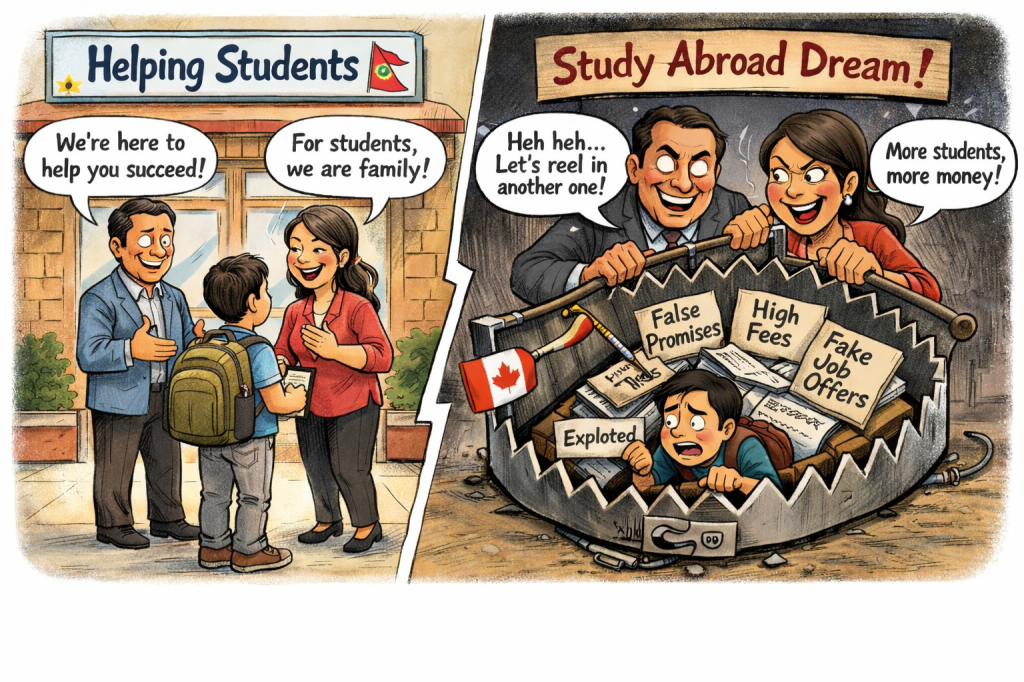
For many young people, the journey begins right after high school. They come to Canada as students, but for many, education is not the primary goal. The real objective is often permanent residency or citizenship. There is nothing inherently wrong with that aspiration. The problem begins when that dream is sold through misinformation, consultants, and brokers who promise easy pathways that no longer exist.

What often goes unspoken are the consequences of believing these promises. As Dr. Punya Sagar Marahatta has consistently warned through his awareness posts—such as his writings on “Diploma Mills” and his recent reflections on March 29—many students arrive with expectations shaped by consultants, only to encounter a completely different reality. Instead of stable work and a clear path forward, they face financial pressure, isolation, and deep uncertainty. In some cases, this leads to serious mental health struggles. There have been tragic incidents, including the recent death of a student in the Niagara region, along with several similar cases in the past. Others have experienced homelessness or have been forced to return home after exhausting their resources. These are not isolated stories but part of a broader pattern that demands urgent attention. Efforts to regulate and monitor consultancies, both in Nepal and abroad, are not just policy discussions—they are a necessary step to prevent further harm to vulnerable students. I say this not as an outsider, but from personal experience.

I say this not as an outsider, but from personal experience.

I came to the United States for my PhD on a teaching assistantship. I prepared for TOEFL and GRE, applied directly to universities, contacted departments and professors, and secured funding. Because I was funded, my focus was entirely on study. That is what studying abroad is supposed to look like.

In early 2010, my journey toward Canadian permanent residence began. At the time, an acquaintance of mine had repeatedly failed to obtain a U.S. visa. In his search for alternatives, he discovered Canada’s high-skilled immigration program, which allowed him to apply for permanent residence for himself and his family. He saw this as a pathway for his family to settle in Canada, with the added advantage of making future travel to the United States easier. Inspired by his approach, I followed his steps, even though my own family was living in the U.S. at the time. The job prospects there were uncertain, and as my dependent, my wife was unable to attend school or work. I applied under the same high-skilled category. However, Canada later decided to eliminate that immigration category. Fortunately, because we had submitted our application before the rule change, our case was still considered. The process took a long time, but finally, we landed in Toronto in April 2013.

Since then, my life has been defined by movement.

While I was based in Texas, I would come to Toronto only during semester breaks. Later, after securing my position at Syracuse University, I found myself about a four-hour drive from Toronto, making frequent weekend trips to stay connected with my family. This back-and-forth life was not ideal, but it was a conscious choice shaped by both professional commitment and family responsibility.

After graduating from the University of Texas, I joined Centennial College as a contract professor in January 2014. In July 2015, I received a job offer from Syracuse University and continued working in both places for some time.

Many people asked me why I did not simply stay in Canada with my family instead of commuting so frequently between the US and Canada.

The answer was simple. It was not that full-time positions at community colleges were hard to obtain at the time. In fact, I could likely have secured a full-time role at Centennial within two or three years. My decision, therefore, was about the kind of academic career I wanted. I chose to remain connected to a top-tier university environment like Syracuse University, where I could focus on research, intellectual growth, and long-term academic development.

Today, with the recent decline in international student numbers, my contract teaching at Centennial is no longer there. Looking back, I feel that decision was the right one.

This is exactly the reality many students are not told.

Over the past few years, a troubling ecosystem has developed around low-tier private and community colleges. Consultants, mostly based in home countries, have been selling a dream. Study well, get a good job, secure PR, build a future. Families take loans, sell land, and invest everything. But what many students encounter instead is a harsh reality. High living costs, unstable work, and an education that often takes a back seat to survival.

If a student is truly committed to education, there is a better path.

Studying abroad in countries like Canada or the United States can be transformative, but it makes the most sense at the graduate level, especially with scholarships, teaching assistantships, or research assistantships. Funded students have the time and stability to focus on learning. In contrast, those who arrive after paying large sums to private colleges often find themselves forced to prioritize work over study.

More importantly, pursuing graduate study does not require paying consultants. Students can apply directly through university websites, meet admission requirements, and contact faculty members themselves. This route is transparent, merit-based, and far more reliable than depending on intermediaries.

This is not an argument against immigration. Canada has long benefited from newcomers, and a well-managed system remains essential. But as Ron Butler also suggests, the recent model driven by volume rather than capacity has reached its limits.

To students and families,
Do not confuse marketing with reality.
Do not confuse shortcuts with opportunity.

Studying abroad can still be a powerful and life-changing experience, but only when it is approached with clarity, preparation, and realistic expectations.

Otherwise, what is sold as a dream may turn into a very expensive lesson.

Canada at a Crossroads: Immigration, Identity, and the 2025 Election

Dr. Rajendra Panthee

The Political Landscape

As Canadians prepare to vote in a pivotal federal election, five major political parties are offering contrasting visions for the nation’s future—Prime Minister Mark Carney’s Liberals, Pierre Poilievre’s Conservatives, Jagmeet Singh’s New Democratic Party (NDP), Yves-François Blanchet’s Bloc Québécois, and Elizabeth May’s Green Party.

Although early media forecasts predicted a Conservative landslide, Mark Carney’s unexpected entry as Liberal leader in March 2025 dramatically reshaped the political landscape. By drawing significant support from traditional NDP voters, Carney has transformed what seemed a foregone conclusion into a competitive three-way contest, fundamentally redefining the stakes of the 2025 election.

The Leadership Contrast: Statesman vs. Perpetual Opponent

This election may offer the starkest leadership contrast in recent Canadian history. Mark Carney, the only person to have led both the Bank of Canada (2008–2013) and the Bank of England (2013–2020), brings economic expertise and global credibility. His leadership during the 2008 global financial crisis and his authorship of key climate finance frameworks underscore a reputation for thoughtful, evidence-based policymaking.

Pierre Poilievre, by contrast, has honed a reputation for perpetual opposition. In Ottawa, political observers describe his style as “oppositionism”—offering relentless criticism with little in the way of constructive alternatives. From blaming Prime Minister Justin Trudeau for global inflation to mocking climate policy without proposing viable energy alternatives, Poilievre has often reduced national discourse to partisan soundbites.

Immigration and Economic Policy: Two Diverging Paths

Carney’s Liberals continue to support Canada’s high-immigration model, welcoming over 400,000 newcomers in 2024. The policy addresses labor shortages and supports an aging population, with experts noting the positive impact on GDP and innovation. However, the sudden growth—amplified by 650,000 international students in 2023—has intensified Canada’s housing crisis, especially in cities like Toronto and Vancouver.

In February 2025, the government capped study permits at 437,000 to relieve pressure on housing and infrastructure. Though controversial, many economists believe this step was necessary to prevent further overheating of the market.

The Conservatives have seized on these challenges, promoting a “merit-based” immigration system. However, they have offered few details, and their rhetoric often recalls Stephen Harper-era policies that restricted family reunification and slashed refugee support—policies now blamed for workforce shortages in healthcare and construction.

Trade, Trump, and the Shadow of Protectionism

The specter of Donald Trump’s political resurgence has cast an unexpected shadow over Canada’s election. When Trump unexpectedly praised Mark Carney during a March 2025 interview, describing their phone conversation as “very meaningful” Conservative strategists scrambled to weaponize this diplomatic courtesy as proof of Liberal weakness on trade. Their efforts backfired spectacularly.

Seasoned observers recognized what Trump himself acknowledged – Carney’s unique credibility as the only leader to have successfully navigated both the 2008 financial crisis and Brexit turbulence. This credibility became Canada’s shield when Trump imposed aluminum and steel tariffs weeks later. While Carney responded with targeted subsidies for affected manufacturers and accelerated negotiations with the EU, Pierre Poilievre could only offer theatrical visits to steel plants, his empty rhetoric exposing the Conservative leader’s inability to match Carney’s nuanced statecraft.

For Canada’s trade-dependent economy, where 72 cents of every dollar earned comes from international commerce, this contrast couldn’t be starker – nor more consequential.

The Nepalese-Canadian Political Awakening 

Canada’s Nepali diaspora finds itself at a defining crossroads, its political maturation tested by three competing visions embodied by its candidates:

  • Bijay Paudel (Conservative) – The NRNA leader’s campaign thrives on ethnic solidarity despite his party’s anti-immigration stance. His connections overshadow policy contradictions that would see family reunification programs gutted even as Nepal faces climate crises exacerbated by the very carbon tax he vows to eliminate.
  • Bhutila Karpoche (NDP) – Her landmark achievements on rent control and pharmacare go curiously ignored by the community she shares heritage with, her Tibetan-Nepali identity somehow rendering her less “authentic” in the eyes of those who claim to value representation.
  • Prashant Dhakal (Green Party) – The Ottawa West-Nepean candidate, whose climate tech background and advocacy for skilled immigrant credential recognition present the diaspora with its starkest generational choice yet. Where Paudel offers nostalgic cultural familiarity and Karpoche delivers progressive policy results, Dhakal forces a confrontation with planetary urgency.

This trio exposes deepening fault lines between ethnic solidarity and policy alignment. When activist Punya Sagar Marahatta questioned these contradictions in his viral post “The Unknown Candidate,” he revealed selective solidarity—where Paudel is embraced but Karpoche and Dhakal are marginalized—along with persistent hierarchies of caste, ethnicity, and generation. 

Three Factions Evolve

The Nepalese-Canadian community’s political consciousness has crystallized into three distinct orientations, each reflecting broader Canadian political currents while wrestling with diaspora-specific tensions:

  1. Traditionalists anchor themselves to Bijay Paudel’s Conservative candidacy with uncritical fervor, their allegiance to cultural identity trumping policy contradictions that would see them support a party advocating immigration restrictions harmful to their own community’s growth. This mirrors the Conservative base’s broader prioritization of cultural symbolism over material outcomes.
  2. Reformers find themselves torn between Bhutila Karpoche’s proven track record on housing justice and Prashant Dhakal’s urgent climate agenda – a schism within progressive politics that sees the diaspora’s younger activists debating whether shelter or sustainability constitutes the more pressing frontline struggle.
  3. Pragmatists, perhaps most intriguingly, operate as the community’s political barometer, their small business interests and centrist instincts making them alternately receptive to Paudel’s tax cut promises, Karpoche’s affordability measures, and Dhakal’s green entrepreneurship vision depending on which platform best addresses their immediate economic anxieties.

What unites these factions is their collective departure from passive ethnic bloc voting toward the messy but necessary work of issue-based political engagement – a maturation that ironically sees the Nepalese-Canadian political landscape increasingly resembling the complex pluralism of Canada itself.

The Stakes for Canada—and Nepalese-Canadians

This election transcends partisan preferences to confront Canadians with existential questions about the nation’s soul. Mark Carney’s candidacy represents the promise of competent globalism, his rare dual central banking experience offering ballast against the storms of Trumpian protectionism and climate disruption.

Pierre Poilievre’s Conservatives peddle the empty calories of perpetual grievance, his “just axe the tax” sloganeering substituting for serious policy while offering no meaningful alternative to address either affordability or environmental crises. Jagmeet Singh’s NDP, meanwhile, watches its historical progressive base erode as Carney’s Liberals co-opt their policy space – a political realignment leaving democratic socialists without a natural home.

For Nepalese-Canadians, these national dynamics manifest as a painful microcosm. The community must decide whether to follow its instincts toward the tribal comfort of Bijay Paudel’s ethnic familiarity, or embrace the policy substance offered by both Karpoche and Dhakal despite their lack of cultural cachet. This tension between ancestral loyalty and civic responsibility mirrors Canada’s own defining challenge – whether to retreat into the false security of identity politics or advance toward the more demanding but ultimately more rewarding terrain of evidence-based governance. The diaspora’s decision may well preshadow the nation’s.

Conclusion: A Test of Political Maturity

Canada stands at a crossroads. The 2025 federal election is a test not only of political leadership but of the nation’s democratic maturity. Will Canada choose evidence-based governance and inclusive policymaking—or retreat into grievance-driven populism? For immigrant communities, including Nepalese-Canadians, this moment demands more than tribal allegiances. It calls for thoughtful civic participation that values competence, transparency, and equity over mere representation. As the world watches, Canada must decide whether it will embrace a future defined by global engagement and evidence-based policy, or veer toward isolationism and identity politics. The path chosen will shape the country’s economy, identity, and global standing for generations to come.

Short Housing Supply: A Contributing Factor of Housing Bubble in Canada

Canada, especially Greater Toronto Area (GTA), has a lack of housing supply! No matter where land for the first time as immigrants or live in general, they want to settle down in GTA since Toronto is the financial capital of Canada and there are more job and enterprenual opportunities than other places in Canada. According to Financial Post, “Among the G7m Canada has the lowest average housing supply per capita with 424 units per 1,000 people, which places the country behind the United States and the United Kingdom. France, by comparison, leades the G7 at 540 units per 1,000. The pandemic, which allowed households to accrue record savings and saw unprecedented stimulus measure, stoked the country’s hot housing market and has pushed it into frothy territory over the past two years”. CMHC warned back in 2022 that Canada will need 5.8 million new homes by 2030 to tackle affordability crisis (CBC News). Yes, they like to build more houses, however, there is a complex time-consuming approval process. According to Amborki, it can take eight to ten years to go from acqiring undeveloped land to building houses. Most importantly, it is very hard to get land in or close to Toronto area.

Canadian government has done something for the housing affordability. And, it has recently (from April 1, 2023) announced First Home Saving Account (FHSA) and it is a registered plan allowing you, as a prospective first-time home buyer, to save for your first home tax-free (up to certain limits). And, it has prohibited on the purchase of residential property by non-Canadians Act. And, it has initiated a vacancy tax at federal, provincial and municipal in some cases. No matter what the government is doine, it shows that it is easier said than done.

Experts say that Canada is sitting on the larguest housing bubble ever! And they believe that bursting of the bubble is inevitable. Even is the economic crisis in US in 2008, Canadian housing market did not crash. It only went to -9.2% low and it recovered quickly. They say that Canadian housing market has not seen that correction yet. After the recession in 2008 the banks around the world lowered the interest rates to very low as a result, it became very easy to get a mortgage and buy a house until 2022.

As a result, many investors took that money and invested in the real estate because the investment in the real estate had a track record of generating income from the investment. As a result, on the one hand there are houses that belong to investors that are empty, on the other hand there not enough houses for other people to live. As a result, when those people who do not have homes want to buy one, there are not enough homes available in the market. Property prices in the market are skyrocket, when so many people want to buy a property. Rapidly rising prices of assets lead to volatile prices. As a result, a huge bubble has been created for a long time and especially after covid-19! Experts say Canada is living in the biggest housing bubble ever! And they believe that the bursting of the bubble is inevitable. (My next post will be in interest rate and housing bubble!)