
Dr. Rajendra K Panthee
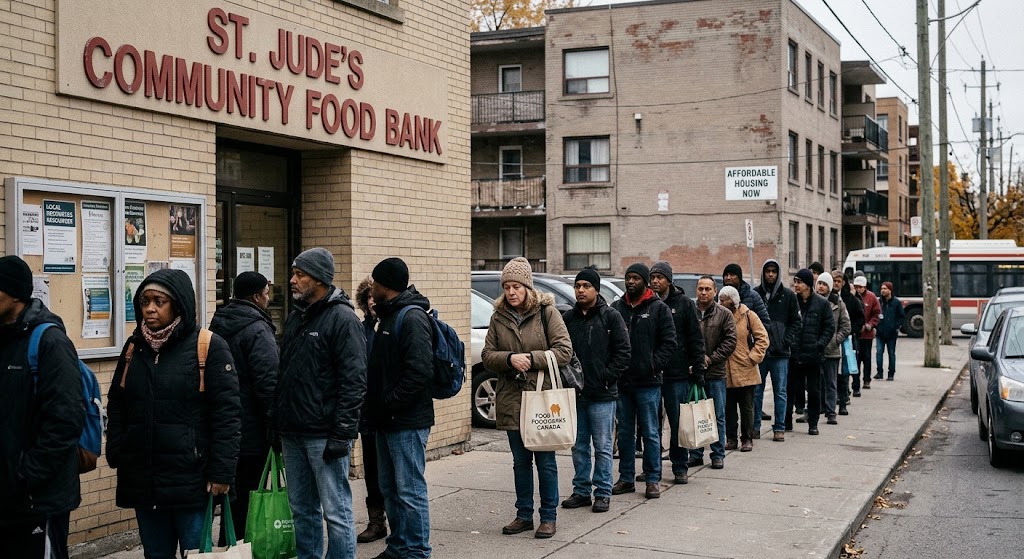
In March 2026, Canadians made 2.35 million visits to food banks. It was the highest monthly number ever recorded and more than double the level of March 2019. In Toronto, Daily Bread Food Bank and North York Harvest Food Bank reported 4.1 million client visits in the year before April 2025, an increase of 340 per cent since 2019. More than 112,000 people used a food bank for the first time in that year alone.
Across Canada, more than 65,000 people were counted as homeless on a single night in 2025. That was 59 per cent higher than in 2020 to 2022. In Toronto, an estimated 12,196 people were experiencing homelessness in October 2025, including 1,446 people staying outdoors.
At the same time, many Canadians say they feel less safe. They see homelessness, addiction, mental-health distress, theft, and sometimes violence in their neighbourhoods. Canada’s Crime Severity Index did fall by 5 per cent in 2025, but that statistic does not erase the fear people feel on a dark street, at a bus stop, or outside a shelter.
These numbers describe a country under strain. They describe people who cannot afford rent, food, medicine, or safety. They describe cities where emergency services have become part of everyday life.
This is not the Canada I imagined when I came here.
Canada meant opportunity, fairness, order, and a decent life for people who worked hard. Like many immigrants, I admired its public institutions and its reputation for looking after those who had fallen behind. I believed Canada was a place where a person who worked honestly could live with dignity.
That is why the news I keep hearing now troubles me so deeply.
Behind every food-bank visit is a person making an impossible choice between rent and groceries, between medication and food, between paying the heating bill and feeding the children. Behind every homeless count is someone without a stable place to sleep. Behind every conversation about crime is a community asking why basic needs have become so difficult to meet.
Hunger has changed its face
For a long time, many Canadians imagined food-bank users as homeless people living on the street. That image is no longer enough. Hunger has entered apartments, workplaces, university campuses, and family homes.
Nearly one in five food-bank clients in Canada is employed. Children account for about one-third of food-bank visits. These are people who wake up, go to work, study, care for their families, and still cannot make their incomes stretch far enough.
When I hear such numbers, I think of Nepal, where poverty has often been visible and where many families have learned to live with scarcity. Canada was supposed to be different.
I still believe that. But belief alone does not put food on the table.
A rich country with a growing problem
Some people ask how this can happen in one of the richest countries in the world. I think the better question is why a rich country has allowed hunger to become so ordinary.
Canada has always had poor people. What has changed is the scale of the problem and the willingness to treat it as normal. Food banks were meant to be emergency bridges. A person might need one after losing a job, after an illness, after a family breakdown, or after an unexpected expense. They were never meant to become a permanent part of life for millions of people.
Yet that is what is happening. When millions of visits become routine, the failure does not belong to charity. It belongs to public policy.
The reasons are not mysterious. Rents have risen faster than incomes. Grocery prices climbed after the pandemic, inflation, supply disruptions, and trade pressures. Many people work in low-paid or unstable jobs. Social assistance and disability benefits have not kept pace with the real cost of living. Newcomers, international students, refugees, single parents, seniors, and people with disabilities often face extra barriers.
COVID-19 did not create these weaknesses. It exposed them. Then it made them worse.
Charity deserves praise, but it cannot replace policy
Organizations such as Daily Bread, North York Harvest, and Second Harvest deserve enormous respect. They feed people, rescue surplus food, mobilize volunteers, and preserve dignity in difficult circumstances. Second Harvest reported distributing 95.3 million pounds of food through community organizations across Canada in its 2025 fiscal year.
The recent attack on Second Harvest’s food-rescue trucks showed both the cruelty and the decency present in our society. Thieves broke into the charity’s Etobicoke yard over Thanksgiving weekend, cut the catalytic converters from seven of its eight trucks, and left most of its fleet unable to deliver food.
Then something good happened. Aurora Foods, a Toronto family business, donated $60,000 to help repair the trucks. Community members also offered money, food, and even vehicles. That generosity deserves praise.
But it also raises an uncomfortable question. Why should a charity that rescues food for hungry people have to depend on emergency donations just to keep its trucks on the road?
We should admire volunteers, donors, and community organizations. We should also refuse to accept a society in which charity must constantly repair what public policy has failed to protect.
Foreign aid and our own people
Some people now say Canada should stop helping Ukraine or reduce foreign aid because Canadians at home are struggling. I understand the anger behind that feeling. When people here cannot afford food, it is natural to ask why resources are being spent elsewhere.
But I do not think the answer is to abandon Ukraine or retreat from the world. Canada can support Ukraine and also feed its own people. These are not either-or choices.
The real issue is different. Canada should not use international commitments as an excuse to neglect people at home. Nor should it use hardship at home as an excuse to abandon its responsibilities abroad.
A mature country can do both. It can defend democratic allies overseas and protect vulnerable people within its own borders. The question is whether our governments have the political will to treat poverty at home with the same urgency they show during foreign crises.
More police cannot solve hunger
There is another uncomfortable issue. Crime, homelessness, addiction, and mental-health crises are becoming more visible in our cities. Some people respond by demanding more police and harsher laws.
Police have a role, especially where there is violence, theft, or exploitation. But police cannot build affordable housing. They cannot raise wages. They cannot improve disability benefits. They cannot make groceries affordable.
Poverty does not automatically produce crime, and most poor people are not criminals. But prolonged desperation can push people toward dangerous situations. It can lead to exploitative work, informal economies, addiction, conflict, and despair.
If people cannot meet their basic needs through legitimate means, society becomes less safe for everyone. That is why slogans about being tough on crime are not enough. A country cannot arrest its way out of hunger, homelessness, or hopelessness.
Employment insurance is not enough
Recent changes to Employment Insurance may help some workers affected by tariffs and job losses. Since March 2025, eligible claimants have benefited from the removal of the usual one-week waiting period, flexibility around severance payments, and extended benefits for some long-tenured workers.
These measures may prevent an immediate income collapse for some families. But temporary measures are not the same as a durable income-security system.
Many people who face food insecurity are not covered by EI at all. They may be self-employed, working too few hours, new to Canada, between precarious jobs, or living on disability or social assistance. When rents and food prices rise, these people have little protection.
A country that patches emergencies one by one will always be reacting too late. It needs stronger foundations.
Not only Canada’s problem
This is not uniquely Canadian. After COVID-19, many wealthy countries have faced rising food insecurity, housing stress, and pressure on emergency services. The United States, the United Kingdom, and parts of Europe have seen similar debates about working people relying on food charities.
In poorer countries, the crisis may look different. Families may eat fewer meals, borrow more, migrate, or depend on informal work. But the underlying issue is similar. The pandemic, inflation, war, climate disruption, and unequal economic systems have made survival harder for people already living close to the edge.
Canada’s case is especially troubling because this country has the wealth, institutions, and public values to do better. When a rich country allows hunger to become ordinary, it faces not only an economic problem but a moral one.
What Canada must do
Canada needs more than sympathy, donation drives, and temporary programs. It needs policies that reduce the need for food banks in the first place.
We need genuinely affordable housing. We need income supports that reflect the real cost of living. We need accessible childcare, transit, and health care. We need protection for workers trapped in precarious employment. We need reforms that do not leave newcomers, students, and refugees in prolonged insecurity. And we need governments to treat food insecurity as an emergency, with clear targets and public accountability.
Food banks should be able to shrink, not grow. Their success should be measured not by how many people they feed, but by how many people no longer need them.
I still believe in Canada. I believe in its generosity, its institutions, and its capacity for fairness. But a country is judged not only by how it helps people far away. It is also judged by how it treats those who are hungry, homeless, and struggling within its own borders.
Food banks were meant to be a bridge. They must not become the destination.
