The RSP government has opened its tenure with speed, energy, and a clear effort to project competence. Its one-month progress report is packed with concrete measures, from telecom and postal reforms to digital service upgrades, cybersecurity steps, and administrative discipline tied to the 100-point governance roadmap. That is a promising start. But a promising start is not yet proof of lasting reform.
What stands out most in the report is its focus on visible, everyday services. Extending prepaid package validity, introducing choice in PAYG billing, improving data-usage alerts, advancing 5G readiness, expanding one-time KYC, and improving passport delivery are practical changes people can understand. In a political culture where governments are often accused of producing more slogans than results, that kind of specificity matters. It gives the administration something tangible to point to.
The report also suggests a government that understands that reform is not only about high-level announcements. Its emphasis on zero pending files, business process re-engineering, and better coordination across agencies shows some awareness that the machinery of government must be fixed if public service is to improve. That is a welcome sign. Administrative reform is often boring, but it is usually the difference between public frustration and public trust.
Still, one month is too short a period to treat these measures as full achievements. Many of the report’s items appear to be starts, not finishes. A policy can be introduced, a system can be launched, and a directive can be issued without yet producing durable institutional change. That distinction matters. Citizens do not ultimately judge governments by the number of announcements they make, but by whether those announcements improve the way the state actually works.
That is why the 100-point roadmap should be read as a test, not a trophy. Roadmaps are useful only if they can be translated into deadlines, measurable outcomes, and real accountability. The report shows movement, but movement is not the same as transformation. Some projects appear to be operational, while others are still at the stage of preparation or coordination. The real challenge is whether this initial momentum can survive beyond the first month.
There is also an important political dimension here. Every new government wants to create a story of competence early in its tenure. That is normal. But the more strongly a government advertises early success, the more closely it will later be judged on whether that success endures. Public trust is not built by momentum alone. It is built by consistency, follow-through, and visible results that ordinary people can feel.
So the fairest reading of the report is balanced. The RSP government has made a fast and visible start, and that should be acknowledged. But it has not yet proven that this start will become a sustained record of reform. The one-month report shows intention, direction, and energy. What it does not yet show is whether the government can turn those qualities into lasting change.
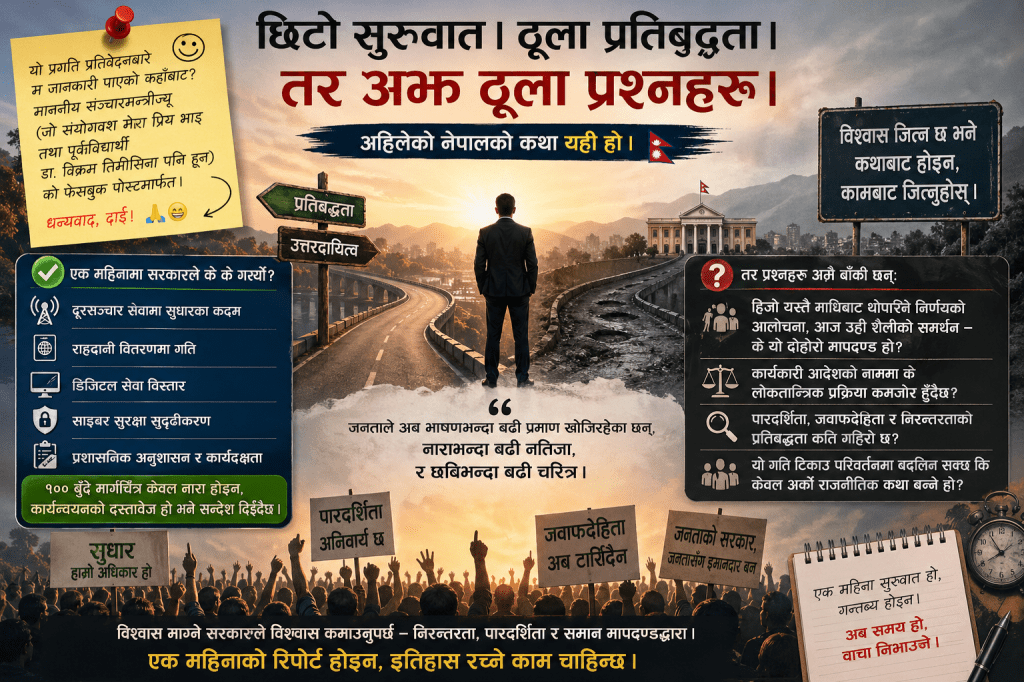
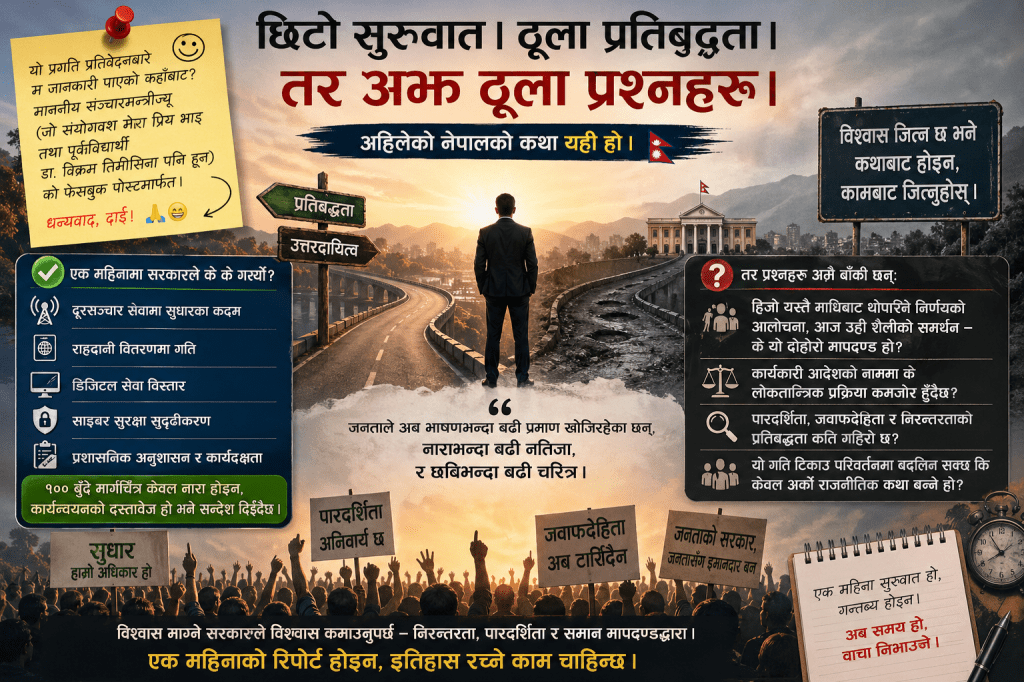
रास्वपा सरकारको एक महिनाको प्रगति प्रतिवेदनबारे मैले जानकारी पाउनु पनि कम रोचक थिएन—माननीय सञ्चारमन्त्रीज्यू (जो संयोगवश मेरा प्रिय भाइ तथा पूर्वविद्यार्थी डा. विक्रम तिमिल्सिना पनि हुन्) को फेसबुक पोस्टमार्फत। राजनीति बदलिएको छ कि सम्बन्धहरूले समाचार छिटो पुर्याउने तरिका मात्र बदलिएको हो, त्यो छुट्टै बहसको विषय रह्यो।
रास्वपा सरकारको एक महिनाको प्रगति प्रतिवेदनले स्पष्ट सन्देश दिएको छ—यो नयाँ सरकार छिटो काम गर्न चाहन्छ, परिणाम देखाउन चाहन्छ, र सुधारको राजनीतिक गति आफ्नो पक्षमा राख्न चाहन्छ। दूरसञ्चार सुधारदेखि राहदानी वितरण, डिजिटल सेवा विस्तार, साइबर सुरक्षा सुदृढीकरण र प्रशासनिक अनुशासनसम्मका उपलब्धिहरूले सरकार आफ्नो १०० बुँदे मार्गचित्र केवल नारामात्र होइन, कार्यान्वयनको दस्तावेज हो भन्ने प्रमाणित गर्न आतुर देखिन्छ। तर सबैभन्दा ठूलो प्रश्न सरकारले के घोषणा गर्यो भन्ने होइन—यी प्रारम्भिक कदमहरू साँच्चिकै दीर्घकालीन परिवर्तनमा रूपान्तरण हुन्छन् कि हुँदैनन् भन्ने हो।
यही बीचमा कार्यकारी आदेशहरूको बहसलाई नजरअन्दाज गर्न मिल्दैन। जनताले बिर्सेका छैनन्—आज सत्तामा रहेका धेरै नेताहरूले हिजो यस्तै माथिबाट थोपारिने निर्णयहरूको सामाजिक सञ्जालमा खुलेर आलोचना गरेका थिए। तर आज उही शैलीलाई ‘तात्कालिकता’ र ‘सुधार’को नाममा उचित ठहर्याइँदैछ। यहीँबाट वास्तविक राजनीतिक परीक्षा सुरु हुन्छ—सरकार कति छिटो निर्णय गर्छ भन्ने मात्र होइन, उसले हिजो अरूबाट मागेका लोकतान्त्रिक मूल्य, पारदर्शिता र सिद्धान्तप्रति आज आफैं कति इमानदार रहन्छ भन्ने प्रश्न अझ गम्भीर बन्छ।
प्रारम्भिक प्रगति स्वागतयोग्य छ। तर उत्तरदायित्व त्यत्तिकै अपरिहार्य छ। जनताको विश्वास माग्ने सरकारले त्यो विश्वास निरन्तरता, पारदर्शिता, आत्मअनुशासन र समान मापदण्डद्वारा कमाउनुपर्छ। विपक्षमा हुँदा जुन नैतिकता र जवाफदेहिताको पाठ पढाइन्थ्यो, सत्तामा पुगेपछि त्यसैलाई व्यवहारमा उतार्न सकिएन भने परिवर्तनको भाषण केवल अर्को राजनीतिक कथामात्र बन्न सक्छ।
यो सरकारको भविष्य केवल एक महिनाको प्रतिवेदनले तय गर्ने छैन—यसले ती वाचाहरूलाई वास्तविक उपलब्धिमा बदल्न सक्छ कि सक्दैन, त्यसैले निर्धारण गर्नेछ। जनताले अब भाषणभन्दा बढी प्रमाण खोजिरहेका छन्, नाराभन्दा बढी नतिजा, र छविभन्दा बढी चरित्र।
छिटो सुरुवात। ठूला प्रतिबद्धता। तर अझ ठूला प्रश्नहरू।
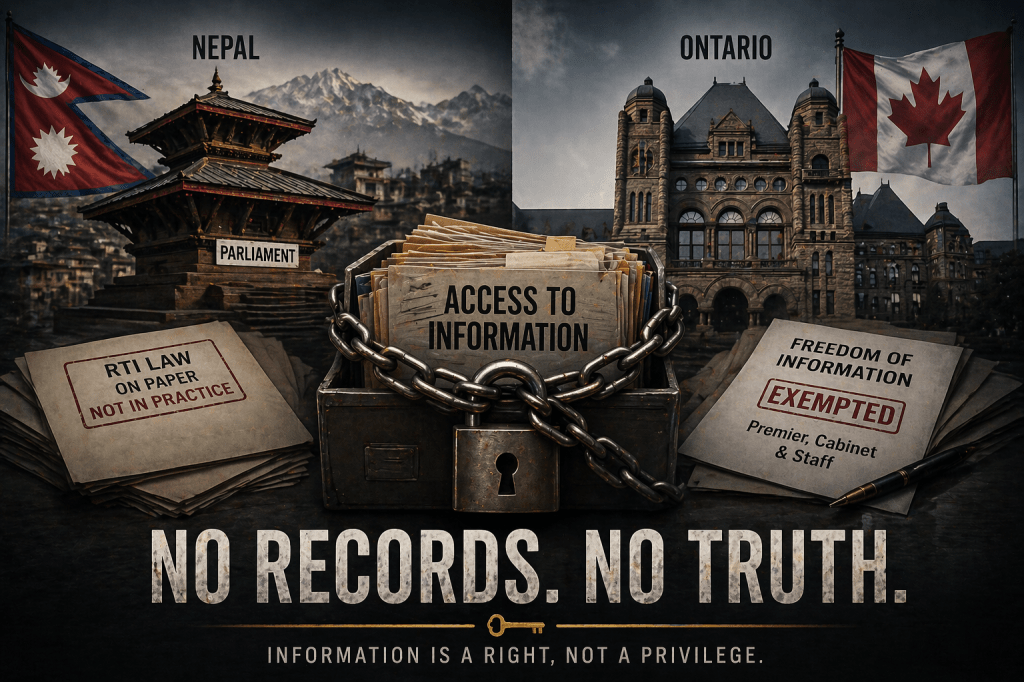
In Ontario, Canada, the Doug Ford government just passed changes to freedom of information laws. These changes exempt the premier, cabinet ministers, and their staff from disclosing emails, texts, and other records related to public business. Across the world in Nepal, the Right to Information Act of 2007 exists on paper. But it routinely fails when citizens seek records about political corruption, elite wealth, or government spending. These are not isolated incidents. They represent a global pattern. Governments promise reform while quietly making it harder for citizens to verify those promises.
The parallel is striking. Ontario’s changes came after court rulings demanded access to the premier’s phone records in connection with the Greenbelt scandal. Nepal’s RTI system has existed for nearly two decades. Yet political offices consistently delay, redact, or deny requests about ministers’ assets, public procurement, or the implementation of reform roadmaps. In both cases, ordinary government agencies must disclose information. But the political leadership creates exemptions for itself.
This is not about partisan politics. It is about a fundamental principle of democratic accountability. Citizens have a right to know how decisions affecting their lives were made. Freedom of information laws exist precisely because governments cannot be trusted to tell their own stories accurately. When leaders exempt themselves from these laws, they are saying their work is too sensitive for public eyes. The public is left to accept official narratives without the records to test them against reality.
In Nepal, the stakes are particularly high. The new government’s 100‑point reform roadmap promises anti‑corruption measures, faster service delivery, and transparent governance. But without strong RTI enforcement, citizens have no way to verify whether these are real commitments or political theatre. Journalists requested details about ministers’ recently declared gold holdings and property. What did they receive? Delays, partial disclosures, or outright denials. The same pattern repeats with questions about arrests of former leaders, implementation of the roadmap, or the budget allocations for promised reforms.
Ontario offers a cautionary tale. The FOI changes there were framed as modernization for the digital age. Yet critics, including the province’s privacy commissioner, warned they would make government less transparent than even some authoritarian states. The timing also mattered. The changes came after court losses over access to political records. That timing suggested a deeper motive. Leaders wanted to shield decision‑making from scrutiny.
Both situations reveal the same structural flaw. Democratic governments often weaken the very mechanisms designed to hold them accountable. Nepal’s RTI Commission exists but lacks teeth. Ontario’s Information and Privacy Commissioner can complain but cannot compel disclosure from the political elite. The result is predictable. Leaders control the flow of information while citizens struggle to separate fact from spin.
This matters most for Nepal because the new government came to power promising to break decades of corrupt governance. The public wants to believe in that promise. But belief without verification becomes blind faith. When citizens cannot access records showing how ministers accumulated their wealth, whether arrests followed due process, or if the 100‑point roadmap hasconcrete timelines and budgets, skepticism grows. Transparency is not a luxury. It is the foundation of trust.
The solution is straightforward but politically difficult. Nepal should strengthen its RTI law. It should mandate timelines for political office responses, create real penalties for non‑compliance, and give the National Information Commission power to compel disclosure. Ontario should reverse its exemptions and recommit to the principle that no public official is above public scrutiny.
Around the world, democracies face this same test. When governments limit access to information, they limit the public’s ability to govern itself. Nepal and Ontario show that the problem transcends borders, political systems, and cultures. The right to know is universal because the need to hold power accountable is universal.
Leaders promising reform should welcome scrutiny, not evade it. Citizens demanding accountability should insist on records, not just rhetoric. When governments exempt themselves from transparency laws, they are not modernizing democracy. They are undermining it.
Recent discussions about Canada’s slowing, and in some cases declining, population are more than just statistics. They reflect a deeper shift in immigration policy, economic pressure, and the consequences of rapid population growth over the past few years. For prospective international students and foreign workers, especially from countries like Nepal, India, and others, this changing reality demands serious reflection.
After listening to Ron Butler on the Angry Mortgage Podcast on March 20, 2026, one thing becomes clear. A system built on rapid expansion, aggressive recruitment, and unrealistic promises is now being forced to correct itself. When such systems correct, it is often the most vulnerable, young international students, who pay the price.
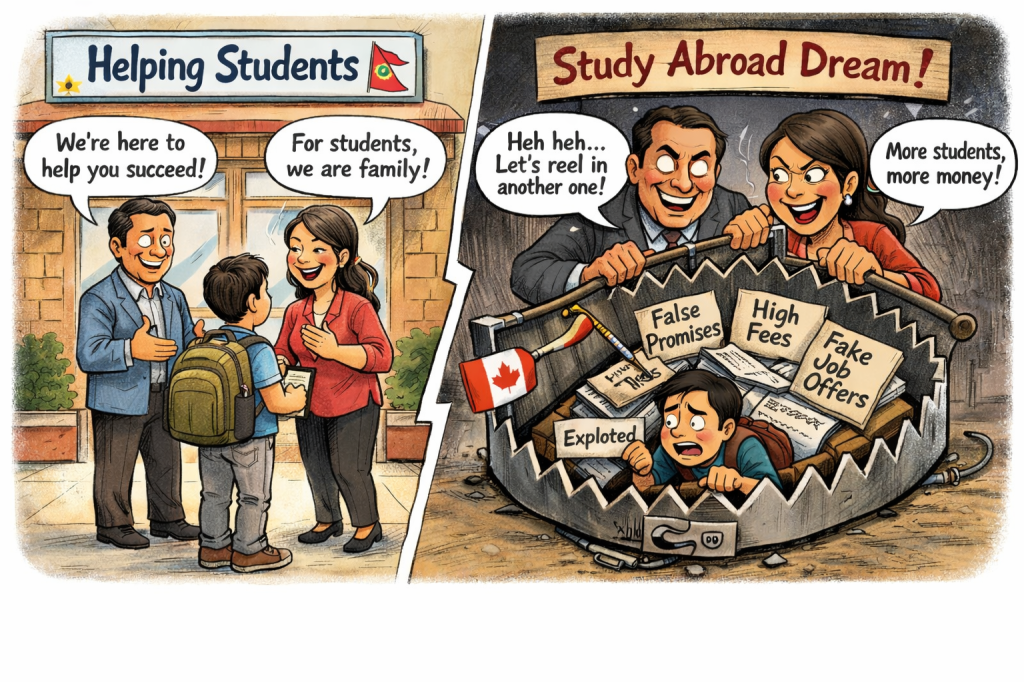
For many young people, the journey begins right after high school. They come to Canada as students, but for many, education is not the primary goal. The real objective is often permanent residency or citizenship. There is nothing inherently wrong with that aspiration. The problem begins when that dream is sold through misinformation, consultants, and brokers who promise easy pathways that no longer exist.
What often goes unspoken are the consequences of believing these promises. As Dr. Punya Sagar Marahatta has consistently warned through his awareness posts—such as his writings on “Diploma Mills” and his recent reflections on March 29—many students arrive with expectations shaped by consultants, only to encounter a completely different reality. Instead of stable work and a clear path forward, they face financial pressure, isolation, and deep uncertainty. In some cases, this leads to serious mental health struggles. There have been tragic incidents, including the recent death of a student in the Niagara region, along with several similar cases in the past. Others have experienced homelessness or have been forced to return home after exhausting their resources. These are not isolated stories but part of a broader pattern that demands urgent attention. Efforts to regulate and monitor consultancies, both in Nepal and abroad, are not just policy discussions—they are a necessary step to prevent further harm to vulnerable students. I say this not as an outsider, but from personal experience.
I say this not as an outsider, but from personal experience.
I came to the United States for my PhD on a teaching assistantship. I prepared for TOEFL and GRE, applied directly to universities, contacted departments and professors, and secured funding. Because I was funded, my focus was entirely on study. That is what studying abroad is supposed to look like.
In early 2010, my journey toward Canadian permanent residence began. At the time, an acquaintance of mine had repeatedly failed to obtain a U.S. visa. In his search for alternatives, he discovered Canada’s high-skilled immigration program, which allowed him to apply for permanent residence for himself and his family. He saw this as a pathway for his family to settle in Canada, with the added advantage of making future travel to the United States easier. Inspired by his approach, I followed his steps, even though my own family was living in the U.S. at the time. The job prospects there were uncertain, and as my dependent, my wife was unable to attend school or work. I applied under the same high-skilled category. However, Canada later decided to eliminate that immigration category. Fortunately, because we had submitted our application before the rule change, our case was still considered. The process took a long time, but finally, we landed in Toronto in April 2013.
Since then, my life has been defined by movement.
While I was based in Texas, I would come to Toronto only during semester breaks. Later, after securing my position at Syracuse University, I found myself about a four-hour drive from Toronto, making frequent weekend trips to stay connected with my family. This back-and-forth life was not ideal, but it was a conscious choice shaped by both professional commitment and family responsibility.
After graduating from the University of Texas, I joined Centennial College as a contract professor in January 2014. In July 2015, I received a job offer from Syracuse University and continued working in both places for some time.
Many people asked me why I did not simply stay in Canada with my family instead of commuting so frequently between the US and Canada.
The answer was simple. It was not that full-time positions at community colleges were hard to obtain at the time. In fact, I could likely have secured a full-time role at Centennial within two or three years. My decision, therefore, was about the kind of academic career I wanted. I chose to remain connected to a top-tier university environment like Syracuse University, where I could focus on research, intellectual growth, and long-term academic development.
Today, with the recent decline in international student numbers, my contract teaching at Centennial is no longer there. Looking back, I feel that decision was the right one.
This is exactly the reality many students are not told.
Over the past few years, a troubling ecosystem has developed around low-tier private and community colleges. Consultants, mostly based in home countries, have been selling a dream. Study well, get a good job, secure PR, build a future. Families take loans, sell land, and invest everything. But what many students encounter instead is a harsh reality. High living costs, unstable work, and an education that often takes a back seat to survival.
If a student is truly committed to education, there is a better path.
Studying abroad in countries like Canada or the United States can be transformative, but it makes the most sense at the graduate level, especially with scholarships, teaching assistantships, or research assistantships. Funded students have the time and stability to focus on learning. In contrast, those who arrive after paying large sums to private colleges often find themselves forced to prioritize work over study.
More importantly, pursuing graduate study does not require paying consultants. Students can apply directly through university websites, meet admission requirements, and contact faculty members themselves. This route is transparent, merit-based, and far more reliable than depending on intermediaries.
This is not an argument against immigration. Canada has long benefited from newcomers, and a well-managed system remains essential. But as Ron Butler also suggests, the recent model driven by volume rather than capacity has reached its limits.
To students and families, Do not confuse marketing with reality. Do not confuse shortcuts with opportunity.
Studying abroad can still be a powerful and life-changing experience, but only when it is approached with clarity, preparation, and realistic expectations.
Otherwise, what is sold as a dream may turn into a very expensive lesson.