A Reflection on Rabi Lamichhane’s Hindustan Times Article

Dr. Rajendra K Panthee
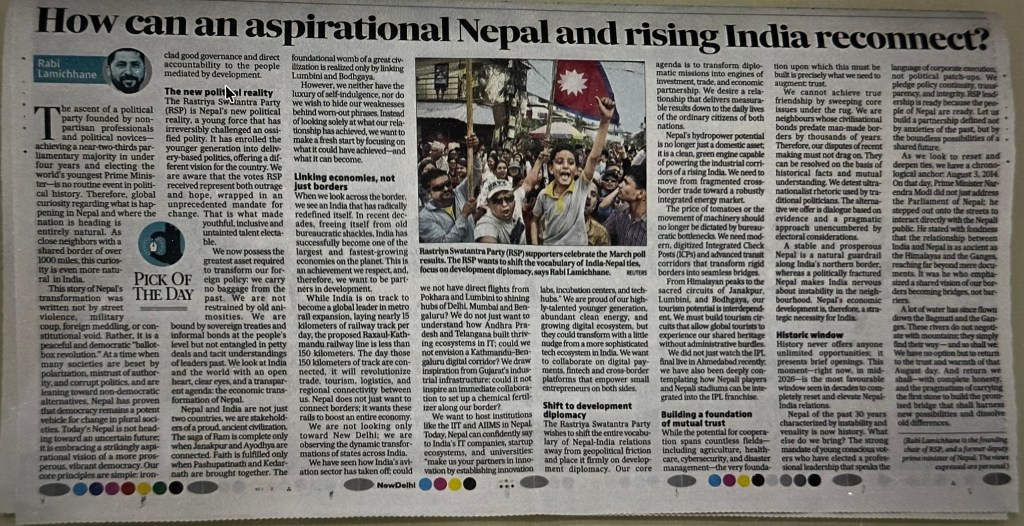
I started reading Rabi Lamichhane’s article “How can an aspirational Nepal and rising India reconnect?” in Hindustan Times and felt compelled to share some thoughts on how we remember Nepal’s recent political transformation.

The article frames Nepal’s transformation as a “peaceful ballot-box revolution” focused on development and aspirational vision. However, the historical record shows that the 2026 election was called because of the September 2025 Gen Z protests, which resulted in:

  • 19 people killed when police opened fire on protesters
  • Over 300 injured with tear gas, rubber bullets, and live ammunition
  • Parliament building damaged during the protests
  • $21 billion in damage — half of Nepal’s annual GDP
  • School kids in uniforms brought to the streets

More than 800,000 new voters registered—two-thirds of them Gen Z. The movement wasn’t about RSP specifically; it was about accountability, anti-corruption, and demanding a political system that serves ordinary citizens. The 2/3 RSP majority we see today is a direct result of this Gen Z movement.

When the article describes this as a “peaceful ballot-box revolution,” it risks erasing the young people who died to make this election possible. The families of the martyrs deserve to be acknowledged in any narrative about Nepal’s transformation.

On border relations, the article’s call to “resolve disputes through dialogue” is constructive, especially after PM Balen’s recent parliamentary remarks on border encroachment sparked debate. What would strengthen Nepal-India ties is not just aspirational vision but transparent governance, accountability for all parties, and respect for democratic institutions.

The warm reception Rabi received in India reflects genuine interest in Nepal-India cooperation, which should be welcomed. However, for that cooperation to be sustainable, both countries need leaders who balance diplomatic engagement with domestic accountability.

When RSP’s 2/3 majority enables governance, it also brings responsibility to ensure that power serves all citizens, not just party interests. True reconnection between Nepal and India will come not from rewriting history, but from building relationships grounded in mutual respect, transparency, and honoring the Gen Z generation whose uprising made this new political moment possible.

We should all remember: accountability today strengthens democracy tomorrow.
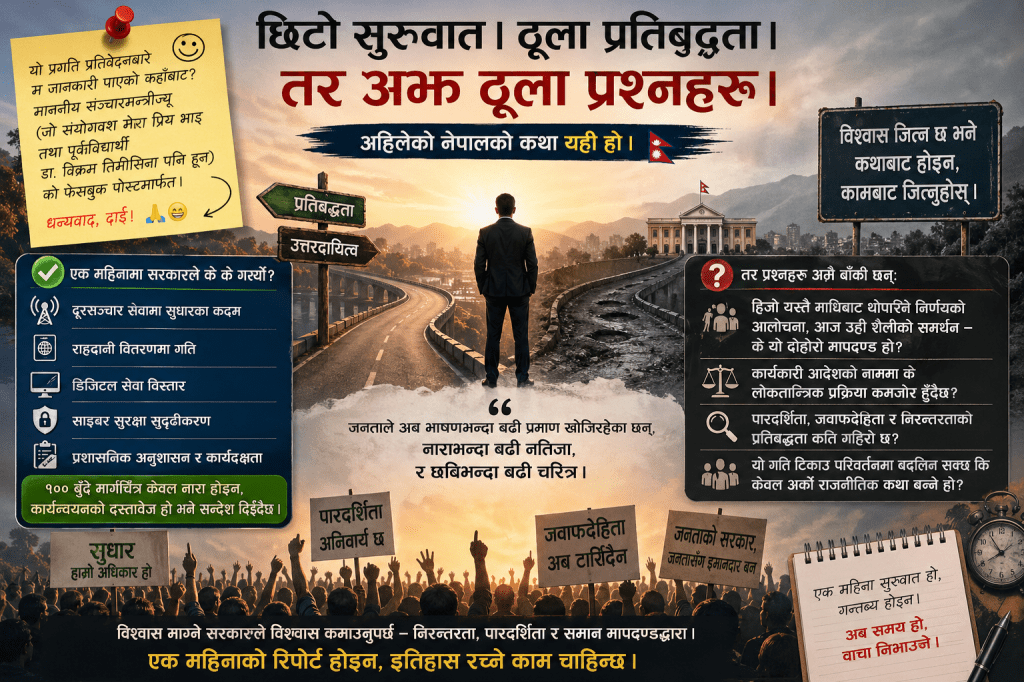
RSP’s First Month: Visible Action, But the Real Test is Still Ahead

Dr. Rajendra K Panthee

The RSP government has opened its tenure with speed, energy, and a clear effort to project competence. Its one-month progress report is packed with concrete measures, from telecom and postal reforms to digital service upgrades, cybersecurity steps, and administrative discipline tied to the 100-point governance roadmap. That is a promising start. But a promising start is not yet proof of lasting reform.

What stands out most in the report is its focus on visible, everyday services. Extending prepaid package validity, introducing choice in PAYG billing, improving data-usage alerts, advancing 5G readiness, expanding one-time KYC, and improving passport delivery are practical changes people can understand. In a political culture where governments are often accused of producing more slogans than results, that kind of specificity matters. It gives the administration something tangible to point to.

The report also suggests a government that understands that reform is not only about high-level announcements. Its emphasis on zero pending files, business process re-engineering, and better coordination across agencies shows some awareness that the machinery of government must be fixed if public service is to improve. That is a welcome sign. Administrative reform is often boring, but it is usually the difference between public frustration and public trust.

Still, one month is too short a period to treat these measures as full achievements. Many of the report’s items appear to be starts, not finishes. A policy can be introduced, a system can be launched, and a directive can be issued without yet producing durable institutional change. That distinction matters. Citizens do not ultimately judge governments by the number of announcements they make, but by whether those announcements improve the way the state actually works.

That is why the 100-point roadmap should be read as a test, not a trophy. Roadmaps are useful only if they can be translated into deadlines, measurable outcomes, and real accountability. The report shows movement, but movement is not the same as transformation. Some projects appear to be operational, while others are still at the stage of preparation or coordination. The real challenge is whether this initial momentum can survive beyond the first month.

There is also an important political dimension here. Every new government wants to create a story of competence early in its tenure. That is normal. But the more strongly a government advertises early success, the more closely it will later be judged on whether that success endures. Public trust is not built by momentum alone. It is built by consistency, follow-through, and visible results that ordinary people can feel.

So the fairest reading of the report is balanced. The RSP government has made a fast and visible start, and that should be acknowledged. But it has not yet proven that this start will become a sustained record of reform. The one-month report shows intention, direction, and energy. What it does not yet show is whether the government can turn those qualities into lasting change.