When Our Distress Becomes Someone Else’s Investment

Dr. Rajendra K Panthee

A group from Montreal is about to spend $500 million buying up unsold condos across the GTA—often at about half the original presale price. These are the very projects that many of our people walked away from after pouring in hard‑earned savings, assignment fees, and years of waiting. Now, the same “problem” that broke individual buyers’ backs is being treated as a “golden opportunity” for big investors.

For months, we watched neighbours cancel assignments, forfeit deposits, and quietly admit defeat. Some families had to choose between sinking more money into overpriced units or walking away with nothing. Many chose the latter—not because they didn’t want to own, but because the market turned against them. Yet, when ordinary people retreat, institutions step in with deep pockets, buying in bulk at deep discounts.

This is not just a real‑estate story. It’s a story about who bears the risk and who reaps the reward. When the market booms, the fantasy is sold to small investors, diaspora families, and first‑time buyers. When the bubble cools, those same buyers are left holding the losses, while corporations quietly acquire entire buildings as “value plays.” Our fear, our stress, our sacrificed savings become their balance‑sheet assets.

What’s even more troubling is what this signals for the future. Those who can buy at half‑price today will likely rent the units back to us at market‑rate or higher tomorrow. Instead of a market correction that brings affordability, we may simply get a transfer of power—from overstretched buyers to consolidated landlords. Public policy and housing regulations have done little to intercept this process. Housing is being treated as a financial instrument, not as a basic human need.

For our community, this moment should be a wake‑up call. We need to stop seeing every presale project as a guaranteed “investment” and start asking: Who really benefits when we are forced to walk away? We need to push for policies that protect small buyers, cap speculative land banking, and ensure that when the market crashes, ordinary people are not left alone to pay the price.

This is not just about losing money in a condo deal. It’s about who controls housing, who gets bailed out, and who gets erased from the story. If we don’t speak up now, our pain today will be written off as “market correction” in textbooks—while the profits quietly go to those who knew exactly when to buy at the bottom.

Home Purchase Failures in Ontario Are Up 500% — What Our Community Needs to Know?

Dr. Rajendra Panthee

I recently watched a podcast by mortgage expert Ron Butler discussing a troubling trend in Ontario’s real estate market: home purchase failures have increased by 500% compared to pre-COVID levels.

That number should make all of us pause.

What Is a “Purchase Failure”?

A purchase failure happens when a buyer signs a contract to buy a home — new construction or resale — but cannot close the deal on the agreed closing date.

In simple terms:
The buyer doesn’t have the money or cannot secure the mortgage needed to complete the purchase.

Before COVID, less than 1% of purchases failed. Today, that number is reportedly around 5% — and in new construction, some estimate it could be much higher.

Why Are Deals Falling Apart?

There are several major reasons:

1. Appraisal Problems (Especially New Construction)

Many buyers purchased pre-construction homes or condos in 2021–2022 at peak prices. Now that projects are completing:

  • Market values have dropped.
  • Appraisals are coming in far below the original purchase price.
  • Buyers must cover the difference in cash.

If you bought at $1.95M and the appraisal comes in at $1.525M, that’s a $400,000 gap you must cover. Many simply can’t.

2. Condo Market Reality

Some buyers purchased condos years ago at inflated prices, expecting appreciation or easy rental income. Today:

  • Comparable units are selling for less.
  • Higher interest rates mean negative monthly cash flow.
  • Rental income often doesn’t cover mortgage payments.

Some buyers are choosing to walk away from large deposits rather than close on a losing investment.

3. Mortgage Qualification Issues

In resale markets, failures are happening because:

  • Buyers couldn’t sell their existing home for the expected price.
  • Income was overstated or improperly assessed.
  • Job losses occurred before closing.
  • Buyers assumed pre-approvals guaranteed final approval (they don’t).

As Ron Butler bluntly stated: “The buyer doesn’t have the money.”

Why This Matters to Our Community

This is not about panic. It’s about awareness.

When purchase failures rise:

  • Sellers face uncertainty.
  • Builders face stress.
  • Buyers risk losing deposits.
  • Legal disputes increase.
  • Financing becomes stricter.

We are entering a market where leverage cuts both ways.

For years, rising prices hid risk. Today, falling values expose it.

If You’re Buying or Investing, Be Careful

Before signing anything:

  • Get a fully verified mortgage approval (not just a quick pre-qual).
  • Be conservative with projected sale prices.
  • Stress-test your finances at higher interest rates.
  • Understand appraisal risk.
  • Have liquidity reserves.
  • Read pre-construction contracts very carefully.

Speculation worked in a rising market. It is dangerous in a correcting one.

Final Thought

Real estate is not guaranteed to go up. It never was.

The goal is not to scare anyone — but to make sure our community members are informed. The people who survive market corrections are not the boldest. They are the most disciplined.

If you’re planning to buy, sell, or close on a property soon, now is the time to review your numbers carefully.

Awareness today can prevent disaster tomorrow.

Toronto’s Condo Market Isn’t Slowing — It’s Crashing

Dr. Rajendra Panthee

Toronto’s condo market is not experiencing a normal downturn. It’s going through a structural breakdown.

According to Urbanation data, by 2029 Toronto could see virtually no new condo completions. That sounds impossible in one of North America’s fastest-growing regions—but the numbers don’t lie. New condo sales in the GTA have collapsed to their lowest levels since 1991, despite today’s population and housing demand being dramatically higher.

This collapse isn’t random. It’s the failure of the investor-driven condo model.

For over a decade, most pre-construction condos weren’t built for families or end-users. They were built for investors. The model was simple: buy pre-construction, wait a few years, prices rise, rent it or flip it. That model only worked in a world of cheap money, rising prices, and investor optimism. That world is gone.

High interest rates, falling prices, and weaker rents have destroyed the economics of pre-construction investing. As investor demand disappears, the entire development pipeline shuts down.

And here’s the key reality:
Pre-construction sales drive future construction.
When sales collapse, housing starts collapse.
When housing starts collapse, future supply disappears.

This is already happening across the GTA, with housing starts far below long-term averages. Even if demand returns tomorrow, supply cannot restart quickly—condo development is a multi-year process. Today’s sales collapse becomes tomorrow’s supply crisis.

This isn’t primarily about government taxes or red tape. Housing starts are falling across North America. This is a housing cycle problem, amplified in Toronto because the city became deeply dependent on speculative investor demand.

The economic impact will go far beyond housing. Construction jobs, trades, suppliers, engineers, and entire supply chains are affected. Housing doesn’t just reflect the economy — it drives it.

But this doesn’t mean prices will automatically surge in a few years. Future outcomes depend on uncertain factors: population growth, immigration, interest rates, economic conditions, and income growth. Anyone selling a simple “supply crash = guaranteed boom” story is oversimplifying reality.

The truth is simpler and more honest:

Toronto’s condo market has hit a breaking point.
The investor model no longer works.
The supply pipeline is shrinking.
And the housing system is entering a painful but necessary reset.

What comes next won’t be shaped by hype —
it will be shaped by fundamentals, policy, and economic reality.

Who Broke Canada’s Housing Market: Government or the Market?

Dr. Rajendra Panthee

Canada’s housing crisis is often discussed in absolutes: either prices will crash, or they will never fall; either governments must intervene more, or get out of the way entirely. But when we place recent market conditions alongside deeper structural critiques—like those raised on Angry Mortgage—a more complicated, and more honest, picture emerges.

A Short-Term Opening for Buyers

In the near term, there is a meaningful shift underway—particularly in markets like Toronto and Vancouver.

Sales volumes are historically low. Investor activity has largely evaporated. Pre-construction is stalled. Buyers who remain are mostly end users: families and individuals looking for a place to live, not to flip. This has quietly shifted leverage. Selection has improved. Negotiation is back. Sellers, not buyers, are adjusting expectations.

This does not mean we are at the “bottom,” nor does it mean prices cannot fall further. But for financially stable households—especially first-time buyers who were entirely shut out between 2020 and 2022—this is the most buyer-friendly environment in years.

Yet this short-term opening exists inside a housing system that remains fundamentally broken.

The Structural Problem: Housing as a Government Revenue Tool

As Ben Woodfinden argued on Angry Mortgage, the most under-discussed driver of unaffordability is not speculation alone, immigration alone, or even interest rates—but government cost-loading on new housing.

In cities like Toronto, as much as 30% of the cost of a new home is made up of development charges, fees, taxes, and levies. These are not marginal costs. They are embedded into the price of every unit, passed directly to buyers, and treated as a normal feature of governance.

Housing, in effect, has been taxed like a luxury good—while being rhetorically framed as a human necessity.

Layered on top is what Woodfinden calls the “Anglo disease”: a regulatory culture that makes building slow, adversarial, and legally dense. Years of approvals, consultant reports, appeals, and political veto points create scarcity by design. The result is not careful planning—it is paralysis.

This is how Canada ends up with 50-storey towers beside single-family zoning, and almost nothing in between.

The Missing Middle—and the Missing Social Contract

What ties these discussions together is not just economics, but expectations.

A generation of Canadians did what the social contract asked of them: education, work, saving, delayed gratification. Yet homeownership now requires top-1–2% household incomes in major cities. The promise that effort leads to stability has quietly collapsed.

That anger is not theoretical. It shows up in delayed families, longer commutes, overcrowding, and a growing sense that democracy responds faster to asset holders than to workers.

When young professionals earning $90,000–$100,000 cannot even imagine owning a modest home, something deeper than market cycles has failed.

So Where Does This Leave Us?

In the short run, today’s market offers cautious opportunity for buyers who are purchasing shelter, not status.

In the long run, affordability will not be restored without structural change:

  • Development charges must be rethought.
  • Zoning must allow mid-density housing where people already live.
  • Speed, not symbolism, must become the metric of housing policy.

More programs alone will not fix this. Nor will pretending the market can self-correct under the current regulatory load.

A Critical Outlook

Canada’s housing crisis is not caused by a single villain. It is the outcome of decades of policy choices that treated housing simultaneously as an investment vehicle, a revenue source, and a political risk to be avoided.

Buyers may find a window today—but unless governments stop profiting from scarcity while promising affordability, that window will close again.

The question is no longer whether housing is broken.
It is whether we are willing to stop pretending we don’t know why.

Home Sales Collapse: Why Toronto and Vancouver Hit Historic Lows—and What 2026 Really Looks Like

I listened to today’s episode of Ron Butler’s Angry Mortgage Podcast, and the numbers he shared were not just bad—they were historic.

By the end of 2025, Canada’s two largest housing markets collapsed in terms of sales activity:

  • Vancouver recorded its lowest home sales in 20 years
  • Toronto (GTA) fell to a 25-year low

These aren’t just market fluctuations. They’re signals of a structural shift that many people—buyers, sellers, and real estate professionals alike—are still struggling to accept.

So, what went wrong?

According to Butler, the biggest reason is simple but uncomfortable:
entire categories of buyers have vanished.

During the peak years (especially around 2021), as much as 40–45% of purchases in the GTA were investor-driven—landlords, flippers, speculators, short-term rental buyers. That group is now gone. Completely.

Buying a condo to rent?
Buying a house as an “investment”?
Those strategies no longer make financial sense in today’s environment.

And once that investor demand disappeared, the market lost nearly half of its fuel.

Prices fell—but that didn’t bring confidence back

Home prices in the GTA are now down roughly 25% from the March 2022 peak. But instead of encouraging activity, this decline has created paralysis.

Many potential sellers are stuck:

  • Selling now wouldn’t give them enough equity for their next purchase
  • After commissions and costs, moving simply doesn’t add up
  • Others fear selling today only to realize prices fall further tomorrow

As Butler puts it, why buy now if you believe you can buy the same house for $50K, $100K—or even $200K less next year?

Who’s left in the market?

At this point, Butler argues there’s really only one group left that might sustain activity:
first-time home buyers.

They don’t need to sell a home first.
They aren’t worried about losing equity.
They’re looking for stability, schools, permanence—a place to call home.

But even they are hesitant.

Job uncertainty, economic unease, global instability, and constant “wait-and-see” messaging have made this a sentiment-driven freeze. Housing isn’t just numbers—it’s emotion. And right now, the emotion is caution.

Will foreign buyers save the market?

Short answer: no.

Even if restrictions ease, Butler notes that any reopening would likely apply only to new construction, not resale homes. That does little for today’s stalled market and won’t reverse the broader trend.

What about 2026?

Ron Butler is blunt:

  • Prices are still coming down
  • Don’t believe anyone who says the bottom is already here
  • If someone tells you “buy now or miss out,” his advice is simple: just say no

Eventually, affordability will improve enough that buyers step back in. But that doesn’t mean a quick rebound or a return to pandemic-era highs.

The bigger takeaway

This isn’t a crash fueled by panic.
It’s a slowdown driven by reality.

The era of speculative excess is over—at least for now. What remains is a slow, difficult recalibration where housing slowly reconnects with wages, stability, and actual human needs.

For buyers, patience matters.
For sellers, expectations matter.
And for anyone promising a sudden turnaround—it’s worth listening carefully to voices like Ron Butler before believing the hype.

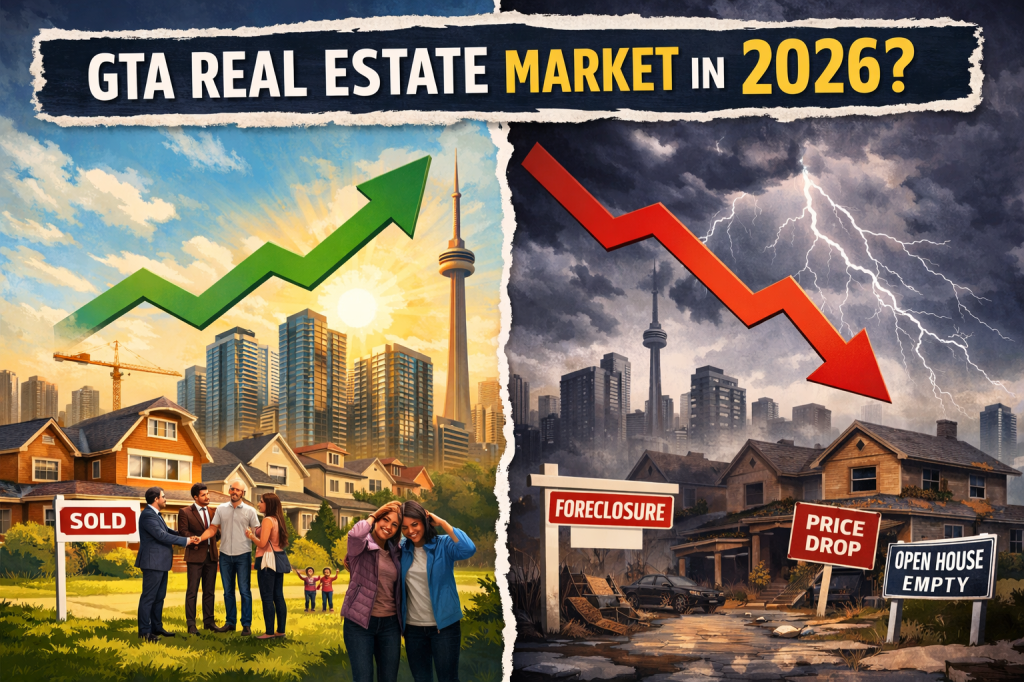
What 2026 Might Look Like for GTA Real Estate: Less Noise, More Reality

For the past few years, talking about real estate in Ontario—especially in the Greater Toronto Area—has felt like walking through a hall of mirrors. Prices up, prices down. Rates rising, rates cutting. Realtors shouting optimism, buyers frozen in fear, sellers clinging to yesterday’s peak.

As we step into 2026, one thing feels different:
the noise is slowly fading, and reality is returning.

This is not a prediction of a boom.
It is not a warning of a crash.
It is something rarer—and healthier.

A Market That Is Finally Catching Its Breath

After years of extreme swings, the GTA market appears to be moving toward normalization.

  • Prices have already corrected from their 2021–2022 peaks
  • Speculative frenzy has largely disappeared
  • Buyers are no longer rushing blindly
  • Sellers are being forced to price realistically

This doesn’t mean homes are suddenly affordable for everyone. But it does mean the market is less emotional, less inflated, and less detached from income realities than it was a few years ago.

That alone is progress.

Interest Rates: Not Cheap, But Predictable

One of the biggest changes heading into 2026 is not ultra-low interest rates—it’s stability.

For the first time in years, buyers can plan without fearing sudden shocks. Mortgage rates may fluctuate slightly, but the era of constant surprises appears to be behind us. That predictability matters more than people realize.

Real estate markets don’t need cheap money to function.
They need certainty.

With rates no longer rising aggressively, more end-users—not speculators—are slowly re-entering the market.

Buyers Are Wiser Than Before

2026 buyers are not the buyers of 2021.

They:

  • Ask questions
  • Compare neighborhoods
  • Negotiate
  • Walk away when numbers don’t make sense

This is a quiet but powerful shift. A market led by informed buyers is healthier than one driven by fear of missing out.

First-time buyers, in particular, may find 2026 less hostile—not easy, but less punishing—especially in condo and townhouse segments where inventory remains higher.

Sellers Will Need to Accept a New Reality

The hardest adjustment in 2026 may not be for buyers—it may be for sellers.

Many homeowners are still emotionally attached to peak-era prices. But the market no longer rewards hope; it rewards pricing aligned with today’s conditions.

Homes that are:

  • Well-priced
  • Well-maintained
  • Realistically marketed

will sell.

Others will sit.

This isn’t a crisis—it’s a correction in expectations.

Investors: A Different Game Now

For investors, 2026 is not about quick appreciation. The math is tighter, margins are thinner, and holding costs matter more than ever.

This is not necessarily bad. It filters out reckless speculation and favors:

  • Long-term thinking
  • Ethical rental practices
  • Cash-flow realism

Housing should not function only as a trading asset. A calmer investment environment ultimately benefits tenants, buyers, and communities.

What 2026 Really Represents

More than anything, 2026 looks like a reset year.

Not a return to the past.
Not a dramatic collapse.
But a slow rebuilding of trust between prices, incomes, and reality.

The GTA market doesn’t need excitement.
It needs honesty.

And for the first time in a long while, honesty may be creeping back in.

A Final Thought

Real estate cycles punish excess and reward patience. The last cycle was built on urgency, leverage, and belief that prices only move one way.

2026 feels different—not because everything is fixed, but because illusions are fading.

For buyers, sellers, and observers alike, this may finally be a year to stop reacting—and start thinking.

And that, in the long run, is how healthier markets are built.

(Note: This post is based on the ideas of GTA real estate experts like Ron Butler, John Pasalis, Jon Flynn and other!)

Mortgage Renewals, Bankruptcy, HELOCs, and Canadian Housing Market Future

Image from Bankruptcy Canada

The Hidden Debt Crisis: What’s Really Happening with Canadian Households in 2025

Based on insights from Doug Hoyes, leading consumer debt expert and co-founder of Hoyes Michalos

If you’ve been feeling financially squeezed lately, you’re not alone. A recent conversation between John Pasalis of MoveSmartly and Doug Hoyes, one of Canada’s foremost experts on consumer debt, reveals a troubling picture of what’s happening beneath the surface of our economy—and surprisingly, it might be worse than the statistics suggest.

The Numbers That Don’t Add Up

Here’s what’s puzzling experts: despite record-high debt levels, rising unemployment, and a challenging real estate market, consumer insolvencies in Ontario haven’t exploded the way many predicted. In fact, they’re only slightly higher than last year.

“What’s most amazing to me is they aren’t as high as I would expect them to be,” admits Hoyes, whose firm has been tracking insolvency trends for nearly 30 years.

So what’s really going on?

The Great Divide: Homeowners vs. Renters

The data reveals a stark reality about Canada’s two-tier economy. Back in 2011, about one-third of Hoyes’ clients were homeowners when they filed for insolvency. By August 2022, that number hit zero—the only time in the firm’s history.

Today, it’s crept back up to around 10%, but that’s still dramatically lower than historical norms.

Why the shift? It comes down to equity. If you bought a house decades—or even just years—ago, you’ve likely built substantial equity that acts as a financial buffer. Need to deal with credit card debt? Refinance, get a HELOC, or sell and pocket the difference.

But if you’re renting? You have no equity cushion whatsoever. You’re the most vulnerable to job loss, inflation, and rising costs.

The Precon Time Bomb

One of the most concerning trends Hoyes discusses is the wave of preconstruction condos that buyers can’t close on. Here’s how the crisis unfolds:

  • Buyer purchases a precon condo in 2022 for $1 million with a $100,000 deposit
  • Property finally ready for occupancy in 2024-2025
  • Current appraisal: $700,000-$800,000
  • Bank refuses to provide a $900,000 mortgage on a $700,000 property
  • Buyer cannot close

Unlike the United States, Canadian buyers have full recourse—they can’t simply walk away. Builders can sue for their losses, potentially going after your other assets, including your primary residence.

“We’ve got this massive amount of pent-up problems—precons that aren’t closing that have not yet resulted in hardly any bankruptcies because the legal process hasn’t consummated yet,” Hoyes explains. “That’ll be a story for 2026, probably into 2027.”

Why Banks Are Playing the Waiting Game

Another revelation: many borrowers have stopped making mortgage payments on rental properties, yet banks aren’t aggressively pursuing power of sale proceedings.

Hoyes shares the story of a client who stopped paying her rental property mortgage in August—and months later, the bank had done virtually nothing beyond sending a letter.

The theory? Banks may be slow-walking foreclosures to avoid flooding the market with inventory, which would drive prices down further and crystallize everyone’s losses. With many borrowers in similar situations, a wave of simultaneous foreclosures could trigger a broader market collapse.

The Rental Property Trap

The mathematics of rental properties have turned brutal for many investors:

  • Monthly shortfall of $1,000-$2,000 was common but manageable when prices were rising $100,000+ annually
  • Investors borrowed from HELOCs and unsecured lines of credit to cover the gap
  • After 2-3 years of monthly shortfalls, credit lines are maxed out
  • Property values have declined or stagnated
  • No equity to refinance
  • No cash flow to continue

“Unless you’re the federal government, you cannot run a deficit every month forever and not experience the consequences,” Hoyes notes bluntly.

A Generation Locked Out

Perhaps most troubling is Hoyes’ explanation of why gambling, risky investing, and speculative real estate purchases have exploded among younger Canadians:

“If you are 25 years old today, you know that there is no hope that you will ever be able to buy a house unless your parents give you the money. There is no mathematical way you can do it.”

He paints a stark picture: making $80,000-$90,000 annually leaves about $50,000-$60,000 after tax—barely enough to cover living expenses in major Canadian cities, let alone save $200,000 for a down payment.

This sense of hopelessness has driven many toward high-risk strategies: gambling apps, cryptocurrency, options trading, and yes—speculative real estate purchases.

The Leverage Trap

Real estate’s appeal as a get-ahead strategy is rooted in leverage. With just 5% down, a 10% increase in property value triples your initial investment (on paper). You can’t get that kind of leverage in the stock market, where margin requirements are typically 50% or higher.

But leverage cuts both ways. When property values decline by 20-30%, highly leveraged buyers don’t just lose their down payment—they end up owing substantially more than their property is worth.

Warning Signs Ahead

Several trends suggest 2026 could bring more financial pain:

  1. Rising bankruptcy rates: The percentage of bankruptcies versus consumer proposals is increasing because people simply don’t have enough income to make payment plans work
  2. Debt too high to restructure: Some people now owe so much (particularly on failed precon purchases) that they exceed the $250,000 limit for consumer proposals and must file bankruptcy instead
  3. Shrinking cash flow: Unlike previous decades where inflation gradually made fixed payment plans easier over time, today’s rising costs mean those $300 monthly proposal payments get harder each year, not easier
  4. Precon lawsuit wave: As builders begin quantifying their losses and pursuing legal action against buyers who couldn’t close, a wave of judgments and garnishments is likely coming

What You Can Do

Whether you’re a homeowner or renter, Hoyes offers practical advice:

Take inventory honestly:

  • List all assets (be realistic about current market values)
  • List all debts with amounts, interest rates, and minimum payments
  • Calculate your actual monthly cash flow

Be realistic about solutions:

  • Can you increase income (part-time work, side gig)?
  • Can you reduce expenses meaningfully?
  • If you’re a homeowner, does selling and renting make sense?
  • Could you move in with family temporarily?

Get professional advice early: “Debt problems do not get better on their own magically. It’s just not how it works,” Hoyes emphasizes.

If you’re overwhelmed, speak with a licensed insolvency trustee—they’re the only professionals licensed by the federal government to administer proposals and bankruptcies. About three-quarters of people who contact them end up finding solutions without filing insolvency.

The Bottom Line

We’re in a strange economic moment where the full extent of financial distress hasn’t yet shown up in official statistics. Banks are delaying foreclosures, legal processes are grinding slowly, and many people are simply kicking the can down the road.

But as Hoyes makes clear, this can’t continue indefinitely. The mathematical reality will eventually catch up.

For those feeling squeezed: you’re not imagining it, you’re not alone, and there are steps you can take before things become crisis-level. The key is acting before you’ve exhausted all your options.

How Ontario’s Real Estate Market Collapsed?

Image from Move Smartly

Ron Butler from Angry Mortgage Podcast talks with Jon Flynn, a 21-year real estate veteran from Niagara, about how we got from normal housing prices to total insanity and back to crisis

https://www.youtube.com/watch?v=lWODFrLHLsI

When Jon Flynn started in real estate in 2004, a single family home in Niagara averaged $130,000. He remembers working with a busy realtor who accidentally countered an offer at $230,000 instead of $130,000. She laughed it off because she was “used to dealing with all these high-end homes.”

Twenty years later, those same modest homes peaked at unimaginable prices. Then they started collapsing. Flynn and mortgage broker Ron Butler traced exactly how this happened and why it will get worse before it gets better.

Phase 1: Vancouver Money Arrives (2015-2016)

The madness started when British Columbia blocked foreign buyers. Chinese millionaires who had been buying Vancouver real estate simply flew to Toronto instead. Their method was smart and legal. Send kids to Canadian universities. Get them PR status. Funnel money through them to buy property.

Toronto prices exploded. Within a year, the craze hit Niagara. Multiple offer nights became normal. Agents would line up buyers outside homes, check their prices, and literally tell them “Get out” if the number was too low.

Flynn says what happened in the GTA always arrived in Niagara about 12 months later.

Phase 2: Toronto Investors Invade (2016-2018)

Toronto homeowners discovered something. They could remortgage their appreciated homes, pull out equity, and buy cheaper properties in Niagara, Hamilton, and other regions. At first the rental math worked. You could rent to a family and break even.

But prices kept climbing beyond what rents could support. So investors switched to Airbnb. When cities cracked down on Airbnb, they pivoted to student rentals. When that collapsed, some literally chopped houses into pieces. Ten bedrooms in an 1,100 square foot house.

Each phase made less economic sense than the one before.

Phase 3: COVID Insanity (2020-2021)

Then COVID hit and things went completely crazy. December 2020 had the highest average home prices of the entire year. December is normally the slowest, lowest price month in real estate.

“That was a sign,” Flynn said. “Something was wrong.”

Ultra low interest rates. Work from home policies. Everyone believed office work was dead forever. Speculation hit levels nobody had seen before. GTA residents fled downtown condos where they waited an hour for elevators with three person limits. They bought everything available in suburban Ontario.

Butler remembers a client in Fort Erie who wanted to pay $700,000 for a basic bungalow. Butler asked why. The client said he had made $400,000 in real estate in the last two years. That was the thinking. Past gains justified any future price.

By 2021, every realtor rebranded as an investment expert. Social media made everything worse. Flynn made two and a half times his normal income that year. Butler made similar multiples. New realtors thought this was normal. They bought Hummers and multiple investment properties.

“Everybody and their brother and their mother were just buying houses,” Butler said. “It didn’t matter what you could rent them for. It didn’t matter what they were worth.”

Phase 4: The Student Explosion (2022-2023)

As interest rates rose and speculation cooled, a new distortion arrived. International students. Canada’s student visa approvals jumped from 172,000 nationally to 480,000 just in Ontario.

Private immigration consultant centers appeared everywhere. More than weed shops in Niagara Falls, Flynn said. Investors who couldn’t make money with families or Airbnb packed international students into houses.

Flynn described buses packed with students fighting to board. Security guards at Niagara College controlling crowds. Neighborhoods transforming overnight.

One story stuck with him. A realtor on his street sold a home to another agent who said her mother and daughter were moving in. On closing day, students with grocery bags stood on the porch. The house was soon chopped into 10 bedrooms.

The Collapse

By 2022, everything stopped. Interest rates spiked. Immigration policies tightened. The fundamentals that never existed could not be ignored anymore.

“Fundamentals are back,” Flynn said. “People want affordable family homes.”

Power of sales started appearing. First from reckless speculators. Now increasingly from regular homeowners. Each foreclosure creates a new, lower price. It drags down entire neighborhoods.

Both Butler and Flynn emphasize this point. What we see now in late 2025 comes from decisions made 9 to 12 months ago. The real pain from job losses has not fully hit yet.

“We haven’t really seen the families with job losses going into power of sale,” Butler said. “That’s the next wave.”

Where We Are Now

Flynn has listings at fair prices. Even below recent sales. Zero showings. One expensive listing had one showing in three months. The GTA investors who flooded Niagara during the boom have completely vanished.

Butler tracks regional numbers. Four Ontario regions are approaching average losses of $400,000 from peak prices. Vancouver and Calgary are grinding down too. The spring market showed no recovery in 2025.

“You cannot expect prices to go up this spring,” Flynn warned about 2026. “They might a little bit, but chances are they’re going to go down.”

The most sobering moment came when Flynn recalled 2012 and 2013. “I sold a house to a girl working as a shift manager at McDonald’s. Only one on title, only one on mortgage. Two people working at Tim Hortons bought a house. Legitimately, no fraud.”

Butler agreed. “When I started 30 years ago, ordinary people with absolutely average incomes were buying houses. Prices have not fallen anywhere near enough for that to come back.”

The Honest Assessment

Neither Butler nor Flynn sugarcoat the situation. They both made good money during the boom years. But they also warned people as far back as 2013 that prices were nuts. They were wrong about timing. Prices went much higher for much longer than seemed rational. But they were not wrong about the fundamentals.

“We just live the honest life,” Butler said. “Maybe it’s not doing us any good, but we did live the honest life.”

Their message for 2026 is clear. It will be rough. The correction is not over. If you are waiting for next spring to be better, it might be much worse.

All the distortions are gone now. Foreign money. Low interest rates. COVID insanity. Student visa explosion. What is left is the simple question that was buried for over a decade.

Can somebody actually afford to buy this house?

For too many properties in Ontario, the answer is still no.

Lessons from a Troubled Real Estate Listing: Why Trust and Due Diligence Matter

Dr. Rajendra Panthee

Good afternoon, everyone.

I hope you’re staying dry on this rainy day. Today, I want to discuss a property listing that has been on my mind for quite some time—not just because of its prolonged presence on the market, but because of the broader lessons it offers about real estate pitfalls.

What bothers me most is this: In the same neighborhood, countless houses have been listed and sold promptly. If they didn’t sell within a reasonable time, the listings were withdrawn—yet these two properties remain, defying the trend. Now, they risk becoming stigmatized listings—homes that buyers avoid simply because they’ve sat unsold for too long, sparking suspicions of hidden flaws or desperate sellers.

The listing in question (pictured) is a prime example of how overpromises, misplaced trust, and a lack of due diligence can turn a straightforward sale into a cautionary tale. Let’s break down why this property has struggled to sell—and what buyers and sellers can learn from its story.

The real estate market is often seen as a realm of opportunity, but it can also be fraught with pitfalls—especially when trust is misplaced, and due diligence is neglected. A recent listing in my neighborhood serves as a cautionary tale, revealing critical lessons for buyers, sellers, and investors alike.

The Story of House #56 and #58: A Case of Failed Promises

The property in question—House #56—is currently listed by a well-known realty brokerage that boldly claims, “We’ll buy the property if it doesn’t sell!” At first glance, this seems like a strong guarantee, but the history of this property (and its neighbor, House #58) tells a different story.

Both houses belong to the same owner, who appears to be facing financial distress. House #58 was initially listed by a Muslim female realtor but remained unsold for over a year. The owner then switched to another Muslim realtor who markets himself as a “real estate don” with a promise to purchase unsold listings. Yet, even under this Celebrity Realtor’s (he loves to be called it) representation, House #58 failed to sell and was eventually pulled off the market.

Now, House #56 has been listed for over six months with no success. The prolonged market exposure has likely stigmatized the property—buyers are wary of homes with long listing histories, assuming there must be something wrong.

The Big Question: Does this Celebrity Realtor Really Buy Unsold Listings?

This Celebrity Realtor’s promise raises skepticism. If his guarantee were genuine, why hasn’t he purchased House #56 or #58? The reality is that such claims may be more marketing gimmick than solid assurance. Sellers should be cautious of bold guarantees that aren’t backed by clear contractual terms.

Key Lessons for Buyers and Sellers

1. Don’t Choose an Agent Based on Religion, Culture, or Community Ties

The owner of Houses #56 and #58 switched from one Muslim realtor to another, possibly assuming shared background would ensure better service. However, competence, market knowledge, and negotiation skills matter far more than shared ethnicity or faith. Other homes in the same neighborhood are selling—just not these two.

Lesson: Hire professionals based on track record, not personal connections.

2. Beware of Closed Networks (Realtor + Mortgage Broker + Inspector)

A dangerous trend in real estate is the “closed network”—where a realtor refers clients to their preferred mortgage broker, home inspector, or lawyer. While convenient, this can lead to conflicts of interest.

  • Inspection Failures: A Toronto buyer sued their realtor after discovering severe defects in their home—defects that the realtor’s “trusted inspector” had missed.
  • Mortgage Traps: Some buyers with strong finances were steered into expensive private mortgages by brokers within the same network, costing them thousands in extra interest.

Lesson: Always seek independent professionals. Never skip a proper inspection or rely solely on referrals from your agent.

3. Verify Everything—Don’t Blindly Trust

Many buyers, especially first-timers, assume that because their realtor is a friend or community member, they won’t be misled. Unfortunately, financial incentives can override loyalty.

  • Skipping Inspections: Buyers spending millions on a home often hesitate to spend $300 on an inspection, believing their agent’s assurances.
  • Ignoring Legal Docs: Some forego condo status certificates or land surveys, only to face costly surprises later.

Lesson: Trust, but verify. Pay for inspections, review condo documents, and get a land survey. These small costs prevent massive losses.

Final Thoughts: Protect Yourself in a Complex Market

The real estate market is cooling in many areas, and sellers must price realistically while buyers must conduct thorough due diligence. The saga of House #56 and #58 highlights:

  • Overpromises mean little without proof.
  • Networks can be traps if not scrutinized.
  • Independent verification is non-negotiable.

Whether buying or selling, approach real estate with a business mindset—not blind trust. The right professionals will welcome your diligence rather than discourage it.The Bottom Line: If a deal seems too reliant on personal connections rather than hard facts, step back and reassess. Your financial future depends on it.

Post 3: How I Convince Clients to Buy Homes They Can’t Afford

Dr. Rajendra Panthee

Welcome back to my world, where dreams are for sale—and so is your financial stability. In my last post, I revealed how I connect with clients and build trust. Today, I’ll share my secrets for convincing clients to buy homes that are way beyond their budget. After all, my goal isn’t to help you find a home you can afford; it’s to help me find a commission I can’t resist.

Step 1: The Dream-Selling Technique

It all starts with selling you a dream. I’ll show you a beautiful, spacious home with a pristine backyard, a modern kitchen, and a walk-in closet big enough to fit your entire wardrobe. When you hesitate at the price, I’ll reassure you: “This isn’t just a house; it’s your future. And isn’t your future worth investing in?”

I’ll downplay the cost, emphasizing the “long-term investment potential” and the “equity growth” you’ll enjoy. I’ll even throw in some buzzwords like “seller’s market” and “low inventory” to make you feel like you’re missing out if you don’t act fast.

Step 2: The Fear of Missing Out (FOMO)

Fear is a powerful motivator, and I’m not afraid to use it. I’ll tell you stories about other clients who hesitated and lost their dream homes. “Just last week,” I’ll say, “a couple waited too long, and now they’re stuck renting. Do you want that to be you?”

I’ll also create a sense of urgency by mentioning “multiple offers” or “interested buyers.” Whether it’s true or not doesn’t matter—what matters is that you feel the pressure to act now.

I’ll always tell you ‘buy now, think later’ – because who needs logic when I need commission? High interest rates? ‘Perfect time to buy – most people can’t even qualify!’ Low rates? ‘Prices will skyrocket soon!’ My job isn’t to help you make smart decisions – it’s to make sure you panic before you realize what a terrible deal you’re getting. That fear of missing out? I brew it fresh daily. ‘Buy today or you will never be able to buy!’ Remember: your poor financial choices are my early retirement plan.

Step 3: The Budget Stretch

When you finally bring up your budget, I’ll nod sympathetically and then gently push you to “stretch a little.” I’ll remind you that “you can always make more money, but you can’t make more time.” I’ll even suggest creative financing options, like borrowing from family or dipping into your retirement savings.

Step 4: Why Show You a Good Deal When I Can Show Myself a Bigger Commission?

Welcome to the realtruth about house hunting—where your dream home is secondary to my dream paycheck. When I show you a house, rest assured—I’ve already vetted it for maximum co-op percentage.

If the selling brokerage dares to list a reasonably priced home while cutting into my precious commission, you’ll never even know it existed. Meanwhile, the house is perfectly fine—it’s just that my paycheck would be slightly less ridiculous, and we can’t have that. My Golden Rule: If My Commission Shrinks, So Does Your Interest. If, by some tragic accident, you do stumble upon a well-priced home with a lower co-op fee, fear not—I have a foolproof method to steer you away.  The Bottom Line: Why would I show you a fair deal when I can show you an overpriced gem—one that you stretch your budget for and Istretch my bank account with? Your financial stability is temporary. My commission is forever.

By the time I’m done, you’ll feel like buying this house isn’t just a good idea—it’s the only idea. And that’s exactly where I want you.