
Dr. Rajendra K Panthee
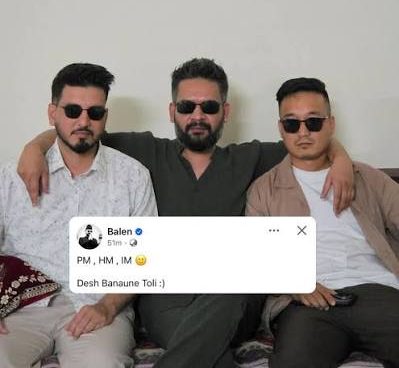
Sometimes I wonder whether some of our newest political heroes in Nepal simply chose the wrong career.
Perhaps they should never have entered government at all.
Instead, they should have established a national institution called the Rich Men’s Club for Nepal’s Development.
Membership would be simple. You must already have enough money that politics cannot tempt you. You must sincerely love Nepal. And you must be fully convinced that everyone who governed before you was either corrupt, incompetent, or both.
Confidence has never been in short supply.
The Club would have obvious advantages. Its members could build schools without first declaring every existing school a failure. They could finance hospitals without turning administrative reshuffling into public spectacle. They could support universities without discovering halfway through that institutions cannot function when leadership is abruptly removed without due process.
They could fund scholarships instead of exposing how fragile national systems can be when handled without care. They could experiment freely and revise quietly.
Most importantly, they could spend their own money while testing their own ideas.
Citizens would applaud. Nobody would object. Everyone likes philanthropy.
What people fear is something else. They fear becoming unwilling participants in political experiments.
The problem begins when success in media, business, or public visibility starts to look like qualification for constitutional leadership.
Business rewards speed. Democracy rewards restraint.
Business celebrates disruption. Democracy survives because institutions are deliberately difficult to disrupt.
In a company, yesterday’s strategy can be abandoned overnight. In a constitutional system, institutions exist because they were built through long struggle and painful compromise.
That difference matters.
Yet recent political practice suggests a different understanding of governance. It resembles a simple pattern. Announce boldly. Receive applause. Encounter legal difficulty. Clarify. Revise. Then explain that revision shows maturity.
Repeat as necessary.
Citizens have already adapted. They no longer react to the first announcement. They wait for the correction.
The rise of the Rastriya Swatantra Party was built on real public frustration. That frustration was justified. Established parties have failed repeatedly on governance, accountability, and delivery. Rabi Lamichhane’s appeal came from positioning himself outside that failure.
That appeal translated into political power. It did not automatically translate into constitutional competence.
Rabi Lamichhane’s political brand helped create the belief that a new kind of leadership could rescue Nepal from old habits. But governing a republic is not the same as exposing a scandal on television or winning public applause for speaking hard truths. It requires respect for law, procedure, and the limits of authority.
Gyanendra Shahi has been among the clearest voices exposing that contradiction. He has criticized RSP for rising on public anger and then behaving as if it stands above the same political rules it used to condemn. That criticism matters because it comes from inside the wider opposition space and shows that the complaint is no longer only external. It is now part of the political conversation itself.
The same problem appears in the rise of Balen Shah. He came from outside the old political class. He had money, talent, visibility, and a public image built around independence. Many people trusted him because they believed he was not part of the corrupt machinery that had disappointed them for years.
That trust was understandable. It was also dangerous if it became blind faith.
If a person enters public office with wealth and good intentions, that is not a sin. The problem begins when he starts treating state institutions as if they were private projects that can be redesigned by instinct. Government is not a startup. It is not a foundation. It is not a club. It is the formal arrangement through which a diverse and often quarrelsome society manages power without destroying itself.
That is why constitutional norms exist.
This is where the richer satire lies. If these leaders already had money, and if they genuinely wanted to serve the country, then the honest path would have been to serve first through private or civic institutions. They could have built schools, hospitals, scholarship funds, local development trusts, research centers, and civic programs. They could have shown public spirit without touching the machinery of the state.
That route would have done two things.
It would have protected constitutional government from being treated as a laboratory.
And it would have given them the very thing they lack now, practical experience in handling complexity.
A country is not run by outrage alone. It is run through compromise, restraint, process, and an acceptance that every decision has consequences beyond the headline. A mayor, minister, or prime minister cannot simply act on impulse and then expect legality to catch up later.
That is why some of the actions associated with the current RSP leadership have created unease. Strong declarations often arrive before the legal foundation is secure. Public relations moves sometimes appear to matter more than institutional durability. Even the cabinet can look more like a showcase of youthful enthusiasm than a serious instrument of statecraft.
The home minister, the education minister, and others may all carry the burden of this same style. They are expected to perform change quickly, visibly, and dramatically. But performance is not the same as governance. And novelty is not the same as competence.
The problem becomes even clearer when this same instinct is applied to the poor.
A government can claim to be modern and disciplined, but if it shows little compassion toward sukumbasi, informal workers, and people living on the edge of survival, then it is not reforming the state. It is hardening it.
Reports of holding centers being emptied with demands for Rs 25,000, the public anger after flooding forced some of those centers to be shifted, and the outrage over how vulnerable families were handled all point to the same failure. Rules are necessary. But rules without study, without context, and without humanity are not governance. They are punishment dressed as order.
A state that cannot understand the difference between discipline and cruelty will eventually lose its moral authority.
Yubaraj Dulal has also spoken forcefully against the same double standard. He has treated RSP’s approach to the provincial question and its wider conduct as dishonest toward the people rather than as some innocent administrative adjustment. That matters because it shows the criticism is not just about style. It is about the party’s willingness to say one thing and do another when it suits power. The provincial question especially reveals the problem, because a federal structure built through sacrifice cannot simply be brushed aside by political impatience. The decision is not neutral. It is a political message about what kind of state the party thinks Nepal should become.
The same concern appears in the use of fines and enforcement. It is one thing to insist on order. It is another to impose penalties without asking who will suffer most. When poor people are punished harshly for violations that the wealthy can absorb with ease, the law stops looking neutral. It starts looking class based.
The death of Ganesh Nepali brought that cruelty into sharp focus. According to reporting and parliamentary debate, a poor ride-hailing driver was fined and then later died after a self-immolation attempt, turning a routine enforcement action into a moral scandal. Whatever one thinks of rules, no civilized government can dismiss such a case as ordinary administration. It should have forced a deeper reflection on how the state treats the poor, the desperate, and the powerless.
That is why public criticism of harsher fines matters. People are not rejecting rules. They are rejecting a system that appears eager to punish the weak while speaking gently to the powerful.
Nepal’s democratic institutions were not handed down by benevolent rulers. They were built through resistance against Rana rule, through the struggle against Panchayat, through democratic movements, and through the sacrifices of people who believed that the country should be governed by rules, not personalities.
Those sacrifices created a system that is imperfect but precious.
To break its norms in the name of change is not courage. It is carelessness.
To appoint near and dear ones to key posts while speaking the language of merit is not reform. It is old patronage in new clothing. To talk about efficiency while treating the poor as administrative inconvenience is not compassion. It is class arrogance.
This is why the idea of a Rich Men’s Club is more than satire. It is a warning. If people have wealth, sincerity, and public trust, let them prove themselves outside the state first. Let them learn how difficult public life is before taking control of it. Let them discover that running a country is not the same as funding a project or speaking in slogans.
If they do that, they may one day become better leaders. They may come to understand that institutions are not obstacles to be defeated but safeguards to be respected. They may also understand that justice without empathy is only a cleaner form of cruelty.
And citizens, having watched them serve without power, would trust them more when they finally do enter government.
That is the real irony.
If these men had chosen the private route first, they might have earned the authority they now assume.
Instead, they entered the state too early and began learning at the public’s expense.
That is an expensive education.
And in every democracy, it is the people who pay the tuition.
