
Dr. Rajendra K. Panthee
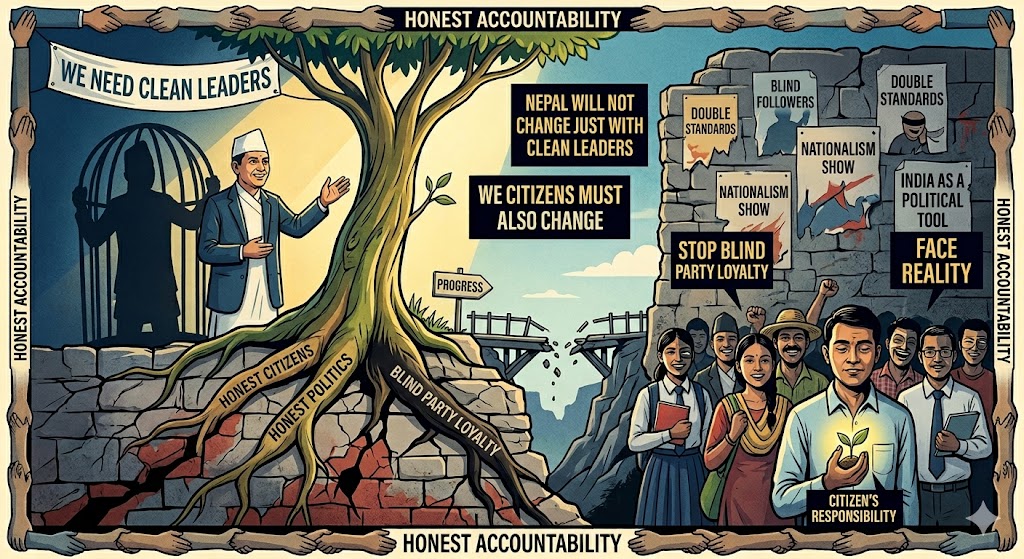
Imagine for a moment that Nepal is suddenly ruled by the most corruption-hating leader in the world. Let us say someone like Lee Kuan Yew, the founding father of Singapore, who is globally known for turning a corrupt and underdeveloped port into a clean and efficient economy. Or perhaps Estonia’s reformers, who built a digital governance model that many countries admire. Imagine his cabinet ministers are equally clean, selfless, and devoted only to the nation. In one magical day, Nepal becomes a Ram Rajya. Honest. Efficient. Benevolent. No more rigged tenders. No more ghost schools. No more money laundering through cooperatives.
Still, Nepal might not change or develop. For a few stubborn reasons.
1. The people
Too many of us do not think about the nation as a shared project. We think about personal benefit, party loyalty, and who will protect our group. Blind support for a party becomes more important than policy, integrity, or long term vision. We say we want clean leaders, but when it comes to our own people, we say, he is not corrupt, he is our guy, he feeds us, he protects us, he is like family.
We want clean leaders at the top, but we also want our own people to be protected, promoted, and let off the hook. We want the system to work for us, not for the nation. We want to be the exception, not the rule.
Even a perfect government gets worn down by our own cynicism, favoritism, and indifference to the public good. We ask for Ram Rajya, but we do not want to live in it. We protest against corruption, but we also protect our corrupt uncle. We vote for clean candidates, but we also vote for the one who gives us a job, a contract, or a favor.
Nepal will not change because we do not want to change. We want the system to be clean, but we do not want to be clean.
2. The political class
There is another ugly truth. Many Nepali political leaders and their supporters also make India into a convenient political weapon. When they feel close to India, everything suddenly feels normal. When they feel ignored, less useful, or less favored than other leaders, they quickly start saying India is playing a game or interfering in Nepal’s affairs.
This is where the hypocrisy becomes obvious. On one hand, some of them are ready to become a puppet of India when it suits their own power. On the other hand, they pull out the nationalist card and shout anti India slogans to emotionally blackmail simple Nepali people. They do not use nationalism as principle. They use it as a tool.
This pattern is dangerous because it turns foreign policy into a domestic performance. Instead of speaking honestly about Nepal’s interests, they use India either as a shield or as a villain depending on what benefits them politically at that moment. That is not patriotism. That is manipulation.
India, as a big and powerful country with its own strategic interests, will never ignore Nepal completely. That much is obvious. But Nepali leaders also help create this cycle by using India whenever it helps them defend themselves, attack rivals, or distract the public from their own failures.
The result is always the same. The public gets confused, the debate gets emotional, and serious national issues become cheap slogans.
The bitter reality
Nepal’s future is not just about cleaning up corruption at the top. It is about how we, as citizens, act. It is about whether we can stop being blind supporters of one party and start being citizens who demand accountability. It is about whether we can stop thinking about personal benefits and start thinking about the nation as a shared project.
It is also about whether our leaders stop using India as a political mask whenever it suits them. A weak political class cannot build a strong state by playing nationalist theater on one side and foreign dependence on the other.
Nepal is stuck between pride and weakness, between sovereignty and dependency, between slogans and reality. Even Ram Rajya in Nepal would struggle, not because leaders alone are bad, but because the people are divided and the political class is often dishonest about bigger forces at play.
What can we do
We can stop being blind supporters. We can stop protecting our corrupt uncle. We can stop voting for the one who gives us a job and start voting for the one who gives us a future. We can start asking questions, demanding transparency, and holding our leaders accountable. We can also stop falling for the same tired game where leaders pretend to defend the nation while using India only when it suits their own power.
We can start being citizens, not just loyalists.
Conclusion
Even if Nepal gets Lee Kuan Yew as its Prime Minister, even if his cabinet is made of angels, even if Nepal becomes Ram Rajya overnight, it will not change or develop unless we change first. Unless we stop being blind supporters. Unless we stop protecting our corrupt uncle. Unless we stop letting leaders use India as a political weapon whenever they want sympathy or advantage.
Nepal’s future is not just about clean leaders. It is about clean citizens. It is about clean institutions. It is about honest politics. And it is about refusing to be emotionally blackmailed by nationalist slogans every time leaders want to hide their weakness.
