
Dr. Rajendra K Panthee
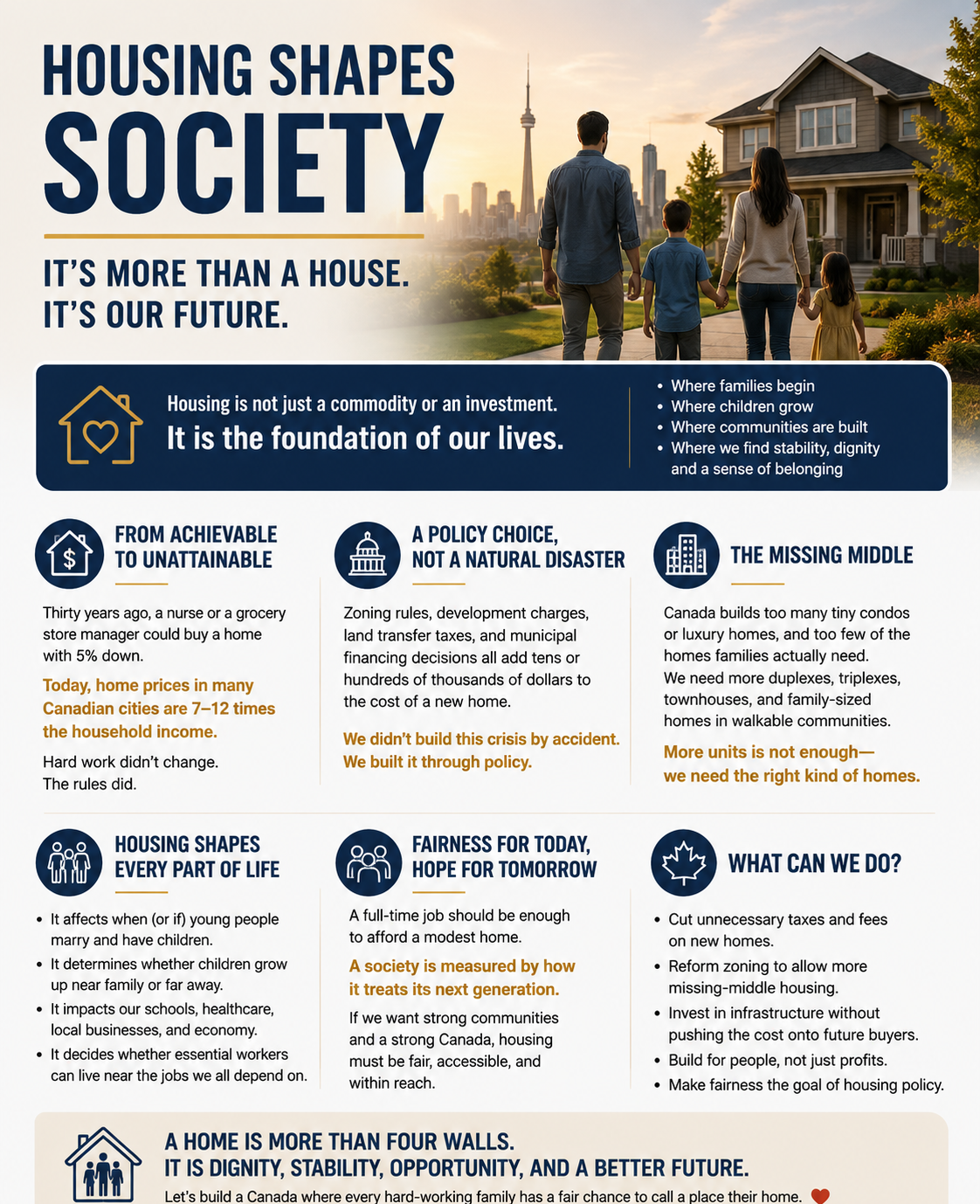
Canada’s housing crisis is usually described as a problem of supply and demand. Build more homes, the argument goes, and prices will eventually come down. That explanation contains some truth, but it also hides a deeper reality that Cara Stern brings out in her conversation with mortgage expert Ron Butler. Canada’s housing crisis is not only about supply. It is about fairness.
The question is no longer simply why houses are expensive. The more important question is why the rules of homeownership have changed so dramatically for one generation while remaining so favorable for another.
A society cannot remain healthy when people working full time, including teachers, nurses, grocery store managers, engineers, and young professionals, can no longer afford to live in the communities they serve. Housing is more than a commodity or an investment. It is the base on which people build families, careers, communities, and a sense of belonging.
Listening to Stern and Butler, one realizes that the conversation is not really about mortgages or real estate. It is about how decades of public policy have quietly reshaped the Canadian dream.
From Ordinary to Unreachable
Ron Butler recalls entering the mortgage industry more than three decades ago when an assistant grocery store manager and a registered nurse could regularly purchase a home in the Greater Toronto Area with a modest down payment. Home prices generally ranged between two and a half and three and a half times a household’s annual income.
Today, in many Canadian cities, particularly Toronto and Vancouver, home prices have reached seven, eight, or even twelve times household income.
That is not just inflation. It is a complete redefinition of adulthood.
For previous generations, buying a home was a realistic milestone reached through employment and savings. For many young Canadians today, homeownership increasingly depends on inherited wealth, parental support, or the willingness to take on decades of crushing debt.
We are told this is progress. It is not. It is a narrowing of social mobility dressed up as a normal market adjustment.
The Myth of Equal Effort
One of the strongest points Stern makes is that acknowledging generational inequality does not diminish the hard work of previous generations.
Many older Canadians respond, quite understandably, by saying, “We worked hard too.”
No one seriously disputes that. The issue is not effort. The issue is whether equal effort still produces equal opportunity.
A young couple earning above the national median income, saving diligently, avoiding extravagance, and making responsible choices can still find themselves priced out of family sized housing. If financially responsible households cannot buy modest homes, the problem cannot be reduced to budgeting discipline or lifestyle choices.
It becomes structural.
Stern speaks from experience. She and her husband were earning above the median household income, living frugally, and saving consistently. Yet they still found themselves unable to purchase even very small homes that could accommodate the family they hoped to build.
That frustration eventually became professional curiosity. Instead of accepting the situation as inevitable, she began asking why the housing market seemed so detached from ordinary incomes. That inquiry led her into housing journalism.
Housing Is a Policy Choice
Perhaps the most important insight in the conversation is Stern’s insistence that today’s housing crisis did not simply happen. It was created through policy.
Too often Canadians speak about housing affordability as though it were a force of nature. It is not.
Governments make decisions about zoning regulations. Governments determine development charges. Governments decide how municipalities finance infrastructure. Governments establish tax systems. Governments regulate land use. Governments shape immigration targets. Governments influence mortgage rules.
Every one of those choices affects housing affordability.
In Stern’s words, the economy is a series of choices.
That changes the whole conversation. If policy helped create the crisis, policy can also help solve it. The challenge is not mainly technical. It is political.
The trouble is that political courage is usually in short supply when the people most protected by the current system are also the loudest defenders of it.
When Cities Fund Themselves Through Housing
One of Butler’s strongest criticisms concerns the enormous rise in municipal development charges.
Municipal governments need revenue, but they do not want to anger existing homeowners by raising property taxes. So instead, they shift infrastructure costs onto new housing developments. The logic is obvious. Existing voters stay happy. Future homeowners pay the bill.
It is a neat trick, and it has been repeated often enough to become normal.
Of course, developers do not absorb these costs forever. They pass them on to buyers. So development charges that were once relatively modest have grown dramatically over the past two decades, adding tens of thousands and sometimes hundreds of thousands of dollars to the price of newly built homes.
The result is perverse. Policies sold as responsible municipal planning end up making homeownership harder for the very people trying to enter the market.
In other words, younger Canadians are paying twice. They pay through high housing prices and again through the financing mechanisms hidden inside those prices.
The Missing Middle
Another major theme in the conversation is Canada’s obsession with building either detached suburban homes or very small condominiums.
What has largely disappeared is what urban planners call the missing middle. Duplexes, triplexes, fourplexes, courtyard apartments, townhouses, and other family sized medium density housing have been squeezed out by zoning rules and planning habits that no longer serve the reality of modern cities.
These forms of housing once allowed neighbourhoods to grow gradually while remaining affordable. Today many municipalities continue to restrict them through rules inherited from another era, as though the car oriented suburbs of the mid 20th century should still dictate how a 21st century city must function.
The result is predictable. Developers either build luxury detached homes where land is available or maximize profit by producing tiny condominium units in expensive urban locations.
Families searching for modest three bedroom homes find very few choices.
Canada has become increasingly successful at producing housing units while becoming less successful at producing homes that ordinary families can actually use. Those are not the same thing.
Counting units tells us little if families cannot live in them.
What Housing Really Means
Perhaps the most affecting part of Stern’s interview is her own plain and deeply human wish.
She does not dream of luxury. She wants what previous generations often treated as ordinary. A stable home. A neighbourhood. Children attending the same school. Some freedom from the anxiety that a landlord may decide to sell and uproot the family.
That should not sound radical. Yet in today’s Canada, even basic stability can sound like a privilege.
Housing shapes far more than the real estate market. It shapes whether people marry, whether they have children, whether they stay in a city, whether they volunteer, whether they build roots, and whether they imagine a future at all.
A country that makes stable housing inaccessible is not just creating a housing problem. It is weakening its own social future.
A Fairness Crisis
The housing debate is usually framed as a contest between homeowners and renters, developers and environmentalists, cities and provinces, or supply advocates and affordability advocates.
Cara Stern’s conversation with Ron Butler suggests a better framework. The central question is fairness.
Can a young Canadian working full time reasonably expect to own a modest home. Can ordinary families remain in the cities where they grew up. Can children afford to live near their parents. Can essential workers afford to live where they work.
If the answer increasingly becomes no, then Canada faces more than a housing shortage. It faces a fairness crisis.
Fixing that will require more than adding units. It will require rebuilding a system that once allowed ordinary work to produce ordinary dreams.
Until that happens, Canada’s housing market will remain not only expensive, but fundamentally unfair.
