When Political Loyalty Distorts Reality: A Sign, Some Laughter, and How We See What We Want to See

Dr. Rajendra Panthee

Introduction: The Delight of Linguistic Discovery
I never expected my playful observation about a political sign would spark such controversy. There it was—a conservative leader’s campaign board reading “Axe the Tax on Homes,” its words awkwardly divided across two lines. To my linguist’s eye, the accidental double meaning was irresistible: “Stop Sales / Tax Homes!!” The irony was perfect—a tax-cutting slogan that, through clumsy design, could be read as advocating precisely what it opposed. I shared this humorous linguistic discovery online, anticipating fellow word enthusiasts might enjoy the joke. Instead, I witnessed how quickly language play collides with political tribalism, and how our capacity for humor evaporates when ideology enters the conversation.

The Battle Over Meaning
The responses fell into distinct camps. The first commenter, a linguistically-inclined friend, set the tone with measured analysis: “When the given sentence is divided into two sentences, then you are right! Otherwise, I do not agree.” His distinction was crucial – he acknowledged the design’s ambiguity without dismissing the intended policy. My reply – “They divided it (for a reason), not I!” – highlighted how the sign’s formatting created the double meaning. His follow-up (“This is design, not a divide”) further clarified his view.

Then another participant offered a diplomatic perspective: “Yes, both of you are correct. It’s a very ambiguous sentence.” This comment was a quiet masterstroke, validating both perspectives while modeling how to depoliticize language.

The Spectrum of Reactions
The literalists analyzed the sign as a communication failure. One noted: “It should read ‘Axe the sales tax on new homes,'” pointing out how line breaks create unintended meanings. The defenders reacted as if I’d launched a political attack rather than a grammatical observation. “You’re misleading people!” insisted one particularly vocal participant, who later escalated: “It was deliberately made misleading by you… Someone like you shouldn’t do this seriously.” This revealed a deeper pattern – for some, any interpretation diverging from party orthodoxy wasn’t just wrong, but malicious.

The Psychology Behind the Responses
What fascinated me wasn’t the disagreement, but how predictably it followed documented psychological patterns. One defender shifted the conversation completely: “Nepali people never change, even in Canada! If you don’t understand English, try French!” Where some saw typography, others saw ideology.

Another participant’s evolving position was particularly telling. They first dismissed the conversation as “AI-generated info,” but later conceded it was simply “a design problem.” This reversal mirrored the classic pattern of conspiracy thinking – initial defensive outrage giving way to reluctant acknowledgment of facts.

The Conversation Spirals: Defensiveness and Distortions
The discussion took revealing turns when certain participants:

  • Framed sarcastic remarks as honoring cultural heritage
  • Made striking accusations completely absent from the original post
  • Sought validation from respected community figures

One observer’s graceful refusal to be drawn in – “Don’t drag me into the dirt” – and another’s probing questions – “Where were Indigenous people defamed?” – underscored how far the conversation had diverged. The most insightful commentary came from those who understood political language operates on multiple levels: “Are we looking at formal or lexical semantics?”

Language as a Political Weapon
The campaign sign wasn’t just policy – it was a rhetorical Rorschach test. Supporters saw their preferred meaning, critics saw the clumsy messaging, and the campaign benefited from the engagement either way. This phenomenon isn’t unique to Canadian politics; similar vague, feel-good phrasing appears in slogans worldwide.

A Mirror for Our Digital Age
This micro-drama reflects our broader information crisis. When participants accused me of “deliberately misleading,” they weren’t engaging with the post – they were reacting to perceived threats to their political identity. We’ve become so accustomed to political warfare that even playful analysis gets weaponized.

Conclusion: Playfulness as Political Mirror
This entire episode began with what should have been an uncontroversial truth: language is inherently playful, and design choices create unintended meanings. My amusement at the sign’s ambiguity wasn’t just about the words themselves, but about how they revealed the fragility of political messaging.

The most telling response wasn’t the disagreement—it was the complete inability of some participants to even recognize the linguistic playfulness. Their insistence that “no competent English speaker could misunderstand the sign” ironically demonstrated their own constrained perception. In policing my observation, they revealed how political allegiance can literally narrow what we’re able to see in plain language.

Three crucial lessons emerge:

Humor is ideological – What one person finds amusing, another perceives as attack

Design has politics – Even accidental ambiguities reveal messaging vulnerabilities

Playfulness is power – The ability to see multiple meanings resists political framing

Perhaps the healthiest democratic practice would be embracing—rather than attacking—those who point out clumsy messaging. After all, if we can’t laugh at awkward phrasing, how will we ever confront substantive policy differences? The sign’s true revelation wasn’t its policy position, but how fiercely we’ll defend our team’s sloppy design—and how angrily we’ll attack those who notice it.

Canada at a Crossroads: Immigration, Identity, and the 2025 Election

Dr. Rajendra Panthee

The Political Landscape

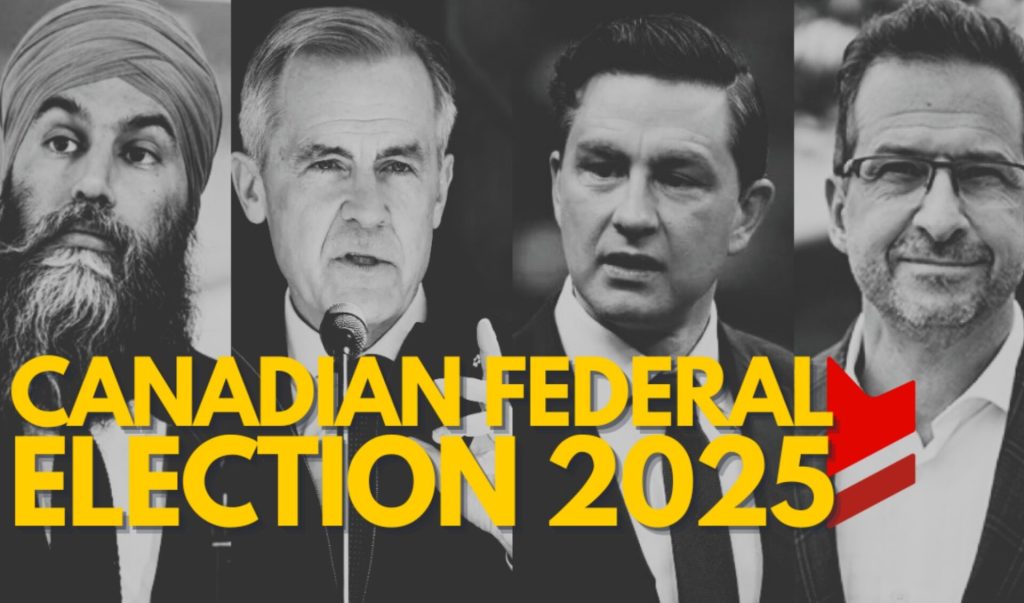
As Canadians prepare to vote in a pivotal federal election, five major political parties are offering contrasting visions for the nation’s future—Prime Minister Mark Carney’s Liberals, Pierre Poilievre’s Conservatives, Jagmeet Singh’s New Democratic Party (NDP), Yves-François Blanchet’s Bloc Québécois, and Elizabeth May’s Green Party.

Although early media forecasts predicted a Conservative landslide, Mark Carney’s unexpected entry as Liberal leader in March 2025 dramatically reshaped the political landscape. By drawing significant support from traditional NDP voters, Carney has transformed what seemed a foregone conclusion into a competitive three-way contest, fundamentally redefining the stakes of the 2025 election.

The Leadership Contrast: Statesman vs. Perpetual Opponent

This election may offer the starkest leadership contrast in recent Canadian history. Mark Carney, the only person to have led both the Bank of Canada (2008–2013) and the Bank of England (2013–2020), brings economic expertise and global credibility. His leadership during the 2008 global financial crisis and his authorship of key climate finance frameworks underscore a reputation for thoughtful, evidence-based policymaking.

Pierre Poilievre, by contrast, has honed a reputation for perpetual opposition. In Ottawa, political observers describe his style as “oppositionism”—offering relentless criticism with little in the way of constructive alternatives. From blaming Prime Minister Justin Trudeau for global inflation to mocking climate policy without proposing viable energy alternatives, Poilievre has often reduced national discourse to partisan soundbites.

Immigration and Economic Policy: Two Diverging Paths

Carney’s Liberals continue to support Canada’s high-immigration model, welcoming over 400,000 newcomers in 2024. The policy addresses labor shortages and supports an aging population, with experts noting the positive impact on GDP and innovation. However, the sudden growth—amplified by 650,000 international students in 2023—has intensified Canada’s housing crisis, especially in cities like Toronto and Vancouver.

In February 2025, the government capped study permits at 437,000 to relieve pressure on housing and infrastructure. Though controversial, many economists believe this step was necessary to prevent further overheating of the market.

The Conservatives have seized on these challenges, promoting a “merit-based” immigration system. However, they have offered few details, and their rhetoric often recalls Stephen Harper-era policies that restricted family reunification and slashed refugee support—policies now blamed for workforce shortages in healthcare and construction.

Trade, Trump, and the Shadow of Protectionism

The specter of Donald Trump’s political resurgence has cast an unexpected shadow over Canada’s election. When Trump unexpectedly praised Mark Carney during a March 2025 interview, describing their phone conversation as “very meaningful” Conservative strategists scrambled to weaponize this diplomatic courtesy as proof of Liberal weakness on trade. Their efforts backfired spectacularly.

Seasoned observers recognized what Trump himself acknowledged – Carney’s unique credibility as the only leader to have successfully navigated both the 2008 financial crisis and Brexit turbulence. This credibility became Canada’s shield when Trump imposed aluminum and steel tariffs weeks later. While Carney responded with targeted subsidies for affected manufacturers and accelerated negotiations with the EU, Pierre Poilievre could only offer theatrical visits to steel plants, his empty rhetoric exposing the Conservative leader’s inability to match Carney’s nuanced statecraft.

For Canada’s trade-dependent economy, where 72 cents of every dollar earned comes from international commerce, this contrast couldn’t be starker – nor more consequential.

The Nepalese-Canadian Political Awakening 

Canada’s Nepali diaspora finds itself at a defining crossroads, its political maturation tested by three competing visions embodied by its candidates:

  • Bijay Paudel (Conservative) – The NRNA leader’s campaign thrives on ethnic solidarity despite his party’s anti-immigration stance. His connections overshadow policy contradictions that would see family reunification programs gutted even as Nepal faces climate crises exacerbated by the very carbon tax he vows to eliminate.
  • Bhutila Karpoche (NDP) – Her landmark achievements on rent control and pharmacare go curiously ignored by the community she shares heritage with, her Tibetan-Nepali identity somehow rendering her less “authentic” in the eyes of those who claim to value representation.
  • Prashant Dhakal (Green Party) – The Ottawa West-Nepean candidate, whose climate tech background and advocacy for skilled immigrant credential recognition present the diaspora with its starkest generational choice yet. Where Paudel offers nostalgic cultural familiarity and Karpoche delivers progressive policy results, Dhakal forces a confrontation with planetary urgency.

This trio exposes deepening fault lines between ethnic solidarity and policy alignment. When activist Punya Sagar Marahatta questioned these contradictions in his viral post “The Unknown Candidate,” he revealed selective solidarity—where Paudel is embraced but Karpoche and Dhakal are marginalized—along with persistent hierarchies of caste, ethnicity, and generation. 

Three Factions Evolve

The Nepalese-Canadian community’s political consciousness has crystallized into three distinct orientations, each reflecting broader Canadian political currents while wrestling with diaspora-specific tensions:

  1. Traditionalists anchor themselves to Bijay Paudel’s Conservative candidacy with uncritical fervor, their allegiance to cultural identity trumping policy contradictions that would see them support a party advocating immigration restrictions harmful to their own community’s growth. This mirrors the Conservative base’s broader prioritization of cultural symbolism over material outcomes.
  2. Reformers find themselves torn between Bhutila Karpoche’s proven track record on housing justice and Prashant Dhakal’s urgent climate agenda – a schism within progressive politics that sees the diaspora’s younger activists debating whether shelter or sustainability constitutes the more pressing frontline struggle.
  3. Pragmatists, perhaps most intriguingly, operate as the community’s political barometer, their small business interests and centrist instincts making them alternately receptive to Paudel’s tax cut promises, Karpoche’s affordability measures, and Dhakal’s green entrepreneurship vision depending on which platform best addresses their immediate economic anxieties.

What unites these factions is their collective departure from passive ethnic bloc voting toward the messy but necessary work of issue-based political engagement – a maturation that ironically sees the Nepalese-Canadian political landscape increasingly resembling the complex pluralism of Canada itself.

The Stakes for Canada—and Nepalese-Canadians

This election transcends partisan preferences to confront Canadians with existential questions about the nation’s soul. Mark Carney’s candidacy represents the promise of competent globalism, his rare dual central banking experience offering ballast against the storms of Trumpian protectionism and climate disruption.

Pierre Poilievre’s Conservatives peddle the empty calories of perpetual grievance, his “just axe the tax” sloganeering substituting for serious policy while offering no meaningful alternative to address either affordability or environmental crises. Jagmeet Singh’s NDP, meanwhile, watches its historical progressive base erode as Carney’s Liberals co-opt their policy space – a political realignment leaving democratic socialists without a natural home.

For Nepalese-Canadians, these national dynamics manifest as a painful microcosm. The community must decide whether to follow its instincts toward the tribal comfort of Bijay Paudel’s ethnic familiarity, or embrace the policy substance offered by both Karpoche and Dhakal despite their lack of cultural cachet. This tension between ancestral loyalty and civic responsibility mirrors Canada’s own defining challenge – whether to retreat into the false security of identity politics or advance toward the more demanding but ultimately more rewarding terrain of evidence-based governance. The diaspora’s decision may well preshadow the nation’s.

Conclusion: A Test of Political Maturity

Canada stands at a crossroads. The 2025 federal election is a test not only of political leadership but of the nation’s democratic maturity. Will Canada choose evidence-based governance and inclusive policymaking—or retreat into grievance-driven populism? For immigrant communities, including Nepalese-Canadians, this moment demands more than tribal allegiances. It calls for thoughtful civic participation that values competence, transparency, and equity over mere representation. As the world watches, Canada must decide whether it will embrace a future defined by global engagement and evidence-based policy, or veer toward isolationism and identity politics. The path chosen will shape the country’s economy, identity, and global standing for generations to come.

The Power and Danger of Silence: A Cross-Cultural Perspective on Importance of Voice Over Silence

Dr. Rajendra Panthee

Eastern vs. Western Rhetoric: The Value of Silence vs. Voice

Growing up in Nepal, I was taught that silence was a virtue. Questioning authority—whether parents, teachers, or bosses—was seen as disrespectful, rebellious, or even dangerous. Knowledge was often treated as absolute, handed down by elders, religious texts, or societal norms. To challenge it was to invite suspicion.

This cultural conditioning creates a society where conformity is rewarded and dissent is suppressed. The danger? A single, unchallenged “truth” dominates, leaving no room for dialogue or growth. As James Berlin’s socio-epistemic rhetoric suggests, knowledge is not absolute but socially constructed through exchange and debate. Yet, in many Eastern traditions, questioning is discouraged, and those who speak up—like me myself and Punya Sagar Marahatta and a few others—are labeled as troublemakers.

In Western rhetoric, however, silence is often viewed with suspicion. Leaders are expected to articulate their positions—when they don’t, they are criticized for hiding their true intentions. When Mark Carney, the future potential Canadian Prime Minister, briefly left the election campaign trail for the third time recently to return to Ottawa and discuss Donald Trump’s proposed tariffs with other world leaders, the move was interpreted with deep significance. Yves-François Blanchet, leader of the Bloc Québécois, seized on Carney’s absence, accusing him of hiding from public scrutiny. Blanchet’s implication was clear: Carney preferred conducting high-stakes negotiations behind closed doors rather than engaging openly with voters.

But this distrust of silence extends beyond politics: in workplaces, employees who don’t speak up in meetings are seen as disengaged; in classrooms, quiet students risk being overlooked; and in social circles, prolonged silence is often misinterpreted as disapproval or disconnection. The Western ideal of participatory democracy and open discourse leaves little room for comfortable silence—it demands vocal engagement as proof of presence and commitment.

But is silence always negative? Cheryl Glenn’s Silence: A Rhetorical Art argues that silence can be more powerful than speech. The Romantic poet John Keats wrote, “Heard melodies are sweet, but those unheard are sweeter.” There is profound meaning in silence—but also danger.

The Double-Standard of Silent Disapproval

When I write about Nepali community issues—whether real estate exploitation, political hypocrisy, or unethical business practices—many agree privately but fear public association. After I wrote about Bijay Paudel’s Conservative Party alignment, some applauded me in private messages but hesitated to talk about it publicly. They feared backlash, revealing a deep cultural reluctance to openly dissent.

This silence is deceptive. Those who remain quiet while privately disapproving are more dangerous than outspoken critics. At least with critics, you know where they stand. But silent dissenters maintain a façade of loyalty while nurturing resentment. For example, let’s take an example of Nepali community members’ support for Bijay Paudel this Canadian Federal Election. Bijay likely interprets the photo-ops and crowded campaign office as genuine support, unaware how many attend just for free food, social clout, or fear of being seen as “disloyal” to the community’s perceived unity. The tragedy isn’t just the hypocrisy, but how this culture of performative allegiance silences meaningful debate about whether supporting any Nepali candidate—regardless of their politics or integrity—truly serves our collective interests.

The Cost of Being Truth-Tellers

Looks like Punya Sagar and I are often labeled as “disruptive” or “controversial” because we refuse to stay silent. Whether exposing fake refugee schemes, diploma mill exploitations, community and political hypocrisy, exploitation of community sentiments for business, and wrong real estate practices, we bring these issues into the open—not to divide, but to spark necessary conversations. At minimum, we strive to make our community aware of practices that ultimately harm us all. Yet when we ask these difficult questions, why are we so often treated as adversaries rather than allies in progress?

The answer lies in a painful truth: unhealthy communities mistake harmony for health. They prioritize the illusion of unity over accountability. But a society that grows stronger does so through open dialogue, not enforced silence. The real obstacle to progress isn’t those who speak up—it’s those who privately acknowledge problems yet publicly remain quiet, allowing harmful norms to persist through their inaction.

Why Our Community Needs More Than Silent Support

In our community’s ongoing journey toward meaningful change, writing stands as one of our most transformative tools – capable not only of critiquing but also of healing and reshaping perspectives. This realization became especially clear to me when Chitra Pradhan responded to a comment on Punya Sagar’s post about Prashanta Dhakal that had dismissed the value of writing. While some contended that financial support for Nepali candidates was more immediately important, Chitra eloquently articulated writing’s unique power: its capacity to preserve truths, alter viewpoints, effect change that outlasts election cycles, and offer alternative perspectives (a favorite concept of Chitra) on social and communal matters.

These alternative perspectives serve as crucial instruments for dismantling the idea of a singular truth in our era of multiple, coexisting truths. They help individuals understand that their personal truths may not align with others’ realities. Truth’s multiplicity encompasses whose truth we’re considering, when it applies, where it’s valid, and how it comes to be accepted as truth.

This cultural shift, though gradual, is unmistakable. Increasing numbers of community members are now engaging in this collective knowledge-building. Punya Sagar’s Facebook posts, for instance, regularly spark active discussions among Nepalis both in Canada and worldwide. Punya himself and Chitra Pradhan stand out as particularly engaged contributors to these dialogues. Observing this evolution fills me with hope. Through my own extensive writing about our community’s social, cultural and political challenges, I’ve witnessed writing’s unique capacity to ignite conversations that years of silent conformity failed to produce. Writing does more than reveal problems – it sows the seeds for their resolution.

Conclusion: Breaking the Culture of Silence

Silence can be powerful—but when misused, it becomes a tool of oppression. My cross-cultural experience has taught me that those who speak, despite backlash, are not the true threats. The real threats are the ones who nod in agreement publicly but whisper criticisms in the dark.

It’s time to move beyond fear. Whether in Eastern or Western contexts, progress demands voices that challenge, question, and refuse to conform. Because in the end, unspoken truths are far more dangerous than the ones we dare to say aloud.

Please know that Silence isn’t peace—it’s postponed conflict. From kitchen tables to boardrooms, the unspoken tensions we ignore today become the ruptures we can’t mend tomorrow. The choice isn’t between harmony and chaos, but between honest dialogue and collective dysfunction.