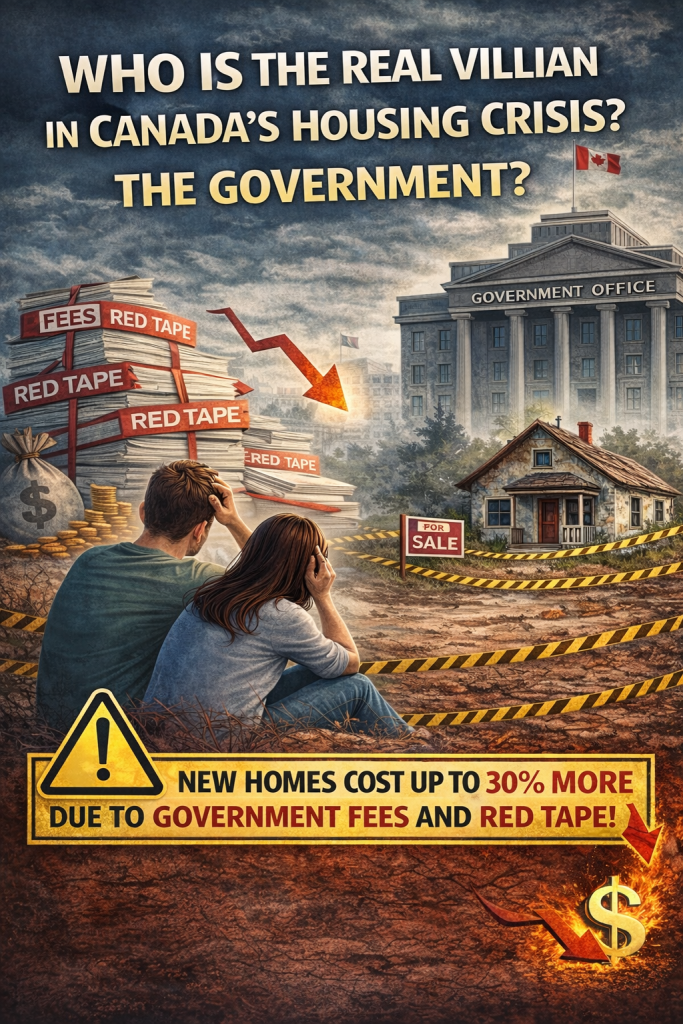
Who Broke Canada’s Housing Market: Government or the Market?

Canada’s housing crisis is often discussed in absolutes: either prices will crash, or they will never fall; either governments must intervene more, or get out of the way entirely. But when we place recent market conditions alongside deeper structural critiques—like those raised on Angry Mortgage—a more complicated, and more honest, picture emerges.

A Short-Term Opening for Buyers

In the near term, there is a meaningful shift underway—particularly in markets like Toronto and Vancouver.

Sales volumes are historically low. Investor activity has largely evaporated. Pre-construction is stalled. Buyers who remain are mostly end users: families and individuals looking for a place to live, not to flip. This has quietly shifted leverage. Selection has improved. Negotiation is back. Sellers, not buyers, are adjusting expectations.

This does not mean we are at the “bottom,” nor does it mean prices cannot fall further. But for financially stable households—especially first-time buyers who were entirely shut out between 2020 and 2022—this is the most buyer-friendly environment in years.

Yet this short-term opening exists inside a housing system that remains fundamentally broken.

The Structural Problem: Housing as a Government Revenue Tool

As Ben Woodfinden argued on Angry Mortgage, the most under-discussed driver of unaffordability is not speculation alone, immigration alone, or even interest rates—but government cost-loading on new housing.

In cities like Toronto, as much as 30% of the cost of a new home is made up of development charges, fees, taxes, and levies. These are not marginal costs. They are embedded into the price of every unit, passed directly to buyers, and treated as a normal feature of governance.

Housing, in effect, has been taxed like a luxury good—while being rhetorically framed as a human necessity.

Layered on top is what Woodfinden calls the “Anglo disease”: a regulatory culture that makes building slow, adversarial, and legally dense. Years of approvals, consultant reports, appeals, and political veto points create scarcity by design. The result is not careful planning—it is paralysis.

This is how Canada ends up with 50-storey towers beside single-family zoning, and almost nothing in between.

The Missing Middle—and the Missing Social Contract

What ties these discussions together is not just economics, but expectations.

A generation of Canadians did what the social contract asked of them: education, work, saving, delayed gratification. Yet homeownership now requires top-1–2% household incomes in major cities. The promise that effort leads to stability has quietly collapsed.

That anger is not theoretical. It shows up in delayed families, longer commutes, overcrowding, and a growing sense that democracy responds faster to asset holders than to workers.

When young professionals earning $90,000–$100,000 cannot even imagine owning a modest home, something deeper than market cycles has failed.

So Where Does This Leave Us?

In the short run, today’s market offers cautious opportunity for buyers who are purchasing shelter, not status.

In the long run, affordability will not be restored without structural change:

  • Development charges must be rethought.
  • Zoning must allow mid-density housing where people already live.
  • Speed, not symbolism, must become the metric of housing policy.

More programs alone will not fix this. Nor will pretending the market can self-correct under the current regulatory load.

A Critical Outlook

Canada’s housing crisis is not caused by a single villain. It is the outcome of decades of policy choices that treated housing simultaneously as an investment vehicle, a revenue source, and a political risk to be avoided.

Buyers may find a window today—but unless governments stop profiting from scarcity while promising affordability, that window will close again.

The question is no longer whether housing is broken.
It is whether we are willing to stop pretending we don’t know why.

Short Housing Supply: A Contributing Factor of Housing Bubble in Canada

Canada, especially Greater Toronto Area (GTA), has a lack of housing supply! No matter where land for the first time as immigrants or live in general, they want to settle down in GTA since Toronto is the financial capital of Canada and there are more job and enterprenual opportunities than other places in Canada. According to Financial Post, “Among the G7m Canada has the lowest average housing supply per capita with 424 units per 1,000 people, which places the country behind the United States and the United Kingdom. France, by comparison, leades the G7 at 540 units per 1,000. The pandemic, which allowed households to accrue record savings and saw unprecedented stimulus measure, stoked the country’s hot housing market and has pushed it into frothy territory over the past two years”. CMHC warned back in 2022 that Canada will need 5.8 million new homes by 2030 to tackle affordability crisis (CBC News). Yes, they like to build more houses, however, there is a complex time-consuming approval process. According to Amborki, it can take eight to ten years to go from acqiring undeveloped land to building houses. Most importantly, it is very hard to get land in or close to Toronto area.

Canadian government has done something for the housing affordability. And, it has recently (from April 1, 2023) announced First Home Saving Account (FHSA) and it is a registered plan allowing you, as a prospective first-time home buyer, to save for your first home tax-free (up to certain limits). And, it has prohibited on the purchase of residential property by non-Canadians Act. And, it has initiated a vacancy tax at federal, provincial and municipal in some cases. No matter what the government is doine, it shows that it is easier said than done.

Experts say that Canada is sitting on the larguest housing bubble ever! And they believe that bursting of the bubble is inevitable. Even is the economic crisis in US in 2008, Canadian housing market did not crash. It only went to -9.2% low and it recovered quickly. They say that Canadian housing market has not seen that correction yet. After the recession in 2008 the banks around the world lowered the interest rates to very low as a result, it became very easy to get a mortgage and buy a house until 2022.

As a result, many investors took that money and invested in the real estate because the investment in the real estate had a track record of generating income from the investment. As a result, on the one hand there are houses that belong to investors that are empty, on the other hand there not enough houses for other people to live. As a result, when those people who do not have homes want to buy one, there are not enough homes available in the market. Property prices in the market are skyrocket, when so many people want to buy a property. Rapidly rising prices of assets lead to volatile prices. As a result, a huge bubble has been created for a long time and especially after covid-19! Experts say Canada is living in the biggest housing bubble ever! And they believe that the bursting of the bubble is inevitable. (My next post will be in interest rate and housing bubble!)

Bank of Canada Interest Cuts and Expert Views on Canadian Real Estate Market

How is real estate market after the latest interest cut by the bank of Canada? What do real estate experts say about the interest cut and its aftermath? We find mixed feelings when we listen to those experts in the field. According to The Globe and Mail article, Royal LePage president predicts 'real lift’ in home sales after Bank of Canada cut the interest rate. However, John Pasalis, one of the real estate practitioner and researcher does not think so. He does not think so since there will be any sales increase until next year because right now the interest rate is very high. On the other hand, John Flynn, another real estate practitioner and researcher says that nothing is going to happen after the interest rate cut as whatever had to happen has already happened before the rate cut. Yes, there is a gradual improvement for freeholds right now. It does not mean that the price will drastically go up after the rate cut for the freehold. Condo market is down right now. The sellers of the vacant condo rush to sale and you may get for even low price. And, the buyers are reluctant to buy the rented condo for various reasons. Stay informed and use your rational before you rush to invest in real estate after listening to people.