
Dr. Rajendra Panthee
Recent discussions about Canada’s slowing, and in some cases declining, population are more than just statistics. They reflect a deeper shift in immigration policy, economic pressure, and the consequences of rapid population growth over the past few years. For prospective international students and foreign workers, especially from countries like Nepal, India, and others, this changing reality demands serious reflection.
After listening to Ron Butler on the Angry Mortgage Podcast on March 20, 2026, one thing becomes clear. A system built on rapid expansion, aggressive recruitment, and unrealistic promises is now being forced to correct itself. When such systems correct, it is often the most vulnerable, young international students, who pay the price.
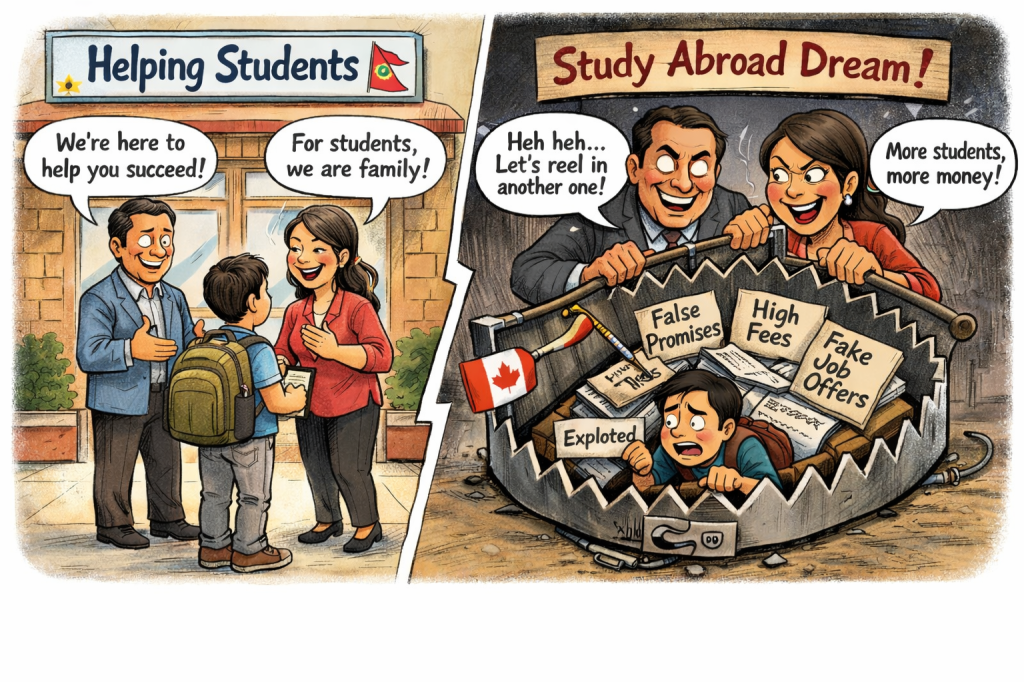
For many young people, the journey begins right after high school. They come to Canada as students, but for many, education is not the primary goal. The real objective is often permanent residency or citizenship. There is nothing inherently wrong with that aspiration. The problem begins when that dream is sold through misinformation, consultants, and brokers who promise easy pathways that no longer exist.
What often goes unspoken are the consequences of believing these promises. As Dr. Punya Sagar Marahatta has consistently warned through his awareness posts—such as his writings on “Diploma Mills” and his recent reflections on March 29—many students arrive with expectations shaped by consultants, only to encounter a completely different reality. Instead of stable work and a clear path forward, they face financial pressure, isolation, and deep uncertainty. In some cases, this leads to serious mental health struggles. There have been tragic incidents, including the recent death of a student in the Niagara region, along with several similar cases in the past. Others have experienced homelessness or have been forced to return home after exhausting their resources. These are not isolated stories but part of a broader pattern that demands urgent attention. Efforts to regulate and monitor consultancies, both in Nepal and abroad, are not just policy discussions—they are a necessary step to prevent further harm to vulnerable students. I say this not as an outsider, but from personal experience.
I say this not as an outsider, but from personal experience.
I came to the United States for my PhD on a teaching assistantship. I prepared for TOEFL and GRE, applied directly to universities, contacted departments and professors, and secured funding. Because I was funded, my focus was entirely on study. That is what studying abroad is supposed to look like.
In early 2010, my journey toward Canadian permanent residence began. At the time, an acquaintance of mine had repeatedly failed to obtain a U.S. visa. In his search for alternatives, he discovered Canada’s high-skilled immigration program, which allowed him to apply for permanent residence for himself and his family. He saw this as a pathway for his family to settle in Canada, with the added advantage of making future travel to the United States easier. Inspired by his approach, I followed his steps, even though my own family was living in the U.S. at the time. The job prospects there were uncertain, and as my dependent, my wife was unable to attend school or work. I applied under the same high-skilled category. However, Canada later decided to eliminate that immigration category. Fortunately, because we had submitted our application before the rule change, our case was still considered. The process took a long time, but finally, we landed in Toronto in April 2013.
Since then, my life has been defined by movement.
While I was based in Texas, I would come to Toronto only during semester breaks. Later, after securing my position at Syracuse University, I found myself about a four-hour drive from Toronto, making frequent weekend trips to stay connected with my family. This back-and-forth life was not ideal, but it was a conscious choice shaped by both professional commitment and family responsibility.
After graduating from the University of Texas, I joined Centennial College as a contract professor in January 2014. In July 2015, I received a job offer from Syracuse University and continued working in both places for some time.
Many people asked me why I did not simply stay in Canada with my family instead of commuting so frequently between the US and Canada.
The answer was simple. It was not that full-time positions at community colleges were hard to obtain at the time. In fact, I could likely have secured a full-time role at Centennial within two or three years. My decision, therefore, was about the kind of academic career I wanted. I chose to remain connected to a top-tier university environment like Syracuse University, where I could focus on research, intellectual growth, and long-term academic development.
Today, with the recent decline in international student numbers, my contract teaching at Centennial is no longer there. Looking back, I feel that decision was the right one.
This is exactly the reality many students are not told.
Over the past few years, a troubling ecosystem has developed around low-tier private and community colleges. Consultants, mostly based in home countries, have been selling a dream. Study well, get a good job, secure PR, build a future. Families take loans, sell land, and invest everything. But what many students encounter instead is a harsh reality. High living costs, unstable work, and an education that often takes a back seat to survival.
If a student is truly committed to education, there is a better path.
Studying abroad in countries like Canada or the United States can be transformative, but it makes the most sense at the graduate level, especially with scholarships, teaching assistantships, or research assistantships. Funded students have the time and stability to focus on learning. In contrast, those who arrive after paying large sums to private colleges often find themselves forced to prioritize work over study.
More importantly, pursuing graduate study does not require paying consultants. Students can apply directly through university websites, meet admission requirements, and contact faculty members themselves. This route is transparent, merit-based, and far more reliable than depending on intermediaries.
This is not an argument against immigration. Canada has long benefited from newcomers, and a well-managed system remains essential. But as Ron Butler also suggests, the recent model driven by volume rather than capacity has reached its limits.
To students and families,
Do not confuse marketing with reality.
Do not confuse shortcuts with opportunity.
Studying abroad can still be a powerful and life-changing experience, but only when it is approached with clarity, preparation, and realistic expectations.
Otherwise, what is sold as a dream may turn into a very expensive lesson.
