
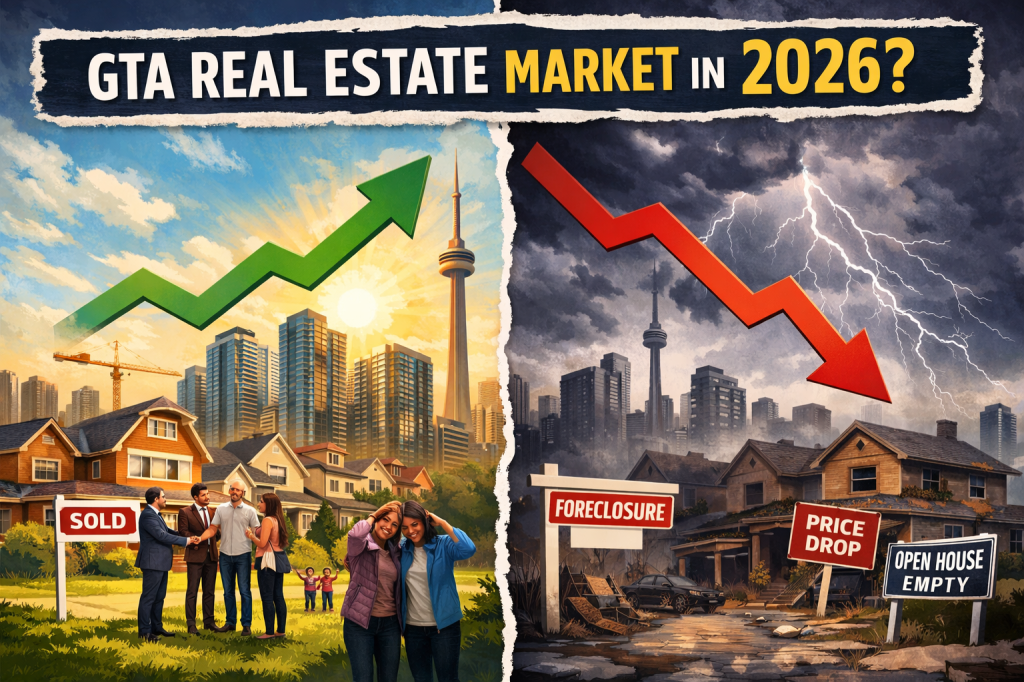
What 2026 Might Look Like for GTA Real Estate: Less Noise, More Reality

For the past few years, talking about real estate in Ontario—especially in the Greater Toronto Area—has felt like walking through a hall of mirrors. Prices up, prices down. Rates rising, rates cutting. Realtors shouting optimism, buyers frozen in fear, sellers clinging to yesterday’s peak.

As we step into 2026, one thing feels different:
the noise is slowly fading, and reality is returning.

This is not a prediction of a boom.
It is not a warning of a crash.
It is something rarer—and healthier.

A Market That Is Finally Catching Its Breath

After years of extreme swings, the GTA market appears to be moving toward normalization.

  • Prices have already corrected from their 2021–2022 peaks
  • Speculative frenzy has largely disappeared
  • Buyers are no longer rushing blindly
  • Sellers are being forced to price realistically

This doesn’t mean homes are suddenly affordable for everyone. But it does mean the market is less emotional, less inflated, and less detached from income realities than it was a few years ago.

That alone is progress.

Interest Rates: Not Cheap, But Predictable

One of the biggest changes heading into 2026 is not ultra-low interest rates—it’s stability.

For the first time in years, buyers can plan without fearing sudden shocks. Mortgage rates may fluctuate slightly, but the era of constant surprises appears to be behind us. That predictability matters more than people realize.

Real estate markets don’t need cheap money to function.
They need certainty.

With rates no longer rising aggressively, more end-users—not speculators—are slowly re-entering the market.

Buyers Are Wiser Than Before

2026 buyers are not the buyers of 2021.

They:

  • Ask questions
  • Compare neighborhoods
  • Negotiate
  • Walk away when numbers don’t make sense

This is a quiet but powerful shift. A market led by informed buyers is healthier than one driven by fear of missing out.

First-time buyers, in particular, may find 2026 less hostile—not easy, but less punishing—especially in condo and townhouse segments where inventory remains higher.

Sellers Will Need to Accept a New Reality

The hardest adjustment in 2026 may not be for buyers—it may be for sellers.

Many homeowners are still emotionally attached to peak-era prices. But the market no longer rewards hope; it rewards pricing aligned with today’s conditions.

Homes that are:

  • Well-priced
  • Well-maintained
  • Realistically marketed

will sell.

Others will sit.

This isn’t a crisis—it’s a correction in expectations.

Investors: A Different Game Now

For investors, 2026 is not about quick appreciation. The math is tighter, margins are thinner, and holding costs matter more than ever.

This is not necessarily bad. It filters out reckless speculation and favors:

  • Long-term thinking
  • Ethical rental practices
  • Cash-flow realism

Housing should not function only as a trading asset. A calmer investment environment ultimately benefits tenants, buyers, and communities.

What 2026 Really Represents

More than anything, 2026 looks like a reset year.

Not a return to the past.
Not a dramatic collapse.
But a slow rebuilding of trust between prices, incomes, and reality.

The GTA market doesn’t need excitement.
It needs honesty.

And for the first time in a long while, honesty may be creeping back in.

A Final Thought

Real estate cycles punish excess and reward patience. The last cycle was built on urgency, leverage, and belief that prices only move one way.

2026 feels different—not because everything is fixed, but because illusions are fading.

For buyers, sellers, and observers alike, this may finally be a year to stop reacting—and start thinking.

And that, in the long run, is how healthier markets are built.

(Note: This post is based on the ideas of GTA real estate experts like Ron Butler, John Pasalis, Jon Flynn and other!)

How Ontario’s Real Estate Market Collapsed?

Image from Move Smartly

Ron Butler from Angry Mortgage Podcast talks with Jon Flynn, a 21-year real estate veteran from Niagara, about how we got from normal housing prices to total insanity and back to crisis

https://www.youtube.com/watch?v=lWODFrLHLsI

When Jon Flynn started in real estate in 2004, a single family home in Niagara averaged $130,000. He remembers working with a busy realtor who accidentally countered an offer at $230,000 instead of $130,000. She laughed it off because she was “used to dealing with all these high-end homes.”

Twenty years later, those same modest homes peaked at unimaginable prices. Then they started collapsing. Flynn and mortgage broker Ron Butler traced exactly how this happened and why it will get worse before it gets better.

Phase 1: Vancouver Money Arrives (2015-2016)

The madness started when British Columbia blocked foreign buyers. Chinese millionaires who had been buying Vancouver real estate simply flew to Toronto instead. Their method was smart and legal. Send kids to Canadian universities. Get them PR status. Funnel money through them to buy property.

Toronto prices exploded. Within a year, the craze hit Niagara. Multiple offer nights became normal. Agents would line up buyers outside homes, check their prices, and literally tell them “Get out” if the number was too low.

Flynn says what happened in the GTA always arrived in Niagara about 12 months later.

Phase 2: Toronto Investors Invade (2016-2018)

Toronto homeowners discovered something. They could remortgage their appreciated homes, pull out equity, and buy cheaper properties in Niagara, Hamilton, and other regions. At first the rental math worked. You could rent to a family and break even.

But prices kept climbing beyond what rents could support. So investors switched to Airbnb. When cities cracked down on Airbnb, they pivoted to student rentals. When that collapsed, some literally chopped houses into pieces. Ten bedrooms in an 1,100 square foot house.

Each phase made less economic sense than the one before.

Phase 3: COVID Insanity (2020-2021)

Then COVID hit and things went completely crazy. December 2020 had the highest average home prices of the entire year. December is normally the slowest, lowest price month in real estate.

“That was a sign,” Flynn said. “Something was wrong.”

Ultra low interest rates. Work from home policies. Everyone believed office work was dead forever. Speculation hit levels nobody had seen before. GTA residents fled downtown condos where they waited an hour for elevators with three person limits. They bought everything available in suburban Ontario.

Butler remembers a client in Fort Erie who wanted to pay $700,000 for a basic bungalow. Butler asked why. The client said he had made $400,000 in real estate in the last two years. That was the thinking. Past gains justified any future price.

By 2021, every realtor rebranded as an investment expert. Social media made everything worse. Flynn made two and a half times his normal income that year. Butler made similar multiples. New realtors thought this was normal. They bought Hummers and multiple investment properties.

“Everybody and their brother and their mother were just buying houses,” Butler said. “It didn’t matter what you could rent them for. It didn’t matter what they were worth.”

Phase 4: The Student Explosion (2022-2023)

As interest rates rose and speculation cooled, a new distortion arrived. International students. Canada’s student visa approvals jumped from 172,000 nationally to 480,000 just in Ontario.

Private immigration consultant centers appeared everywhere. More than weed shops in Niagara Falls, Flynn said. Investors who couldn’t make money with families or Airbnb packed international students into houses.

Flynn described buses packed with students fighting to board. Security guards at Niagara College controlling crowds. Neighborhoods transforming overnight.

One story stuck with him. A realtor on his street sold a home to another agent who said her mother and daughter were moving in. On closing day, students with grocery bags stood on the porch. The house was soon chopped into 10 bedrooms.

The Collapse

By 2022, everything stopped. Interest rates spiked. Immigration policies tightened. The fundamentals that never existed could not be ignored anymore.

“Fundamentals are back,” Flynn said. “People want affordable family homes.”

Power of sales started appearing. First from reckless speculators. Now increasingly from regular homeowners. Each foreclosure creates a new, lower price. It drags down entire neighborhoods.

Both Butler and Flynn emphasize this point. What we see now in late 2025 comes from decisions made 9 to 12 months ago. The real pain from job losses has not fully hit yet.

“We haven’t really seen the families with job losses going into power of sale,” Butler said. “That’s the next wave.”

Where We Are Now

Flynn has listings at fair prices. Even below recent sales. Zero showings. One expensive listing had one showing in three months. The GTA investors who flooded Niagara during the boom have completely vanished.

Butler tracks regional numbers. Four Ontario regions are approaching average losses of $400,000 from peak prices. Vancouver and Calgary are grinding down too. The spring market showed no recovery in 2025.

“You cannot expect prices to go up this spring,” Flynn warned about 2026. “They might a little bit, but chances are they’re going to go down.”

The most sobering moment came when Flynn recalled 2012 and 2013. “I sold a house to a girl working as a shift manager at McDonald’s. Only one on title, only one on mortgage. Two people working at Tim Hortons bought a house. Legitimately, no fraud.”

Butler agreed. “When I started 30 years ago, ordinary people with absolutely average incomes were buying houses. Prices have not fallen anywhere near enough for that to come back.”

The Honest Assessment

Neither Butler nor Flynn sugarcoat the situation. They both made good money during the boom years. But they also warned people as far back as 2013 that prices were nuts. They were wrong about timing. Prices went much higher for much longer than seemed rational. But they were not wrong about the fundamentals.

“We just live the honest life,” Butler said. “Maybe it’s not doing us any good, but we did live the honest life.”

Their message for 2026 is clear. It will be rough. The correction is not over. If you are waiting for next spring to be better, it might be much worse.

All the distortions are gone now. Foreign money. Low interest rates. COVID insanity. Student visa explosion. What is left is the simple question that was buried for over a decade.

Can somebody actually afford to buy this house?

For too many properties in Ontario, the answer is still no.