
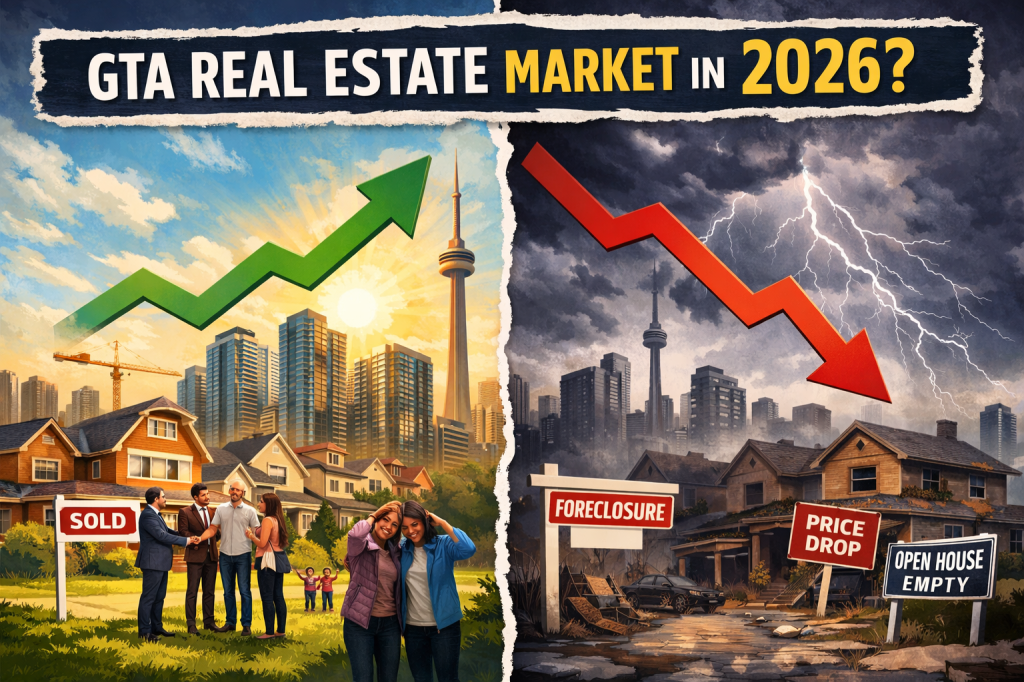
For the past few years, talking about real estate in Ontario—especially in the Greater Toronto Area—has felt like walking through a hall of mirrors. Prices up, prices down. Rates rising, rates cutting. Realtors shouting optimism, buyers frozen in fear, sellers clinging to yesterday’s peak.
As we step into 2026, one thing feels different:
the noise is slowly fading, and reality is returning.
This is not a prediction of a boom.
It is not a warning of a crash.
It is something rarer—and healthier.
A Market That Is Finally Catching Its Breath
After years of extreme swings, the GTA market appears to be moving toward normalization.
- Prices have already corrected from their 2021–2022 peaks
- Speculative frenzy has largely disappeared
- Buyers are no longer rushing blindly
- Sellers are being forced to price realistically
This doesn’t mean homes are suddenly affordable for everyone. But it does mean the market is less emotional, less inflated, and less detached from income realities than it was a few years ago.
That alone is progress.
Interest Rates: Not Cheap, But Predictable
One of the biggest changes heading into 2026 is not ultra-low interest rates—it’s stability.
For the first time in years, buyers can plan without fearing sudden shocks. Mortgage rates may fluctuate slightly, but the era of constant surprises appears to be behind us. That predictability matters more than people realize.
Real estate markets don’t need cheap money to function.
They need certainty.
With rates no longer rising aggressively, more end-users—not speculators—are slowly re-entering the market.
Buyers Are Wiser Than Before
2026 buyers are not the buyers of 2021.
They:
- Ask questions
- Compare neighborhoods
- Negotiate
- Walk away when numbers don’t make sense
This is a quiet but powerful shift. A market led by informed buyers is healthier than one driven by fear of missing out.
First-time buyers, in particular, may find 2026 less hostile—not easy, but less punishing—especially in condo and townhouse segments where inventory remains higher.
Sellers Will Need to Accept a New Reality
The hardest adjustment in 2026 may not be for buyers—it may be for sellers.
Many homeowners are still emotionally attached to peak-era prices. But the market no longer rewards hope; it rewards pricing aligned with today’s conditions.
Homes that are:
- Well-priced
- Well-maintained
- Realistically marketed
will sell.
Others will sit.
This isn’t a crisis—it’s a correction in expectations.
Investors: A Different Game Now
For investors, 2026 is not about quick appreciation. The math is tighter, margins are thinner, and holding costs matter more than ever.
This is not necessarily bad. It filters out reckless speculation and favors:
- Long-term thinking
- Ethical rental practices
- Cash-flow realism
Housing should not function only as a trading asset. A calmer investment environment ultimately benefits tenants, buyers, and communities.
What 2026 Really Represents
More than anything, 2026 looks like a reset year.
Not a return to the past.
Not a dramatic collapse.
But a slow rebuilding of trust between prices, incomes, and reality.
The GTA market doesn’t need excitement.
It needs honesty.
And for the first time in a long while, honesty may be creeping back in.
A Final Thought
Real estate cycles punish excess and reward patience. The last cycle was built on urgency, leverage, and belief that prices only move one way.
2026 feels different—not because everything is fixed, but because illusions are fading.
For buyers, sellers, and observers alike, this may finally be a year to stop reacting—and start thinking.
And that, in the long run, is how healthier markets are built.
(Note: This post is based on the ideas of GTA real estate experts like Ron Butler, John Pasalis, Jon Flynn and other!)
