
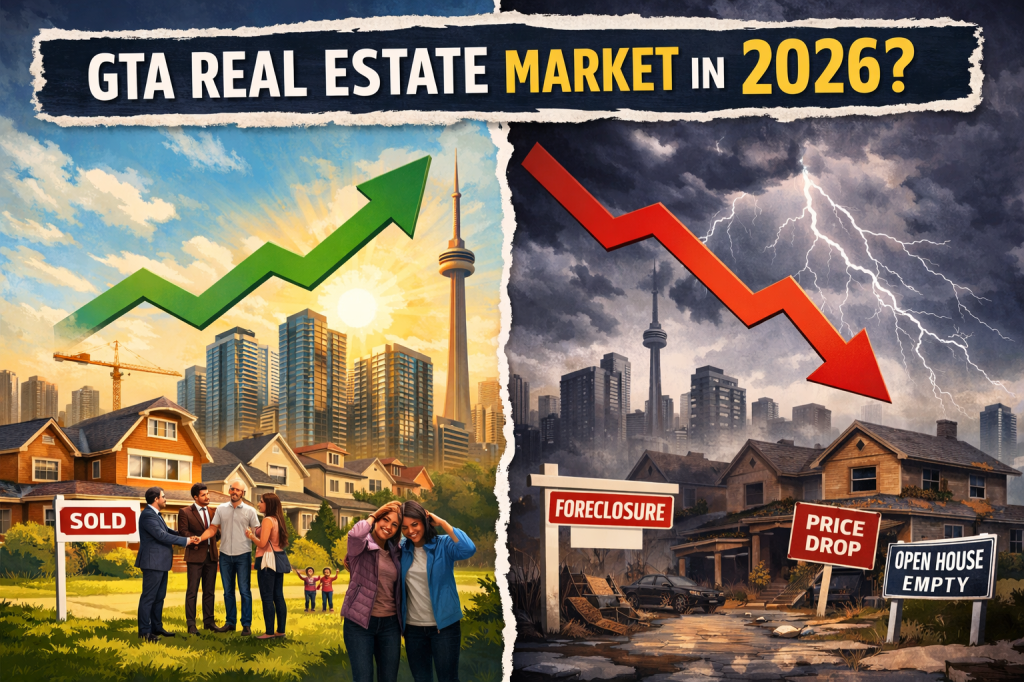
I listened to today’s episode of Ron Butler’s Angry Mortgage Podcast, and the numbers he shared were not just bad—they were historic.
By the end of 2025, Canada’s two largest housing markets collapsed in terms of sales activity:
- Vancouver recorded its lowest home sales in 20 years
- Toronto (GTA) fell to a 25-year low
These aren’t just market fluctuations. They’re signals of a structural shift that many people—buyers, sellers, and real estate professionals alike—are still struggling to accept.
So, what went wrong?
According to Butler, the biggest reason is simple but uncomfortable:
entire categories of buyers have vanished.
During the peak years (especially around 2021), as much as 40–45% of purchases in the GTA were investor-driven—landlords, flippers, speculators, short-term rental buyers. That group is now gone. Completely.
Buying a condo to rent?
Buying a house as an “investment”?
Those strategies no longer make financial sense in today’s environment.
And once that investor demand disappeared, the market lost nearly half of its fuel.
Prices fell—but that didn’t bring confidence back
Home prices in the GTA are now down roughly 25% from the March 2022 peak. But instead of encouraging activity, this decline has created paralysis.
Many potential sellers are stuck:
- Selling now wouldn’t give them enough equity for their next purchase
- After commissions and costs, moving simply doesn’t add up
- Others fear selling today only to realize prices fall further tomorrow
As Butler puts it, why buy now if you believe you can buy the same house for $50K, $100K—or even $200K less next year?
Who’s left in the market?
At this point, Butler argues there’s really only one group left that might sustain activity:
first-time home buyers.
They don’t need to sell a home first.
They aren’t worried about losing equity.
They’re looking for stability, schools, permanence—a place to call home.
But even they are hesitant.
Job uncertainty, economic unease, global instability, and constant “wait-and-see” messaging have made this a sentiment-driven freeze. Housing isn’t just numbers—it’s emotion. And right now, the emotion is caution.
Will foreign buyers save the market?
Short answer: no.
Even if restrictions ease, Butler notes that any reopening would likely apply only to new construction, not resale homes. That does little for today’s stalled market and won’t reverse the broader trend.
What about 2026?
Ron Butler is blunt:
- Prices are still coming down
- Don’t believe anyone who says the bottom is already here
- If someone tells you “buy now or miss out,” his advice is simple: just say no
Eventually, affordability will improve enough that buyers step back in. But that doesn’t mean a quick rebound or a return to pandemic-era highs.
The bigger takeaway
This isn’t a crash fueled by panic.
It’s a slowdown driven by reality.
The era of speculative excess is over—at least for now. What remains is a slow, difficult recalibration where housing slowly reconnects with wages, stability, and actual human needs.
For buyers, patience matters.
For sellers, expectations matter.
And for anyone promising a sudden turnaround—it’s worth listening carefully to voices like Ron Butler before believing the hype.
