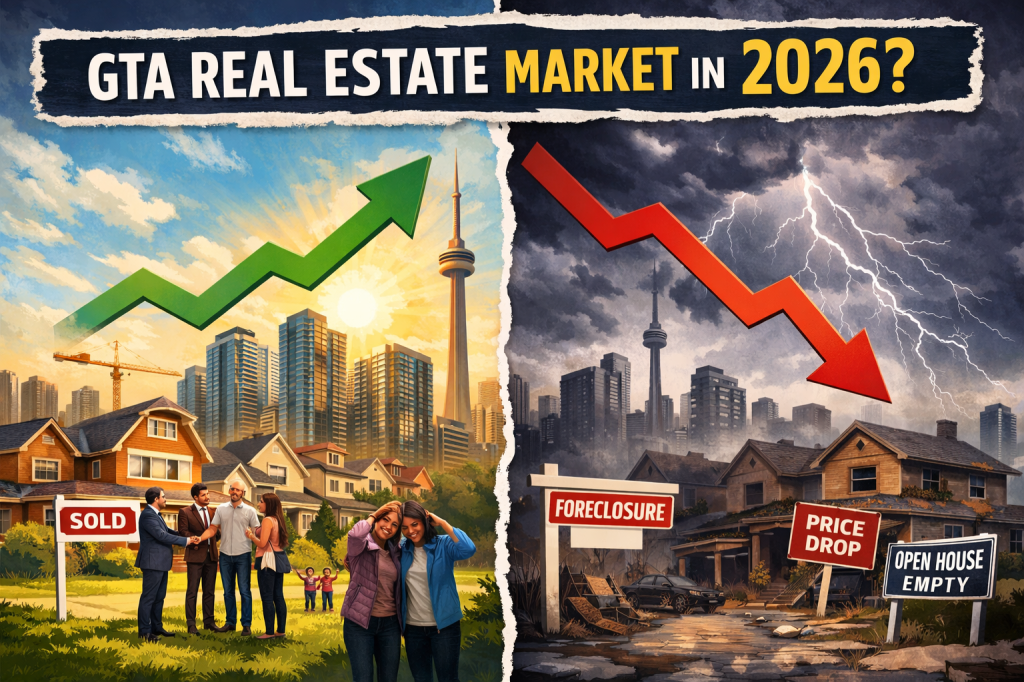
What 2026 Might Look Like for GTA Real Estate: Less Noise, More Reality

For the past few years, talking about real estate in Ontario—especially in the Greater Toronto Area—has felt like walking through a hall of mirrors. Prices up, prices down. Rates rising, rates cutting. Realtors shouting optimism, buyers frozen in fear, sellers clinging to yesterday’s peak.

As we step into 2026, one thing feels different:
the noise is slowly fading, and reality is returning.

This is not a prediction of a boom.
It is not a warning of a crash.
It is something rarer—and healthier.

A Market That Is Finally Catching Its Breath

After years of extreme swings, the GTA market appears to be moving toward normalization.

  • Prices have already corrected from their 2021–2022 peaks
  • Speculative frenzy has largely disappeared
  • Buyers are no longer rushing blindly
  • Sellers are being forced to price realistically

This doesn’t mean homes are suddenly affordable for everyone. But it does mean the market is less emotional, less inflated, and less detached from income realities than it was a few years ago.

That alone is progress.

Interest Rates: Not Cheap, But Predictable

One of the biggest changes heading into 2026 is not ultra-low interest rates—it’s stability.

For the first time in years, buyers can plan without fearing sudden shocks. Mortgage rates may fluctuate slightly, but the era of constant surprises appears to be behind us. That predictability matters more than people realize.

Real estate markets don’t need cheap money to function.
They need certainty.

With rates no longer rising aggressively, more end-users—not speculators—are slowly re-entering the market.

Buyers Are Wiser Than Before

2026 buyers are not the buyers of 2021.

They:

  • Ask questions
  • Compare neighborhoods
  • Negotiate
  • Walk away when numbers don’t make sense

This is a quiet but powerful shift. A market led by informed buyers is healthier than one driven by fear of missing out.

First-time buyers, in particular, may find 2026 less hostile—not easy, but less punishing—especially in condo and townhouse segments where inventory remains higher.

Sellers Will Need to Accept a New Reality

The hardest adjustment in 2026 may not be for buyers—it may be for sellers.

Many homeowners are still emotionally attached to peak-era prices. But the market no longer rewards hope; it rewards pricing aligned with today’s conditions.

Homes that are:

  • Well-priced
  • Well-maintained
  • Realistically marketed

will sell.

Others will sit.

This isn’t a crisis—it’s a correction in expectations.

Investors: A Different Game Now

For investors, 2026 is not about quick appreciation. The math is tighter, margins are thinner, and holding costs matter more than ever.

This is not necessarily bad. It filters out reckless speculation and favors:

  • Long-term thinking
  • Ethical rental practices
  • Cash-flow realism

Housing should not function only as a trading asset. A calmer investment environment ultimately benefits tenants, buyers, and communities.

What 2026 Really Represents

More than anything, 2026 looks like a reset year.

Not a return to the past.
Not a dramatic collapse.
But a slow rebuilding of trust between prices, incomes, and reality.

The GTA market doesn’t need excitement.
It needs honesty.

And for the first time in a long while, honesty may be creeping back in.

A Final Thought

Real estate cycles punish excess and reward patience. The last cycle was built on urgency, leverage, and belief that prices only move one way.

2026 feels different—not because everything is fixed, but because illusions are fading.

For buyers, sellers, and observers alike, this may finally be a year to stop reacting—and start thinking.

And that, in the long run, is how healthier markets are built.

(Note: This post is based on the ideas of GTA real estate experts like Ron Butler, John Pasalis, Jon Flynn and other!)
Lessons from a Troubled Real Estate Listing: Why Trust and Due Diligence Matter

Good afternoon, everyone.

I hope you’re staying dry on this rainy day. Today, I want to discuss a property listing that has been on my mind for quite some time—not just because of its prolonged presence on the market, but because of the broader lessons it offers about real estate pitfalls.

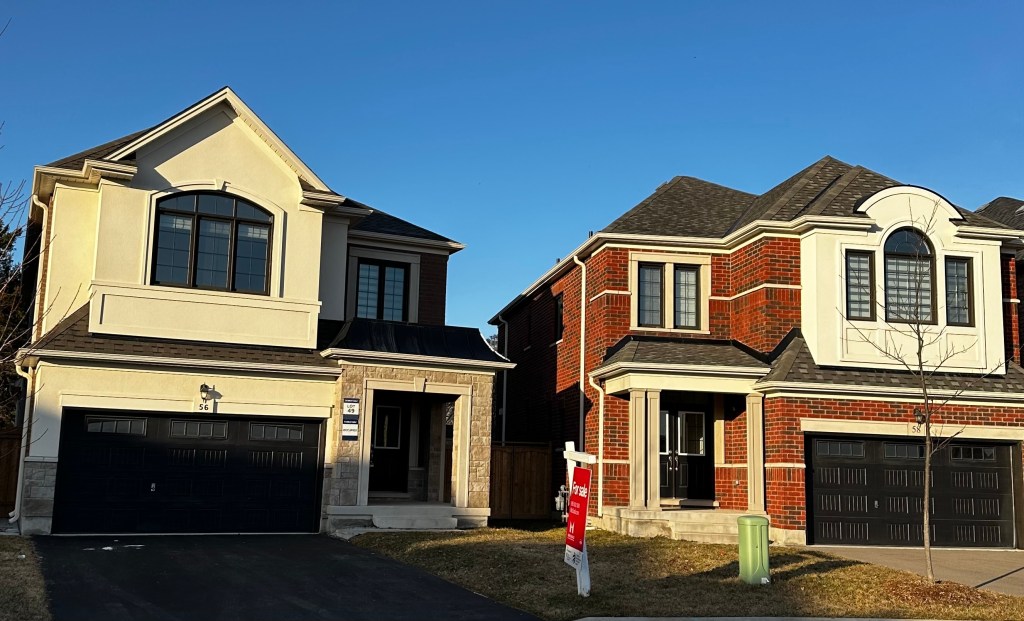
What bothers me most is this: In the same neighborhood, countless houses have been listed and sold promptly. If they didn’t sell within a reasonable time, the listings were withdrawn—yet these two properties remain, defying the trend. Now, they risk becoming stigmatized listings—homes that buyers avoid simply because they’ve sat unsold for too long, sparking suspicions of hidden flaws or desperate sellers.

The listing in question (pictured) is a prime example of how overpromises, misplaced trust, and a lack of due diligence can turn a straightforward sale into a cautionary tale. Let’s break down why this property has struggled to sell—and what buyers and sellers can learn from its story.

The real estate market is often seen as a realm of opportunity, but it can also be fraught with pitfalls—especially when trust is misplaced, and due diligence is neglected. A recent listing in my neighborhood serves as a cautionary tale, revealing critical lessons for buyers, sellers, and investors alike.

The Story of House #56 and #58: A Case of Failed Promises

The property in question—House #56—is currently listed by a well-known realty brokerage that boldly claims, “We’ll buy the property if it doesn’t sell!” At first glance, this seems like a strong guarantee, but the history of this property (and its neighbor, House #58) tells a different story.

Both houses belong to the same owner, who appears to be facing financial distress. House #58 was initially listed by a Muslim female realtor but remained unsold for over a year. The owner then switched to another Muslim realtor who markets himself as a “real estate don” with a promise to purchase unsold listings. Yet, even under this Celebrity Realtor’s (he loves to be called it) representation, House #58 failed to sell and was eventually pulled off the market.

Now, House #56 has been listed for over six months with no success. The prolonged market exposure has likely stigmatized the property—buyers are wary of homes with long listing histories, assuming there must be something wrong.

The Big Question: Does this Celebrity Realtor Really Buy Unsold Listings?

This Celebrity Realtor’s promise raises skepticism. If his guarantee were genuine, why hasn’t he purchased House #56 or #58? The reality is that such claims may be more marketing gimmick than solid assurance. Sellers should be cautious of bold guarantees that aren’t backed by clear contractual terms.

Key Lessons for Buyers and Sellers

1. Don’t Choose an Agent Based on Religion, Culture, or Community Ties

The owner of Houses #56 and #58 switched from one Muslim realtor to another, possibly assuming shared background would ensure better service. However, competence, market knowledge, and negotiation skills matter far more than shared ethnicity or faith. Other homes in the same neighborhood are selling—just not these two.

Lesson: Hire professionals based on track record, not personal connections.

2. Beware of Closed Networks (Realtor + Mortgage Broker + Inspector)

A dangerous trend in real estate is the “closed network”—where a realtor refers clients to their preferred mortgage broker, home inspector, or lawyer. While convenient, this can lead to conflicts of interest.

  • Inspection Failures: A Toronto buyer sued their realtor after discovering severe defects in their home—defects that the realtor’s “trusted inspector” had missed.
  • Mortgage Traps: Some buyers with strong finances were steered into expensive private mortgages by brokers within the same network, costing them thousands in extra interest.

Lesson: Always seek independent professionals. Never skip a proper inspection or rely solely on referrals from your agent.

3. Verify Everything—Don’t Blindly Trust

Many buyers, especially first-timers, assume that because their realtor is a friend or community member, they won’t be misled. Unfortunately, financial incentives can override loyalty.

  • Skipping Inspections: Buyers spending millions on a home often hesitate to spend $300 on an inspection, believing their agent’s assurances.
  • Ignoring Legal Docs: Some forego condo status certificates or land surveys, only to face costly surprises later.

Lesson: Trust, but verify. Pay for inspections, review condo documents, and get a land survey. These small costs prevent massive losses.

Final Thoughts: Protect Yourself in a Complex Market

The real estate market is cooling in many areas, and sellers must price realistically while buyers must conduct thorough due diligence. The saga of House #56 and #58 highlights:

  • Overpromises mean little without proof.
  • Networks can be traps if not scrutinized.
  • Independent verification is non-negotiable.

Whether buying or selling, approach real estate with a business mindset—not blind trust. The right professionals will welcome your diligence rather than discourage it.The Bottom Line: If a deal seems too reliant on personal connections rather than hard facts, step back and reassess. Your financial future depends on it.